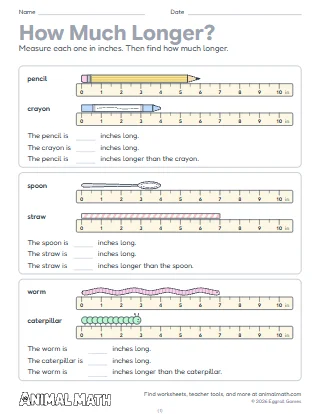
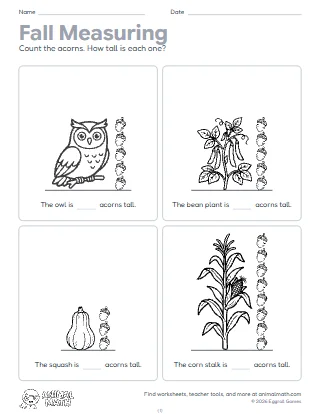
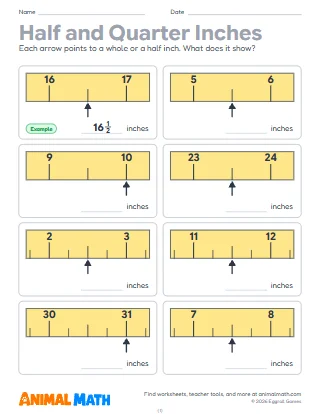
Five pages of ruler practice that go past "line it up with the 0." On page 1 each bar or object lies on a centimeter ruler, but it starts at 3, at 6, or on a broken ruler that begins at 4: students write where it starts, where it ends, and how long it is. Page 2 does the same in whole inches. On page 3 students use the ruler themselves to draw lines of a given length from a dot and arrows to numbers. Page 4 has five pairs to measure and compare with >, <, or =, including two equal pairs and one where the shorter thing ends farther along the ruler. Page 5 puts four things in order from shortest to longest and measures three lines drawn above one ruler.
Before page 1, snap a paper ruler at 3 and ask how to measure a crayon with it. Let students try counting the spaces from one end to the other, then show that the end number minus the start number gives the same answer. The first problem on pages 1, 2, 3, and 4 is worked as an example to talk through together.
Measure a spoon or a toy, then slide it so it starts at 2 on the ruler and measure it again: it is still the same length. On page 3, check each drawn line with a real ruler.
This pack supports the following Common Core State Standards for Mathematics:
© Copyright 2010. National Governors Association Center for Best Practices and Council of Chief State School Officers. All rights reserved.
A 5-page ruler pack for 1st and 2nd grade where things do not always start at 0. Find how long bars and objects are on centimeter rulers and inch rulers that start at other numbers, draw lines of a given length and arrows to numbers, measure two things and write >, <, or =, then put four things in order and measure three lines above one ruler. Every page comes in color and in black and white. Answer keys included.
Tell us what to make next, or build your own with a worksheet maker.
This worksheet is free to download, print, copy, and hand out in your classroom or at home. You do not need to create an account, and there are no watermarks on the PDF.