Five pages that follow the stamp game lessons, each problem a mat of stamps beside the written problem. Page 1 is addition with no exchange: both numbers are laid out in stamps, and children add each place and write the total. Page 2 adds with exchanging: when a place has ten stamps or more, ten of them are exchanged for one stamp of the next place, and children write that 1 in the small box over the next column. Page 3 is subtraction with no exchange: only the first number is laid out, as with the real stamps, and children cross out the stamps they take away and write what is left. Page 4 subtracts with exchanging: when a place has too few stamps, one stamp of the next place is exchanged for ten, and children write the new digits over the old ones; the last problem exchanges across a zero. Page 5 mixes addition and subtraction, two of them to 9,999: children read the numbers from the stamps, write the problem in the empty columns and solve it. Every page begins with a worked example, and the keys show each exchange.
Use the pages after the child has worked the stamp game with real stamps: building the first number, adding the second below it, then pushing the stamps together and counting from the units. Let children check a page with the stamps, which is the material's control of error. Ask them to say each exchange aloud, such as "ten units make one ten", before they write the 1.
Cut small squares of paper and write 1, 10, 100 and 1000 on them. Build a number in columns with the thousands on the left and the units on the right, add a second number below it, and count each column together, starting with the units. When there are ten of one kind, trade them for one of the next.
This pack supports the following Common Core State Standards for Mathematics:
© Copyright 2010. National Governors Association Center for Best Practices and Council of Chief State School Officers. All rights reserved.
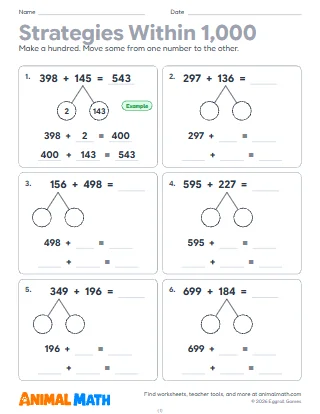
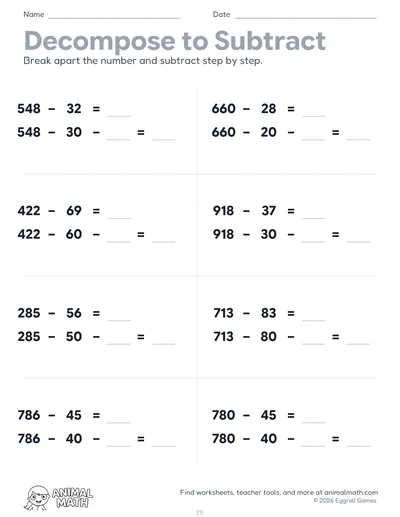
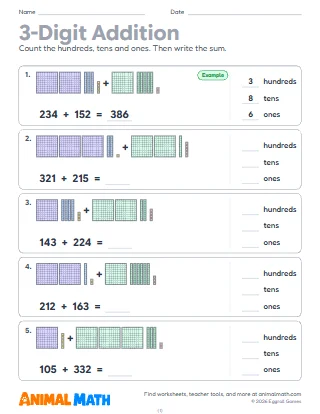
Addition and subtraction with the Montessori stamp game, where unit, ten, hundred and thousand stamps sit in their place columns beside the written problem. Students add and subtract with and without exchanging, trading ten stamps for one of the next place or one stamp for ten, and write each problem in columns.
Tell us what to make next, or build your own with a worksheet maker.
This worksheet is free to download, print, copy, and hand out in your classroom or at home. You do not need to create an account, and there are no watermarks on the PDF.