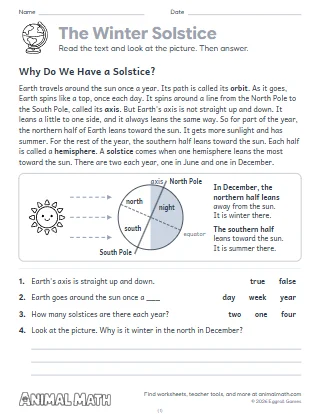
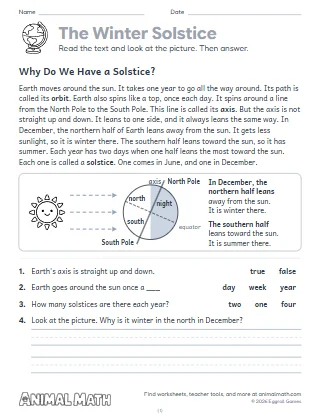
Earth's axis leans about 23.4 degrees, always the same way, so as Earth goes around the sun each half of the world leans towards it for part of the year. Around 22 December in Australia and New Zealand, the southern half leans the most towards the sun: the longest day and the shortest night in the south, while at the very same moment the north has its shortest day and its winter. People in the north have watched for that solstice for thousands of years. Newgrange in Ireland and Stonehenge in England line up with the sun, and families still gather on the longest night for Dongzhi in China and Yalda Night in Iran.
Eight pages, on plain notebook lines. Page 1 explains why there is a solstice, with a picture of the tilted Earth in December. Page 2 is the longest day, with the sun's path across the sky in December, March and September, and June. Page 3 holds two short texts on Newgrange and Stonehenge, and page 4 two on Dongzhi and Yalda Night, winter festivals in the north. Page 5 matches six science words to their meanings, and page 6 sorts ten statements into the north or the south in December. Page 7 is a week-long daylight log to fill in at home, working out the hours of daylight each day, and page 8 a page to draw and write how you would spend the longest day.
Before page 1, shine a torch on a globe or a ball in a dark room. Tip it so the south leans towards the light, then walk it around the "sun" and keep it leaning the same way. Read pages 3 and 4 before the summer holidays, and send page 7 home for the week around 22 December.
Look up the sunrise and sunset for your town each day of the week around 22 December and fill in page 7 together. Is the day getting longer or shorter? Then go outside at midday on a sunny day and look at how short your shadow is.
Science and history texts for the longest day of the year in Australia and New Zealand: why Earth's tilt gives us a solstice, the sun's high path in December, and how people in the north, where it is winter, mark the same day, from Newgrange and Stonehenge to Dongzhi and Yalda Night. Students answer questions from the texts and pictures, match science words to their meanings, sort what is true in each hemisphere, keep a daylight log and write about the longest day.
Tell us what to make next, or build your own with a worksheet maker.
This worksheet is free to download, print, copy, and hand out in your classroom or at home. You do not need to create an account, and there are no watermarks on the PDF.