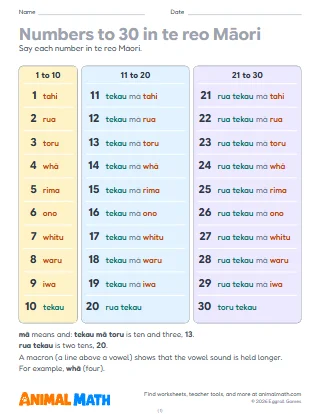
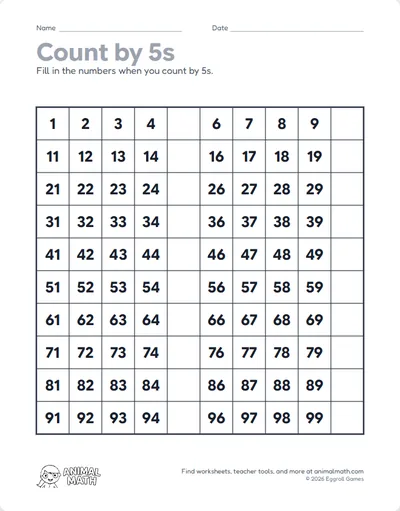
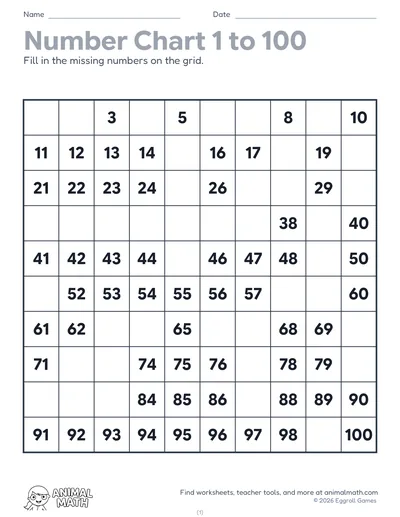
Five pages for Year 2 on saying the numbers to 100 in te reo Māori. Every word is built like the number, the tens, then mā (and), then the ones, so the pages are place value practice too. Read each page aloud with the class before children work on their own. Page 1 is a chart to say together: tahi to iwa, the tens from tekau to kotahi rau (1 hundred, or 10 tens), and three numbers put together with base-ten blocks, such as rua tekau mā toru, 2 tens and 3. On page 2 children count rods of ten, write the number and circle its word; the other two words are easy to mix up, such as tekau mā ono (16) and ono tekau (60). Page 3 shows numbers in base-ten blocks: children write the number, then its words, ___ tekau mā ___, from the word bank. On page 4 children read the words aloud and write the number; most rows are a pair that use the same words in another order, such as toru tekau mā ono (36) and ono tekau mā toru (63). Page 5 has number grids, pieces of a 100 chart: children read the number words above each grid and write the numeral in the centre, then 10 less above it, 10 more below, and 1 less and 1 more beside it. Each worksheet starts with a worked example.
Count by tens together from tekau to kotahi rau before page 2, holding up a rod or a bundle of ten sticks for each one. For page 3, build a number in blocks or bundles and ask the class to say it: the tens first, then mā, then the ones. On page 4, read each pair aloud and ask what changed. Say the numbers on page 5 aloud as children fill in each piece, and count in te reo Māori at other times of the day, such as the roll or the date.
Count in tens together in te reo Māori, up to kotahi rau. Pick a number on a page, a letterbox or a clock, and take turns saying it: the tens, mā, then the ones. Make a number with bundles of ten sticks or straws and some single ones, and ask your child to say it.
Saying the numbers to kotahi rau in te reo Māori, where every word is built like the number: the tens, mā (and), then the ones. Children say a chart together, count tens and circle the word, build numbers in base-ten blocks and write their words, read words to write the numeral, and complete number grids from a 100 chart.
Tell us what to make next, or build your own with a worksheet maker.
This worksheet is free to download, print, copy, and hand out in your classroom or at home. You do not need to create an account, and there are no watermarks on the PDF.