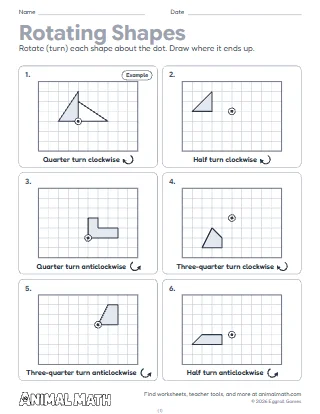
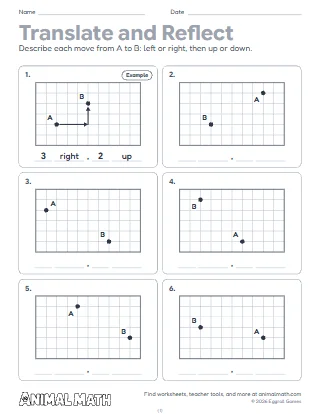
Five pages for Year 6 on tessellations. Page 1 takes six regular shapes, from the triangle to the decagon: students multiply each angle to see whether copies fill the 360° round a point, and circle whether the shape tessellates on its own. Page 2 starts tessellations of L shapes, T shapes, a nibbled square, zigzags and more on square grid paper, and students continue each one to cover the grid. Page 3 does the same on triangle dot paper with triangles, hexagons, rhombuses and trapeziums. On page 4 students look at a finished tessellation and circle the move that takes tile A to tile B: a translation (slide), a reflection (flip) or a rotation (turn). Page 5 shows regular shapes meeting at a point with a gap: students find the angle of the gap and the regular shape that fits it, if there is one.
Hand out card triangles, squares, pentagons and hexagons and let groups try to fit copies round a point. Which leave a gap, and which overlap? Record the angles on the board and look for the ones that add to exactly 360°. For page 4, cut out one tile and move it onto another: did you slide it, flip it over or turn it?
Go on a tessellation hunt: floor tiles, brick walls, paving, a honeycomb, a soccer ball. Talk about which shapes are used and whether one shape or a mix of shapes covers the surface. Draw a tile on squared paper, cut it out and trace round it again and again to make your own tessellation.
This pack supports the following Common Core State Standards for Mathematics:
© Copyright 2010. National Governors Association Center for Best Practices and Council of Chief State School Officers. All rights reserved.
Tessellations of regular shapes, polyominoes, triangles, hexagons, rhombuses and trapeziums, and the slides, flips and turns that make them. Students test which shapes fit round a point, continue tessellations on grid and dot paper, name the move between two tiles and find the angles that complete a point.
Tell us what to make next, or build your own with a worksheet maker.
This worksheet is free to download, print, copy, and hand out in your classroom or at home. You do not need to create an account, and there are no watermarks on the PDF.