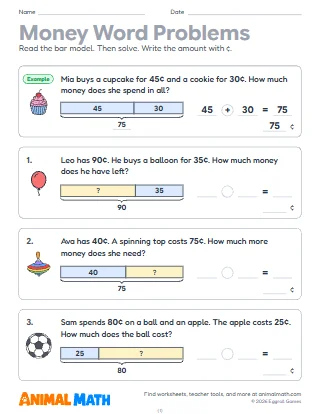
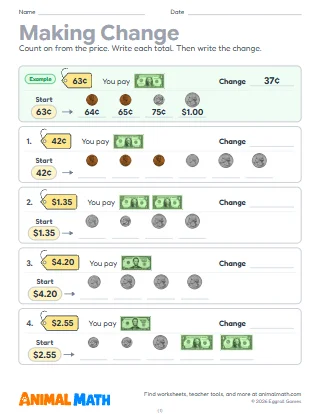
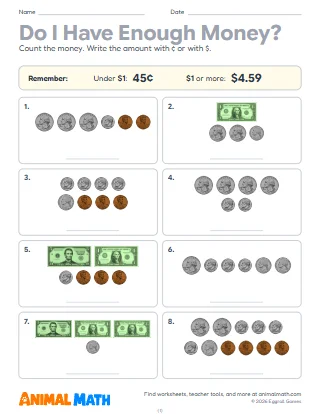
Six pages of shopping for the Thanksgiving feast. Pages 1 to 3 are 2nd grade money, with ¢ for coins and whole dollars for bills: page 1 counts the coins that pay for each food and writes the price on its tag, page 2 counts bills and decides whether they are enough for a whole-dollar price, and page 3 adds two prices from a farm stand or a market. Pages 4 to 6 use dollars and cents with a decimal point: page 4 counts bills and coins and draws a line to the food each collection buys (one food is left over), page 5 makes change from a $5, $10 or $20 bill by counting up to the next dollar and then to the bill, and page 6 fills in two shopping lists from a market price board, finds the money left and ends with two word problems. The first problem on pages 1, 3, 4 and 5 is a worked example.
Set up a feast market with play money and the prices from page 3 or page 6, and let partners take turns as shopper and cashier. Model counting up on page 5 with real coins and bills: start at the price, add coins to reach the next dollar, then add bills to reach the bill that was paid.
Look at a grocery flyer or receipt together while planning a holiday meal. Ask how much two things cost together, and how much change you would get from a $10 or $20 bill.
This pack supports the following Common Core State Standards for Mathematics:
© Copyright 2010. National Governors Association Center for Best Practices and Council of Chief State School Officers. All rights reserved.
Shopping for the Thanksgiving feast with coins and bills. Students count money to pay for turkey, pies and rolls, add prices, make change by counting up and fill in shopping lists on a budget.
Tell us what to make next, or build your own with a worksheet maker.
This worksheet is free to download, print, copy, and hand out in your classroom or at home. You do not need to create an account, and there are no watermarks on the PDF.