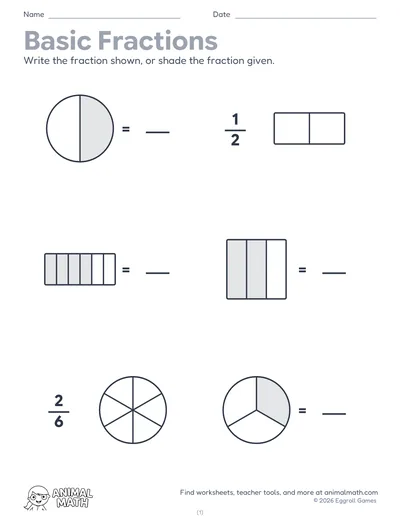
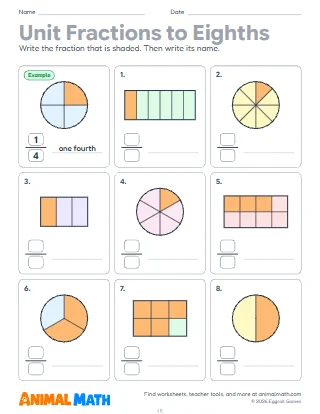
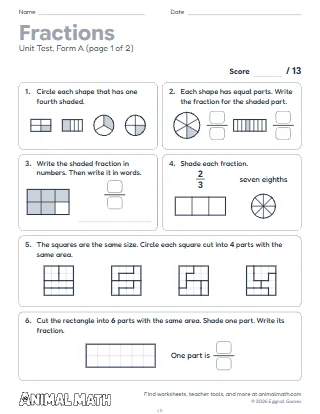
Five pages on fractions with denominators 2, 3, 4, 6 and 8, each with a worked example. On page 1 students circle equal or not equal for six cut shapes, then count the equal parts of six more and write the unit fraction for one part, like 1/6. Page 2 has six shaded shapes: students write the fraction, its numerator and its denominator, and its name in words, then write three fractions given in words as numbers. On page 3 students shade nine fractions, some written in numbers and some in words, then draw the cuts on a rectangle, a circle and a square before shading. Page 4 puts shapes on a grid: students count the squares in each part and cross out the shapes whose parts are not equal, then name one part of shapes whose equal parts are not all the same shape. Page 5 finds fractions of sets of counters, animals and fruit, and ends with three sharing stories.
Fold paper strips into halves, fourths and eighths, and others into thirds and sixths, and write the fraction on each part. Before page 2, write 3/4 on the board and ask what the 4 tells (how many equal parts make the whole) and what the 3 tells (how many parts we are counting). For page 4, give each pair grid paper: cut a 4 by 4 square into four parts with 4 squares each, as many different ways as they can, and hold them up side by side.
Cut a sandwich, a tortilla or a sheet of paper into equal parts and name each part together. Make a set out of things at home, like 3 spoons and 5 forks, and ask what fraction of the set are spoons. Share a snack equally and ask what fraction of it each person gets.
This pack supports the following Common Core State Standards for Mathematics:
© Copyright 2010. National Governors Association Center for Best Practices and Council of Chief State School Officers. All rights reserved.
Fractions as equal parts of a whole, a set or a fair share, with halves, thirds, fourths, sixths and eighths. Students tell equal parts from parts that are not equal, write and shade fractions with their numerators, denominators and names, compare parts by area and solve sharing stories.
Tell us what to make next, or build your own with a worksheet maker.
This worksheet is free to download, print, copy, and hand out in your classroom or at home. You do not need to create an account, and there are no watermarks on the PDF.