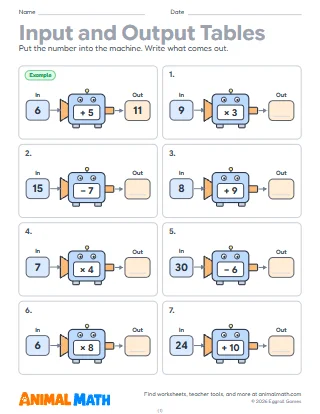
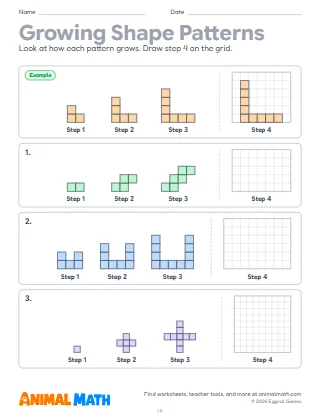
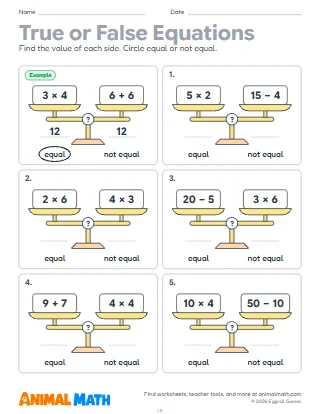
Five pages on letters that stand for numbers. Page 1 shows that n + 7 = 15, □ + 7 = 15 and ★ + 7 = 15 all ask the same question, then solves ten equations with all four operations and the unknown first, second or after the equal sign, and matches two strip diagrams and two pan balances to their equations. Page 2 writes = or ≠ between two expressions (4 × 3 = 2 × 6, but 24 ÷ 4 ≠ 3 + 4), fills in the number or the expression that makes an equation true, and circles True or False with a reason. Page 3 turns words into expressions and expressions into words, including the turned-around ones like 9 less than a number m (m − 9), then finds the value of expressions in a table for n = 4, 6 and 10 and with two letters. Page 4 puts a value in for the letter and decides whether an equation or an inequality such as 30 ÷ n < 5 is true, writes an equation with a variable for four stories, and writes a story for b − 14 = 30 and 5 × p = 40. Page 5 finds the rule of input-output tables and writes it with n (n × 4, 2 × n + 1), fills in missing ins and outs, tells adding rules from multiplying rules, and uses a table to price fair tickets.
Hide a few counters in a bag, put it on one side of a pan balance and counters on the other, and ask how many are in the bag. Write it as n + 9 = 30 and as □ + 9 = 30 to show that the letter and the box mean the same. On page 2, read the equal sign aloud as "has the same value as". For page 3, act out "9 less than a number" and "a number subtracted from 30" with counters to see why the order matters. Page 4's story writing makes good partner work: trade stories and solve each other's.
Play "I am thinking of a number": I add 8 and get 20. Write it with a letter, n + 8 = 20, and solve it together. Then let your child make one up for you, using times or divided by too.
This pack supports the following Common Core State Standards for Mathematics:
© Copyright 2010. National Governors Association Center for Best Practices and Council of Chief State School Officers. All rights reserved.
A 5-page variables and equations pack for 4th and 5th grade. Learn that a letter, a box or a star can stand for a number you do not know, solve equations like 72 ÷ y = 6 and 56 = 8 × k, and match strip diagrams and pan balances to their equations. Write = or ≠ between expressions such as 4 × 3 and 2 × 6, fill in a number or an expression that makes an equation true, and say why an equation is true or false. Turn words like 5 more than a number n into n + 5 and back, find the value of an expression for given values, test whether an equation or inequality is true when n = 6, write an equation for a story and a story for an equation, and find the rule of an input-output table as an expression. Every page comes in color and in black and white. Answer keys included.
Tell us what to make next, or build your own with a worksheet maker.
This worksheet is free to download, print, copy, and hand out in your classroom or at home. You do not need to create an account, and there are no watermarks on the PDF.