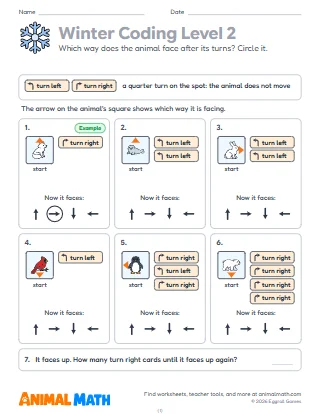
Computer Science Education Week is held every December, in the week of Grace Hopper's birthday (December 9, 1906). She was a computer scientist and a rear admiral in the US Navy who helped make some of the first computer programming languages, so that people could write code in words instead of strings of numbers. Classes everywhere spend part of the week trying out coding, and unplugged coding like these puzzles needs no computer at all: just a pencil and careful thinking, one step at a time.
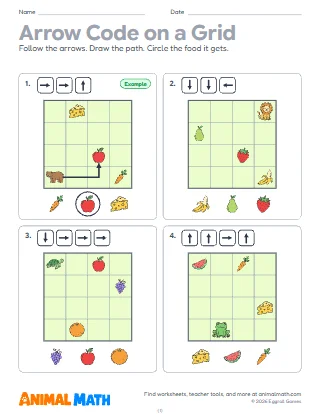
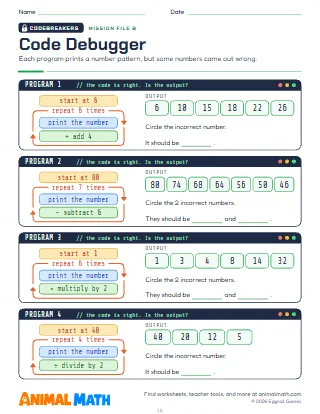
Six pages of coding with no computer. Each arrow card moves the animal one square up, down, left or right. Page 1 follows short codes on big grids: draw the path and circle what the animal gets. Page 2 writes the arrows that take the animal to the picture, going around the trees; each grid has just one shortest way, so the empty cards show how many arrows to write. Page 3 has one wrong arrow in each code: cross it out and draw the right arrow under it. Page 4 brings in the repeat loop, a block that runs the arrows inside it again and again: follow it, draw the path and circle what the animal gets. Page 5 turns long codes into short ones with a loop: write how many times it repeats and the arrows inside. Page 6, for 3rd grade, has loops inside loops: draw the path, circle the picture and count how many arrows run in all. The first problem on every page is worked as an example.
Tape a grid on the floor and let one child be the arctic fox while another holds up arrow cards, the class saying each step out loud. Before page 4, act out a loop: "repeat 3 times: step right, step up" and count the steps together. On page 6, ask how the count could be found without drawing every arrow, so students see the loop as groups: repeat 2 times, 3 arrows each time, is 6 arrows.
Draw a small grid on paper, put a toy on one square and a winter picture on another. Take turns writing arrow codes for each other to follow. Then ask for a shorter way to write the same code, with a repeat loop.
Unplugged coding on snowy grids, where an arctic fox, a seal pup and other winter animals move one square for each arrow card to reach their mittens, hats and hot cocoa. Students follow codes, write their own around the trees, fix a wrong arrow, and use repeat loops and loops inside loops to make long codes short.
Tell us what to make next, or build your own with a worksheet maker.
This worksheet is free to download, print, copy, and hand out in your classroom or at home. You do not need to create an account, and there are no watermarks on the PDF.