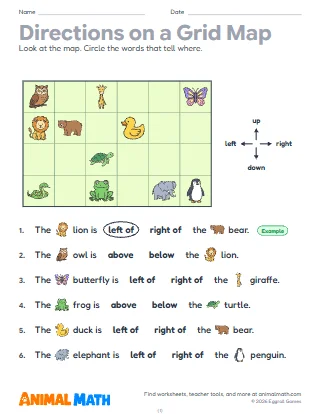
Five pages of coding with no computer. Each arrow card moves the animal one square up, down, left or right. Page 1 follows short codes of two to four arrows on big grids: draw the path and circle the food the animal gets. Page 2 writes the arrows that take the animal to its food, going around the rocks; each grid has just one shortest way, so the boxes show how many arrows to write. Page 3 has one wrong arrow in each code: cross it out and draw the right arrow under it. Page 4 follows a code, then the same code with one arrow changed (the shaded card), and circles the food each one gets. Page 5 runs two codes at the same time: on every step both animals move one square, and students draw an X where they meet and write the step.
Make a grid on the floor with tape and let one child be the animal while another holds up arrow cards. The class says each step out loud as the animal moves. Then do page 1 together, touching each arrow and moving a finger one square. On page 5, two children can walk the two codes side by side, one step at a time, to see why crossing the same square at different times is not a meeting.
Draw a small grid on paper, put a toy on one square and a snack picture on another. Take turns writing arrow codes for each other to follow. When a code goes wrong, ask which arrow made it go wrong and how to fix it.
This pack supports the following Common Core State Standards for Mathematics:
© Copyright 2010. National Governors Association Center for Best Practices and Council of Chief State School Officers. All rights reserved.
Unplugged coding with arrow cards: an animal moves one square on a grid for each arrow. Students follow codes, write their own, fix a wrong arrow, change a code and run two codes at the same time.
Tell us what to make next, or build your own with a worksheet maker.
This worksheet is free to download, print, copy, and hand out in your classroom or at home. You do not need to create an account, and there are no watermarks on the PDF.