Earth spins on an axis that leans about 23.4 degrees. In December the northern half of Earth leans away from the sun, so the sun stays low in the sky, days are short and shadows are long. The December solstice, on December 21, 2026 at 3:50 p.m. Eastern time, is the moment the North Pole leans farthest from the sun: the shortest day of the year in the north and the longest in the south, where it is summer. After it, northern days slowly grow longer again until the June solstice. The sunrise and sunset times in this pack are real, worked out with NOAA's solar calculator equations and checked against the US Naval Observatory.
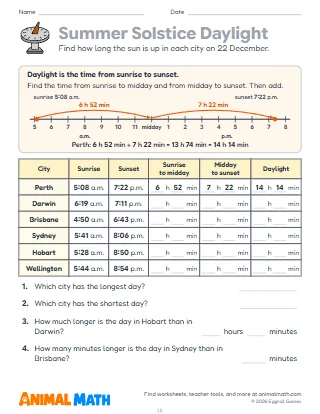
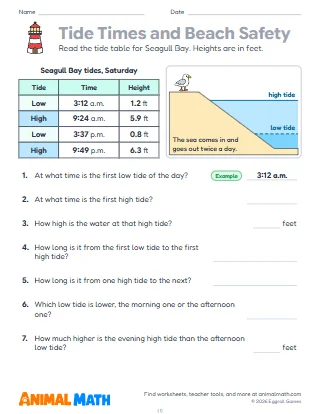
Six pages. Page 1 gives the sunrise and sunset in six cities on December 21: find the time from sunrise to noon, from noon to sunset, and add them, turning 60 minutes into an hour where needed. Page 2 rounds the daylight in six more cities to the nearest half hour and makes a bar graph of it. Page 3 is a year of daylight in Seattle, on the 21st of each month: plot it as a line graph and find the longest and shortest months and the two months with 12 hours. Page 4 shows the tilted Earth in December and compares five cities, north and south, on the December and June solstices. Page 5 shows a yardstick's noon shadow in New York in December and in June, drawn to scale, then compares six cities' shadows: write each December shadow in feet and inches and find how much longer it is than in June. Page 6 is six word problems. The first row or problem on pages 1, 2, 3 and 5 is worked as an example.
Before page 1, look up today's sunrise and sunset for your town and work out the daylight together on a time line, as in the example. Before page 4, shine a flashlight on a tilted globe or ball in a dark room and turn it to see why the north gets less light in December. For page 5, stand a yardstick up outside at noon on a sunny day and measure its shadow, then try again near the end of the school year.
Write down the sunrise and sunset times from a weather app for a week around December 21 and find the daylight each day. Is it getting longer or shorter? On a sunny day, measure a shadow at noon now and again in spring.
This pack supports the following Common Core State Standards for Mathematics:
© Copyright 2010. National Governors Association Center for Best Practices and Council of Chief State School Officers. All rights reserved.
The shortest day of the year, with real sunrise and sunset times from cities in North America, Britain and the far south. Students work out hours of daylight across noon, round and graph them, follow a year of daylight on a line graph, compare the north and the south and read noon shadows in inches and feet.
Tell us what to make next, or build your own with a worksheet maker.
This worksheet is free to download, print, copy, and hand out in your classroom or at home. You do not need to create an account, and there are no watermarks on the PDF.