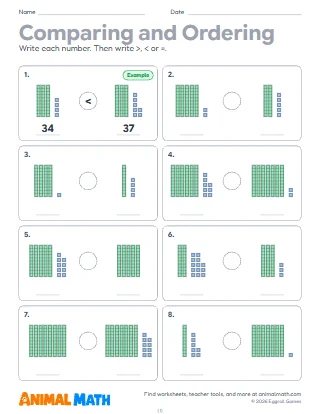
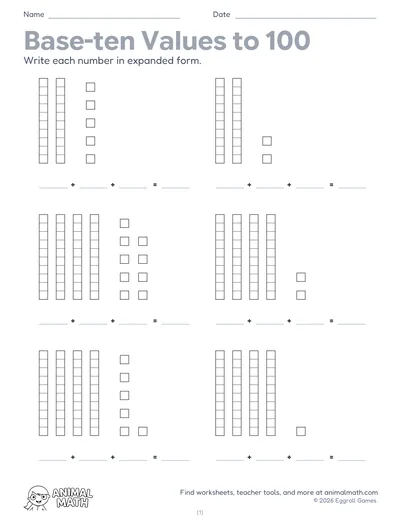
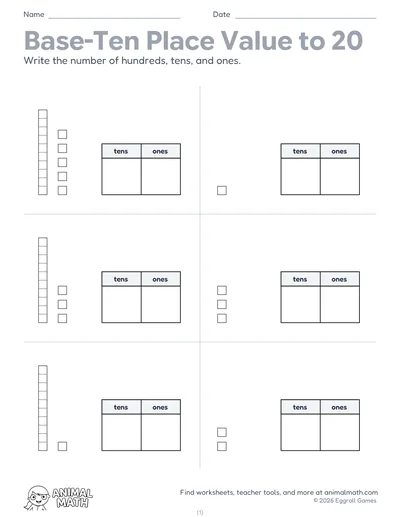
Seven pages for one unit on tens and ones. Page 1 is a pre-check to give before the unit, to see what students already know. Pages 2 and 3 are a review to do together before the test, with a tip on every question. Pages 4 and 5 are the unit test, Form A. Pages 6 and 7 are Form B: the same questions in the same order with different numbers, for a retake, a make-up or a second seating. Each form has 12 questions, one point each, and a Score line on its first page.
Give the pre-check on the first day of the unit and sort the class by what they missed. Do the review the day before the test, reading the tips aloud, with base-ten blocks on the tables. Question 12 (number words to 100) is taught in 1st grade in Florida and Oklahoma: leave it out and score out of 11 if your class does not learn it. The answer keys name each question's skill, so a missed question points to the lesson to reteach.
Use the review as practice before a test at school, or Form B as a check after the unit. Count a pile of small things by making groups of ten, and ask your child how many tens and how many ones there are.
This pack supports the following Common Core State Standards for Mathematics:
© Copyright 2010. National Governors Association Center for Best Practices and Council of Chief State School Officers. All rights reserved.
A unit test for tens and ones in 1st grade: a one-page pre-check, a two-page review with a tip on every question, and the unit test in two forms (A and B) that ask the same questions with different numbers. Students circle groups of ten, write teen numbers and decade numbers as tens and ones, read base-ten blocks, write numbers as tens plus ones, find two pictures that show the same number, compare numbers with blocks and with >, < and =, put three numbers to 120 in order, place numbers on a number line and sort numbers in a Venn diagram. The last question (number words to 100) is for the states that teach it in 1st grade. Answer keys name the skill and standard of every question.
Tell us what to make next, or build your own with a worksheet maker.
This worksheet is free to download, print, copy, and hand out in your classroom or at home. You do not need to create an account, and there are no watermarks on the PDF.