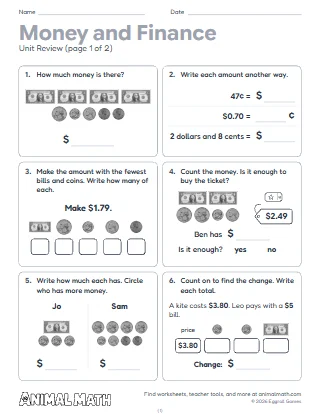
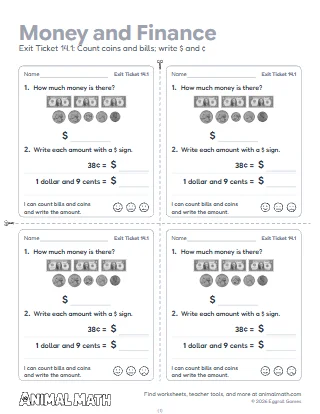
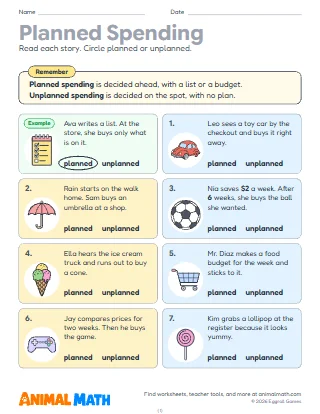
The unit test for the money and financial literacy unit. Pages 1 and 2 are Form A. Pages 3 and 4 are Form B: the same questions in the same order with different money and stories, for a retake, a make-up or a second seating. Each form has 12 questions, one point each, and a Score line on its first page. Every lesson in this unit is a state lesson, and the questions follow the lessons: questions 1 to 3 count and write money, 4 and 5 ask whether there is enough and who has more, 6 and 7 make change, and 8 to 12 are financial literacy (income, scarcity, spending, credit, saving and giving). The pre-check and the unit review are packs of their own.
This unit comes from state standards, so give the parts your state teaches and score out of the questions you give. Questions 1 to 3 (counting bills and coins, writing amounts with $ and ¢, the fewest bills and coins) are taught in 3rd grade in Indiana, Oklahoma, South Carolina, Texas and Virginia. Questions 4 and 5 (enough money, comparing amounts) are taught in Indiana, Oklahoma and Virginia. Questions 6 and 7 (making change from $5.00 or less) are Virginia's. Questions 8 to 12 are the Texas financial literacy lessons. Every amount of coins and bills is $5.00 or less; the stories use whole dollars. The parts can also be given at different times of the year, as each is taught. The answer keys name each question's skill, so a missed question points to the lesson to reteach.
Use Form B as a check after the unit. Count the money in a wallet together, pay for something small and count on to check the change, and talk about a savings goal and how many weeks it would take.
This pack supports the following Common Core State Standards for Mathematics:
© Copyright 2010. National Governors Association Center for Best Practices and Council of Chief State School Officers. All rights reserved.
A unit test on money and financial literacy, in two forms, A and B. Students count bills and coins, decide whether there is enough money, make change, and answer questions about income, scarcity, spending, credit and saving.
Tell us what to make next, or build your own with a worksheet maker.
This worksheet is free to download, print, copy, and hand out in your classroom or at home. You do not need to create an account, and there are no watermarks on the PDF.