3rd Grade Math Curriculum

A full year of 3rd grade math in 14 units and 125 lessons, free to print. Every lesson has a one-page lesson plan (how to teach it, the words to use, the mistakes to watch for) and an exit ticket, and every unit has a pre-check, a review and a test in two forms. Each lesson plan points to the worksheets, worksheet makers, teaching tools and quizzes that practice it. The plan below counts one lesson a day, with a day for the pre-check, the review and the test of each unit: 167 days, which leaves room in a 180-day year for catching up, holidays and seasonal packs.

14 units125 lessons167 days34 weeks

Unit 1

Multiplication

Weeks 1–3 · 12 days

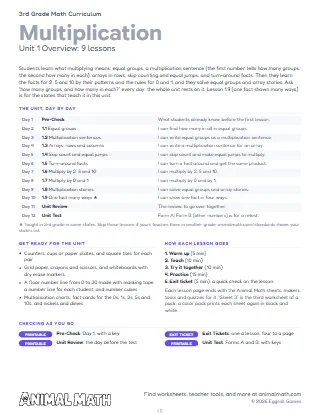
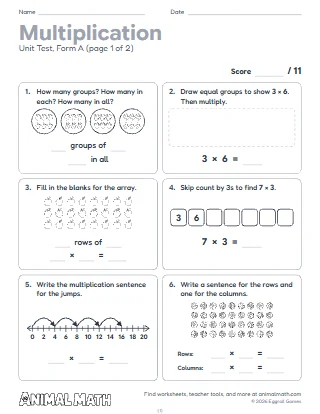
Students learn what multiplying means: equal groups, a multiplication sentence (the first number tells how many groups, the second how many in each), arrays in rows, skip counting and equal jumps, and turn-around facts. Then they learn the facts for 2, 5 and 10 by their patterns and the rules for 0 and 1, and they solve equal groups and array stories. Ask “how many groups, and how many in each?” every day: the whole unit rests on it. Lesson 1.9 (one fact shown many ways) is for the states that teach it in this unit.

Week 1
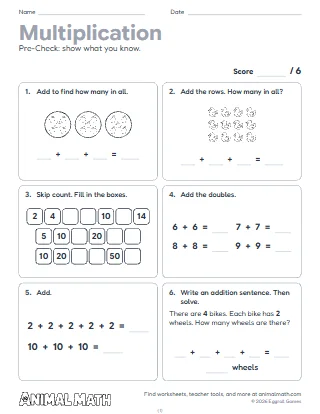
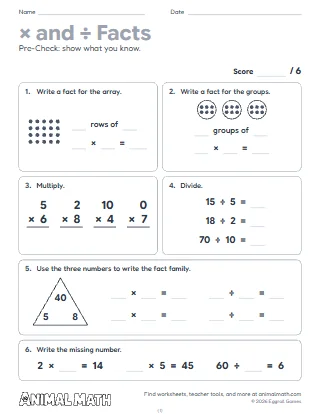
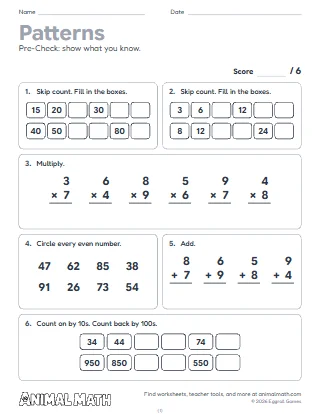
Day 1Pre-CheckWhat students already know, before the unit.
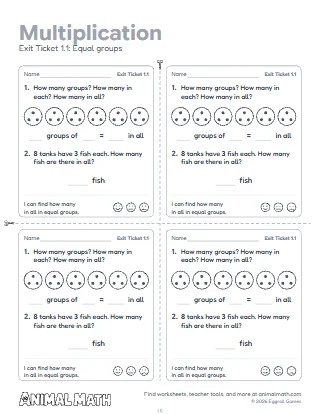
Day 21.1 Equal groupsI can find how many in all in equal groups.
Day 31.2 Multiplication sentencesI can write equal groups as a multiplication sentence.
Day 41.3 Arrays: rows and columnsI can write a multiplication sentence for an array.
Day 51.4 Skip count and equal jumpsI can skip count and make equal jumps to multiply.
Week 2
Day 61.5 Turn-around factsI can turn a fact around and get the same product.
Day 71.6 Multiply by 2, 5 and 10I can multiply by 2, 5 and 10.
Day 81.7 Multiply by 0 and 1I can multiply by 0 and by 1.
Day 91.8 Multiplication storiesI can solve equal groups and array stories.
Day 101.9 One fact many ways ★I can show one fact in four ways.
Week 3
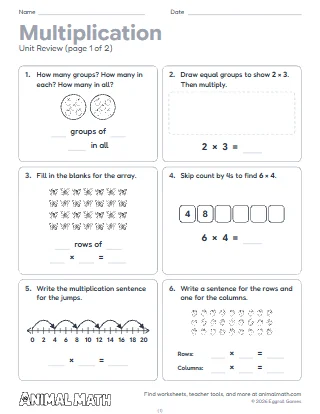
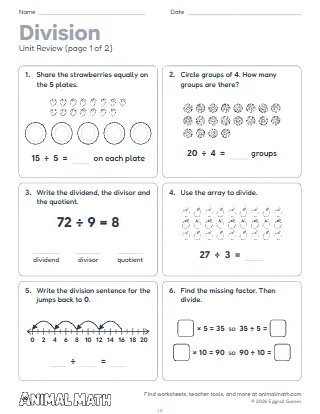
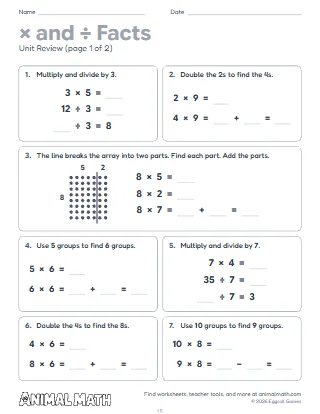
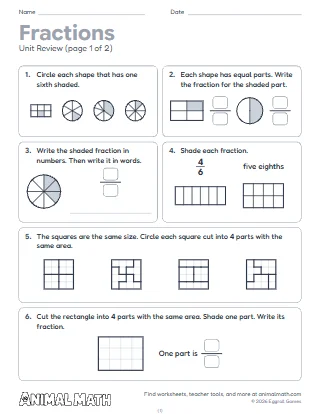
Day 11Unit ReviewThe review, to go over together.
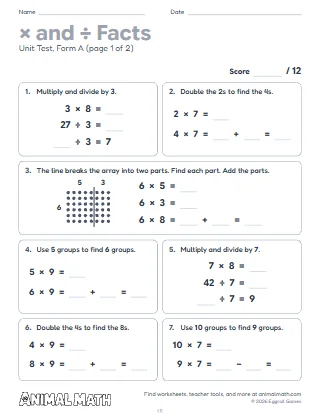
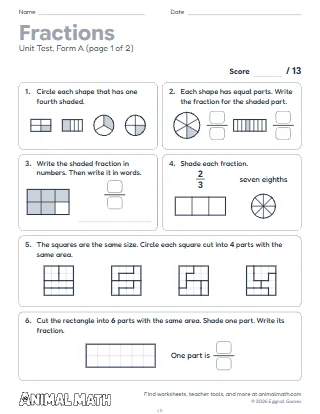
Day 12Unit TestForm A; Form B (other numbers) is for a retest.
Unit 2

Division

Weeks 3–5 · 12 days

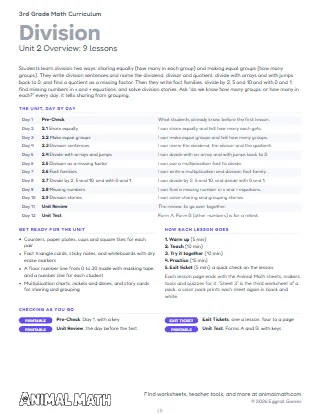
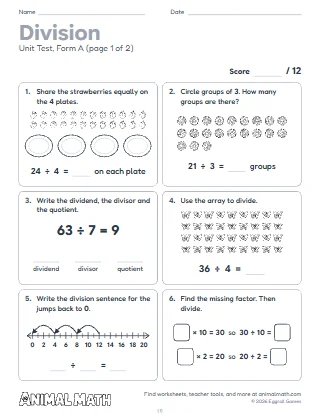
Students learn division two ways: sharing equally (how many in each group) and making equal groups (how many groups). They write division sentences and name the dividend, divisor and quotient, divide with arrays and with jumps back to 0, and find a quotient as a missing factor. Then they write fact families, divide by 2, 5 and 10 and with 0 and 1, find missing numbers in × and ÷ equations, and solve division stories. Ask “do we know how many groups, or how many in each?” every day: it tells sharing from grouping.

Week 3 (continued)
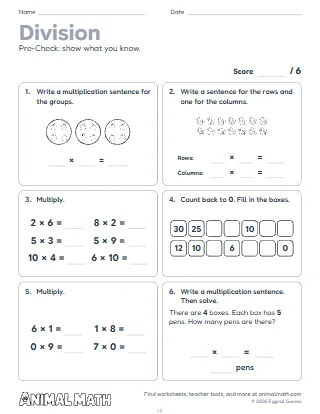
Day 13Pre-CheckWhat students already know, before the unit.
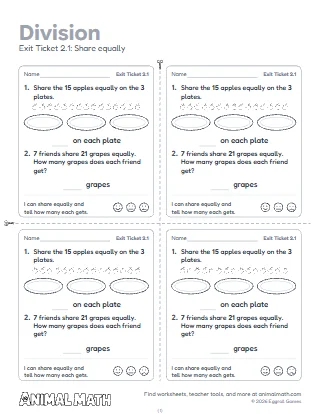
Day 142.1 Share equallyI can share equally and tell how many each gets.
Day 152.2 Make equal groupsI can make equal groups and tell how many groups.
Week 4
Day 162.3 Division sentencesI can name the dividend, the divisor and the quotient.
Day 172.4 Divide with arrays and jumpsI can divide with an array and with jumps back to 0.
Day 182.5 Division as a missing factorI can use a multiplication fact to divide.
Day 192.6 Fact familiesI can write a multiplication and division fact family.
Day 202.7 Divide by 2, 5 and 10, and with 0 and 1I can divide by 2, 5 and 10, and divide with 0 and 1.
Week 5
Day 212.8 Missing numbersI can find a missing number in × and ÷ equations.
Day 222.9 Division storiesI can solve sharing and grouping stories.
Day 23Unit ReviewThe review, to go over together.
Day 24Unit TestForm A; Form B (other numbers) is for a retest.
Unit 3

Multiplication and Division Facts

Weeks 5–8 · 14 days

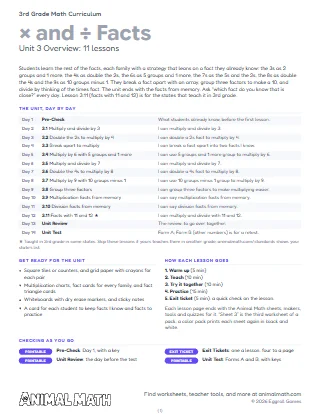
Students learn the rest of the facts, each family with a strategy that leans on a fact they already know: the 3s as 2 groups and 1 more, the 4s as double the 2s, the 6s as 5 groups and 1 more, the 7s as the 5s and the 2s, the 8s as double the 4s and the 9s as 10 groups minus 1. They break a fact apart with an array, group three factors to make a 10, and divide by thinking of the times fact. The unit ends with the facts from memory. Ask “which fact do you know that is close?” every day. Lesson 3.11 (facts with 11 and 12) is for the states that teach it in 3rd grade.

Week 5 (continued)
Day 25Pre-CheckWhat students already know, before the unit.
Week 6
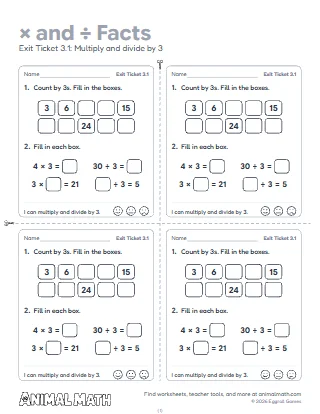
Day 263.1 Multiply and divide by 3I can multiply and divide by 3.
Day 273.2 Double the 2s to multiply by 4I can double a 2s fact to multiply by 4.
Day 283.3 Break apart to multiplyI can break a fact apart into two facts I know.
Day 293.4 Multiply by 6 with 5 groups and 1 moreI can use 5 groups and 1 more group to multiply by 6.
Day 303.5 Multiply and divide by 7I can multiply and divide by 7.
Week 7
Day 313.6 Double the 4s to multiply by 8I can double a 4s fact to multiply by 8.
Day 323.7 Multiply by 9 with 10 groups minus 1I can use 10 groups minus 1 group to multiply by 9.
Day 333.8 Group three factorsI can group three factors to make multiplying easier.
Day 343.9 Multiplication facts from memoryI can say multiplication facts from memory.
Day 353.10 Division facts from memoryI can say division facts from memory.
Week 8
Day 363.11 Facts with 11 and 12 ★I can multiply and divide with 11 and 12.
Day 37Unit ReviewThe review, to go over together.
Day 38Unit TestForm A; Form B (other numbers) is for a retest.
Unit 4

Area

Weeks 8–10 · 11 days

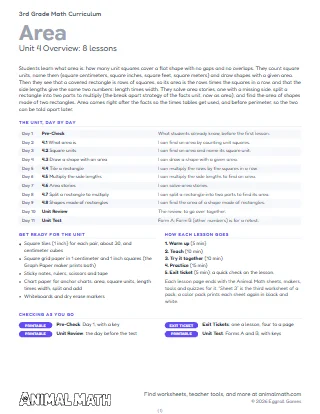
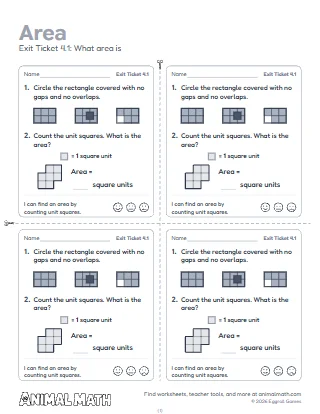
Students learn what area is: how many unit squares cover a flat shape with no gaps and no overlaps. They count square units, name them (square centimeters, square inches, square feet, square meters) and draw shapes with a given area. Then they see that a covered rectangle is rows of squares, so its area is the rows times the squares in a row, and that the side lengths give the same two numbers: length times width. They solve area stories, one with a missing side, split a rectangle into two parts to multiply (the break apart strategy of the facts unit, now as area), and find the area of shapes made of two rectangles. Area comes right after the facts so the times tables get used, and before perimeter, so the two can be told apart later.

Week 8 (continued)
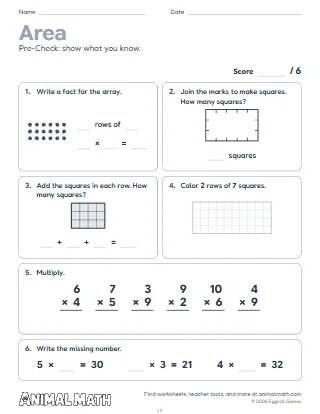
Day 39Pre-CheckWhat students already know, before the unit.
Day 404.1 What area isI can find an area by counting unit squares.
Week 9
Day 414.2 Square unitsI can find an area and name its square unit.
Day 424.3 Draw a shape with an areaI can draw a shape with a given area.
Day 434.4 Tile a rectangleI can multiply the rows by the squares in a row.
Day 444.5 Multiply the side lengthsI can multiply the side lengths to find an area.
Day 454.6 Area storiesI can solve area stories.
Week 10
Day 464.7 Split a rectangle to multiplyI can split a rectangle into two parts to find its area.
Day 474.8 Shapes made of rectanglesI can find the area of a shape made of rectangles.
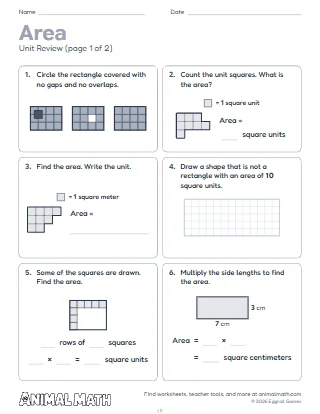
Day 48Unit ReviewThe review, to go over together.
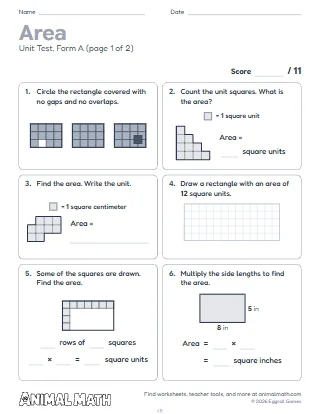
Day 49Unit TestForm A; Form B (other numbers) is for a retest.
Unit 5

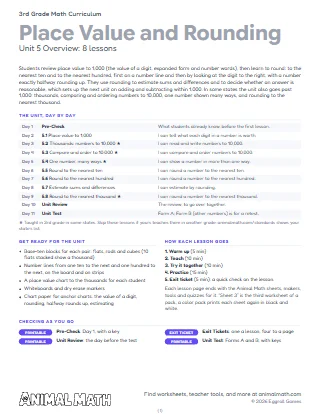
Place Value and Rounding

Weeks 10–12 · 11 days

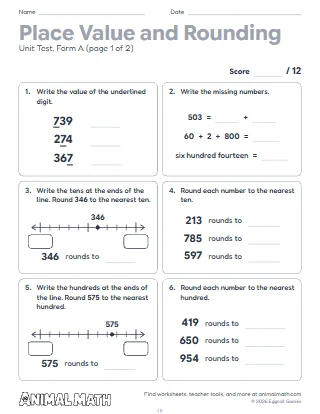
Students review place value to 1,000 (the value of a digit, expanded form and number words), then learn to round: to the nearest ten and to the nearest hundred, first on a number line and then by looking at the digit to the right, with a number exactly halfway rounding up. They use rounding to estimate sums and differences and to decide whether an answer is reasonable, which sets up the next unit on adding and subtracting within 1,000. In some states the unit also goes past 1,000: thousands, comparing and ordering numbers to 10,000, one number shown many ways, and rounding to the nearest thousand.

Week 10 (continued)
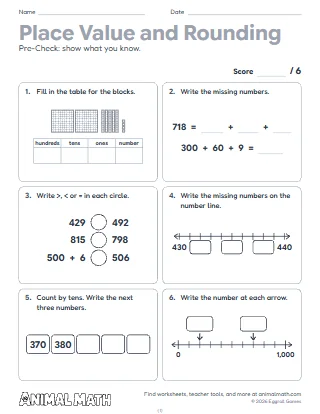
Day 50Pre-CheckWhat students already know, before the unit.
Week 11
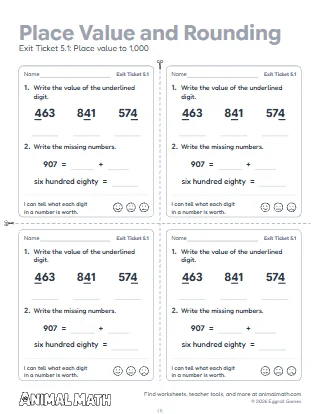
Day 515.1 Place value to 1,000I can tell what each digit in a number is worth.
Day 525.2 Thousands: numbers to 10,000 ★I can read and write numbers to 10,000.
Day 535.3 Compare and order to 10,000 ★I can compare and order numbers to 10,000.
Day 545.4 One number, many ways ★I can show a number in more than one way.
Day 555.5 Round to the nearest tenI can round a number to the nearest ten.
Week 12
Day 565.6 Round to the nearest hundredI can round a number to the nearest hundred.
Day 575.7 Estimate sums and differencesI can estimate by rounding.
Day 585.8 Round to the nearest thousand ★I can round a number to the nearest thousand.
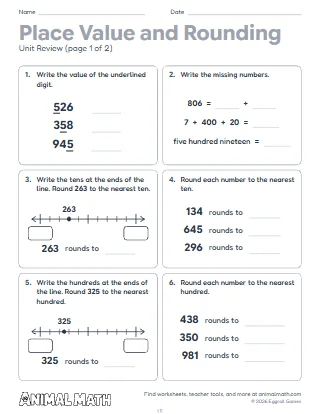
Day 59Unit ReviewThe review, to go over together.
Day 60Unit TestForm A; Form B (other numbers) is for a retest.
Unit 6

Add and Subtract Within 1,000

Weeks 13–15 · 12 days

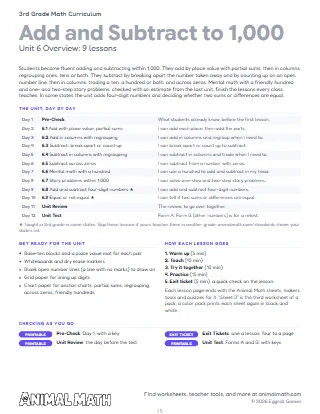
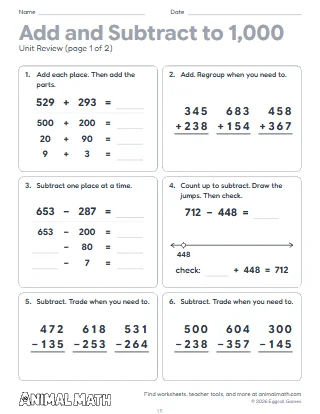
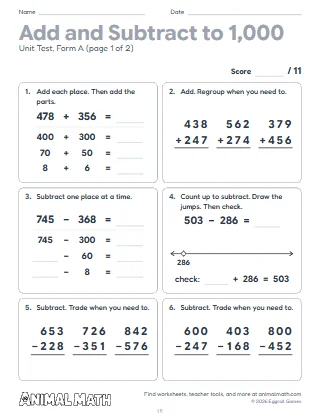
Students become fluent adding and subtracting within 1,000. They add by place value with partial sums, then in columns, regrouping ones, tens or both. They subtract by breaking apart the number taken away and by counting up on an open number line, then in columns, trading a ten, a hundred or both, and across zeros. Mental math with a friendly hundred and one- and two-step story problems, checked with an estimate from the last unit, finish the lessons every class teaches. In some states the unit adds four-digit numbers and deciding whether two sums or differences are equal.

Week 13
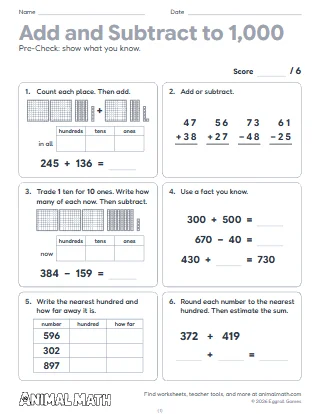
Day 61Pre-CheckWhat students already know, before the unit.
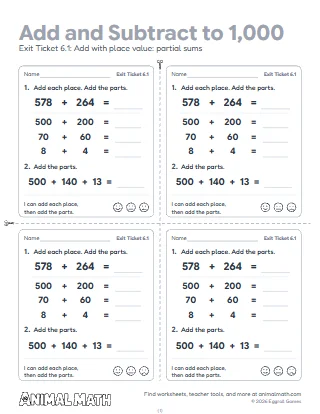
Day 626.1 Add with place value: partial sumsI can add each place, then add the parts.
Day 636.2 Add in columns with regroupingI can add in columns and regroup when I need to.
Day 646.3 Subtract: break apart or count upI can break apart or count up to subtract.
Day 656.4 Subtract in columns with regroupingI can subtract in columns and trade when I need to.
Week 14
Day 666.5 Subtract across zerosI can subtract from a number with zeros.
Day 676.6 Mental math with a hundredI can use a hundred to add and subtract in my head.
Day 686.7 Story problems within 1,000I can solve one-step and two-step story problems.
Day 696.8 Add and subtract four-digit numbers ★I can add and subtract four-digit numbers.
Day 706.9 Equal or not equal ★I can tell if two sums or differences are equal.
Week 15
Day 71Unit ReviewThe review, to go over together.
Day 72Unit TestForm A; Form B (other numbers) is for a retest.
Unit 7

Word Problems

Weeks 15–17 · 13 days

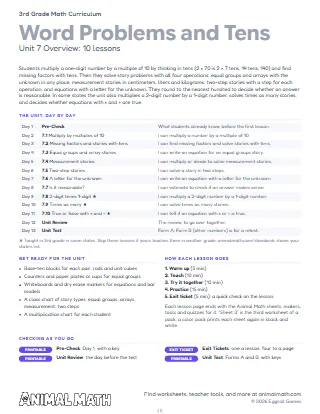
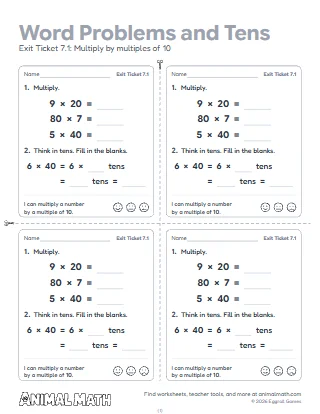
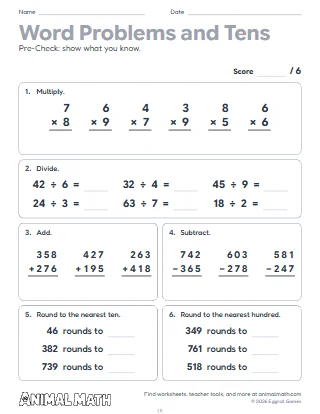
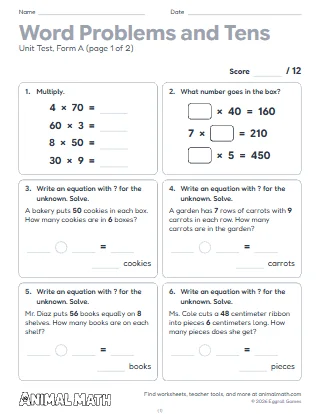
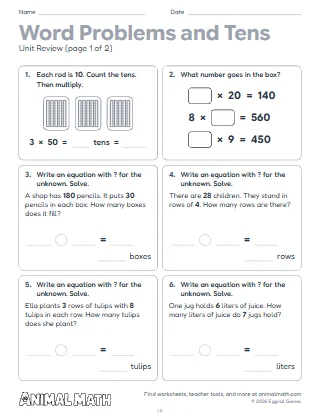
Students multiply a one-digit number by a multiple of 10 by thinking in tens (2 × 70 is 2 × 7 tens, 14 tens, 140) and find missing factors with tens. Then they solve story problems with all four operations: equal groups and arrays with the unknown in any place, measurement stories in centimeters, liters and kilograms, two-step stories with a step for each operation, and equations with a letter for the unknown. They round to the nearest hundred to decide whether an answer is reasonable. In some states the unit also multiplies a 2-digit number by a 1-digit number, solves times as many stories, and decides whether equations with × and ÷ are true.

Week 15 (continued)
Day 73Pre-CheckWhat students already know, before the unit.
Day 747.1 Multiply by multiples of 10I can multiply a number by a multiple of 10.
Day 757.2 Missing factors and stories with tensI can find missing factors and solve stories with tens.
Week 16
Day 767.3 Equal groups and array storiesI can write an equation for an equal groups story.
Day 777.4 Measurement storiesI can multiply or divide to solve measurement stories.
Day 787.5 Two-step storiesI can solve a story in two steps.
Day 797.6 A letter for the unknownI can write an equation with a letter for the unknown.
Day 807.7 Is it reasonable?I can estimate to check if an answer makes sense.
Week 17
Day 817.8 2-digit times 1-digit ★I can multiply a 2-digit number by a 1-digit number.
Day 827.9 Times as many ★I can solve times as many stories.
Day 837.10 True or false with × and ÷ ★I can tell if an equation with × or ÷ is true.
Day 84Unit ReviewThe review, to go over together.
Day 85Unit TestForm A; Form B (other numbers) is for a retest.
Unit 8

Patterns

Weeks 18–19 · 10 days

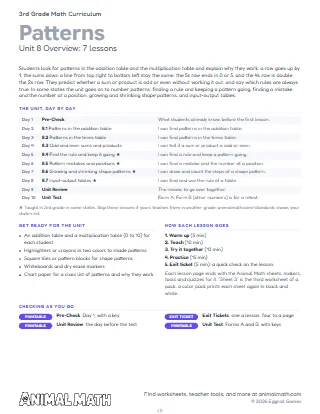
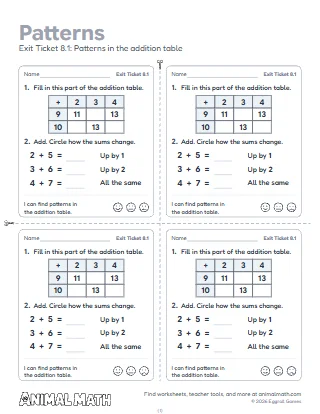
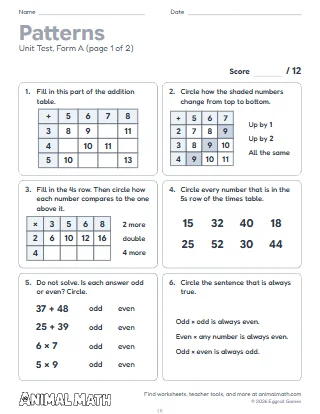
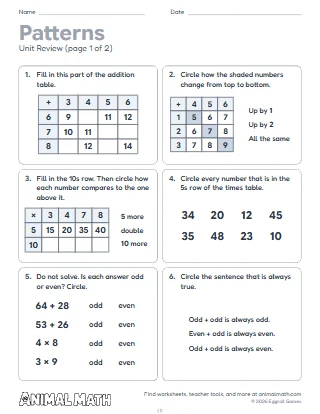
Students look for patterns in the addition table and the multiplication table and explain why they work: a row goes up by 1, the sums down a line from top right to bottom left stay the same, the 5s row ends in 0 or 5, and the 4s row is double the 2s row. They predict whether a sum or product is odd or even without working it out, and say which rules are always true. In some states the unit goes on to number patterns: finding a rule and keeping a pattern going, finding a mistake and the number at a position, growing and shrinking shape patterns, and input-output tables.

Week 18
Day 86Pre-CheckWhat students already know, before the unit.
Day 878.1 Patterns in the addition tableI can find patterns in the addition table.
Day 888.2 Patterns in the times tableI can find patterns in the times table.
Day 898.3 Odd and even sums and productsI can tell if a sum or product is odd or even.
Day 908.4 Find the rule and keep it going ★I can find a rule and keep a pattern going.
Week 19
Day 918.5 Pattern mistakes and positions ★I can find a mistake and the number at a position.
Day 928.6 Growing and shrinking shape patterns ★I can draw and count the steps of a shape pattern.
Day 938.7 Input-output tables ★I can find and use the rule of a table.
Day 94Unit ReviewThe review, to go over together.
Day 95Unit TestForm A; Form B (other numbers) is for a retest.
Unit 9

Fractions

Weeks 20–22 · 11 days

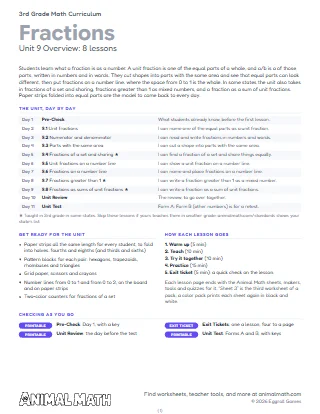
Students learn what a fraction is as a number. A unit fraction is one of the equal parts of a whole, and a/b is a of those parts, written in numbers and in words. They cut shapes into parts with the same area and see that equal parts can look different, then put fractions on a number line, where the space from 0 to 1 is the whole. In some states the unit also takes in fractions of a set and sharing, fractions greater than 1 as mixed numbers, and a fraction as a sum of unit fractions. Paper strips folded into equal parts are the model to come back to every day.

Week 20
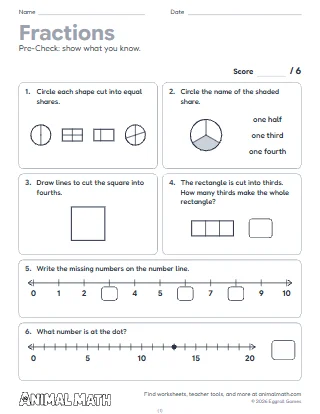
Day 96Pre-CheckWhat students already know, before the unit.
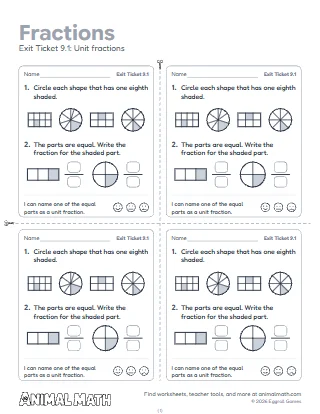
Day 979.1 Unit fractionsI can name one of the equal parts as a unit fraction.
Day 989.2 Numerator and denominatorI can read and write fractions in numbers and words.
Day 999.3 Parts with the same areaI can cut a shape into parts with the same area.
Day 1009.4 Fractions of a set and sharing ★I can find a fraction of a set and share things equally.
Week 21
Day 1019.5 Unit fractions on a number lineI can show a unit fraction on a number line.
Day 1029.6 Fractions on a number lineI can name and place fractions on a number line.
Day 1039.7 Fractions greater than 1 ★I can write a fraction greater than 1 as a mixed number.
Day 1049.8 Fractions as sums of unit fractions ★I can write a fraction as a sum of unit fractions.
Day 105Unit ReviewThe review, to go over together.
Week 22
Day 106Unit TestForm A; Form B (other numbers) is for a retest.
Unit 10

Equivalent and Comparing Fractions

Weeks 22–24 · 11 days

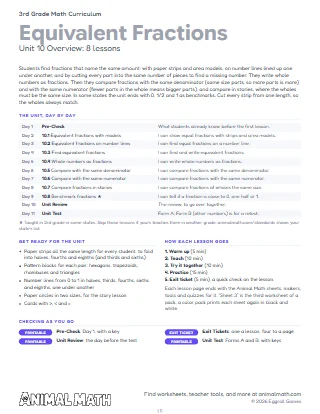
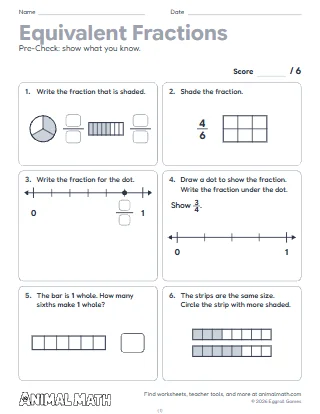
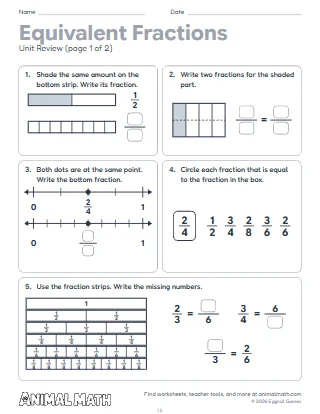
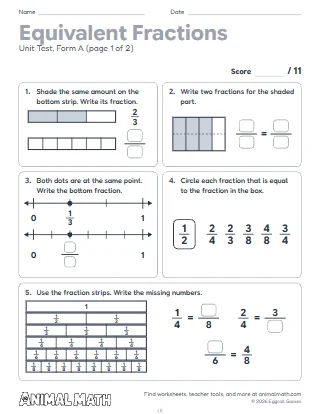
Students find fractions that name the same amount: with paper strips and area models, on number lines lined up one under another, and by cutting every part into the same number of pieces to find a missing number. They write whole numbers as fractions. Then they compare fractions with the same denominator (same size parts, so more parts is more) and with the same numerator (fewer parts in the whole means bigger parts), and compare in stories, where the wholes must be the same size. In some states the unit ends with 0, 1/2 and 1 as benchmarks. Cut every strip from one length, so the wholes always match.
Week 22 (continued)
Day 107Pre-CheckWhat students already know, before the unit.
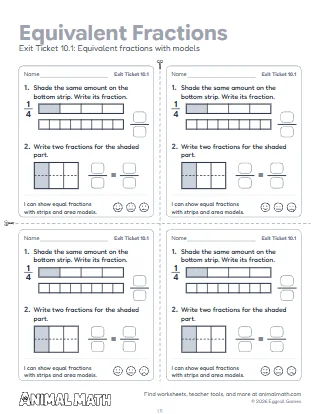
Day 10810.1 Equivalent fractions with modelsI can show equal fractions with strips and area models.
Day 10910.2 Equivalent fractions on number linesI can find equal fractions on a number line.
Day 11010.3 Find equivalent fractionsI can find and write equivalent fractions.
Week 23
Day 11110.4 Whole numbers as fractionsI can write whole numbers as fractions.
Day 11210.5 Compare with the same denominatorI can compare fractions with the same denominator.
Day 11310.6 Compare with the same numeratorI can compare fractions with the same numerator.
Day 11410.7 Compare fractions in storiesI can compare fractions of wholes the same size.
Day 11510.8 Benchmark fractions ★I can tell if a fraction is close to 0, one half or 1.
Week 24
Day 116Unit ReviewThe review, to go over together.
Day 117Unit TestForm A; Form B (other numbers) is for a retest.
Unit 11

Time, Mass and Liquid Volume

Weeks 24–26 · 13 days

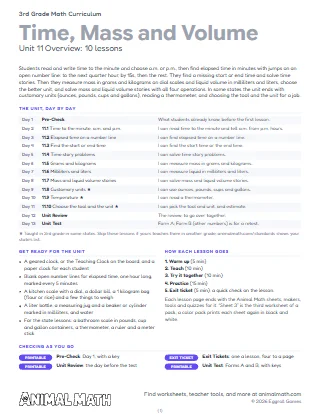
Students read and write time to the minute and choose a.m. or p.m., then find elapsed time in minutes with jumps on an open number line: to the next quarter hour, by 15s, then the rest. They find a missing start or end time and solve time stories. Then they measure mass in grams and kilograms on dial scales and liquid volume in milliliters and liters, choose the better unit, and solve mass and liquid volume stories with all four operations. In some states the unit ends with customary units (ounces, pounds, cups and gallons), reading a thermometer, and choosing the tool and the unit for a job.

Week 24 (continued)
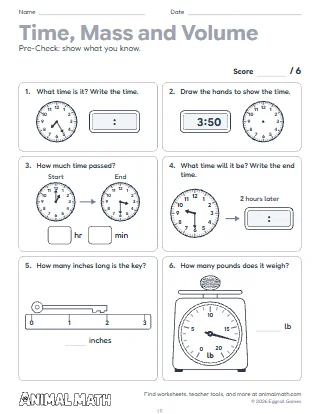
Day 118Pre-CheckWhat students already know, before the unit.
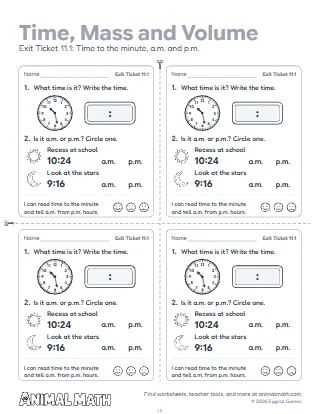
Day 11911.1 Time to the minute, a.m. and p.m.I can read time to the minute and tell a.m. from p.m. hours.
Day 12011.2 Elapsed time on a number lineI can find elapsed time on a number line.
Week 25
Day 12111.3 Find the start or end timeI can find the start time or the end time.
Day 12211.4 Time story problemsI can solve time story problems.
Day 12311.5 Grams and kilogramsI can measure mass in grams and kilograms.
Day 12411.6 Milliliters and litersI can measure liquid in milliliters and liters.
Day 12511.7 Mass and liquid volume storiesI can solve mass and liquid volume stories.
Week 26
Day 12611.8 Customary units ★I can use ounces, pounds, cups and gallons.
Day 12711.9 Temperature ★I can read a thermometer.
Day 12811.10 Choose the tool and the unit ★I can pick the tool and unit, and estimate.
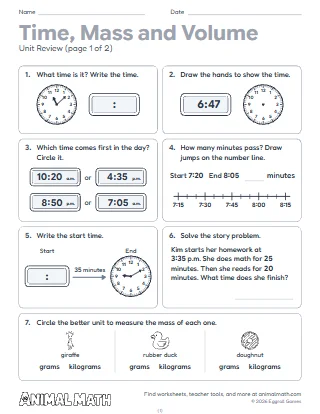
Day 129Unit ReviewThe review, to go over together.
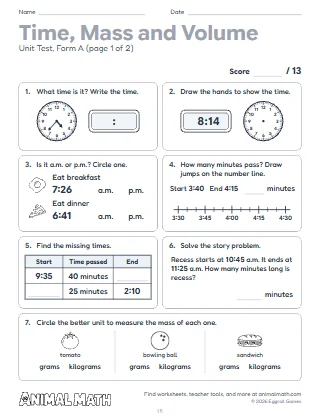
Day 130Unit TestForm A; Form B (other numbers) is for a retest.
Unit 12

Data and Line Plots

Weeks 27–29 · 12 days

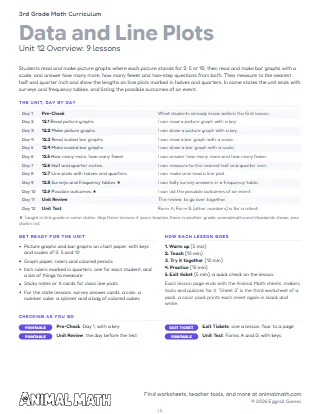
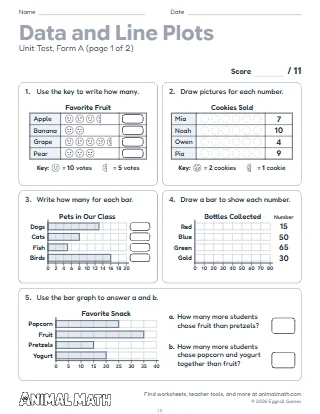
Students read and make picture graphs where each picture stands for 2, 5 or 10, then read and make bar graphs with a scale, and answer how many more, how many fewer and two-step questions from both. They measure to the nearest half and quarter inch and show the lengths on line plots marked in halves and quarters. In some states the unit ends with surveys and frequency tables, and listing the possible outcomes of an event.

Week 27
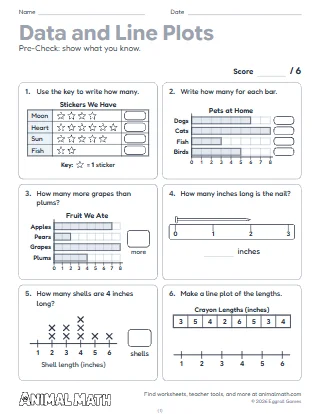
Day 131Pre-CheckWhat students already know, before the unit.
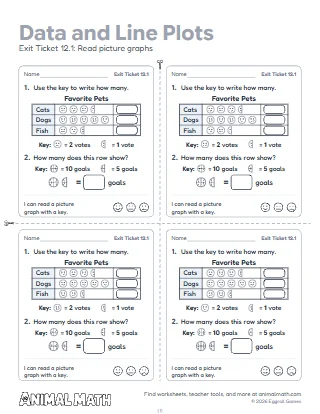
Day 13212.1 Read picture graphsI can read a picture graph with a key.
Day 13312.2 Make picture graphsI can draw a picture graph with a key.
Day 13412.3 Read scaled bar graphsI can read a bar graph with a scale.
Day 13512.4 Make scaled bar graphsI can draw a bar graph with a scale.
Week 28
Day 13612.5 How many more, how many fewerI can answer how many more and how many fewer.
Day 13712.6 Half and quarter inchesI can measure to the nearest half and quarter inch.
Day 13812.7 Line plots with halves and quartersI can make and read a line plot.
Day 13912.8 Surveys and frequency tables ★I can tally survey answers in a frequency table.
Day 14012.9 Possible outcomes ★I can list the possible outcomes of an event.
Week 29
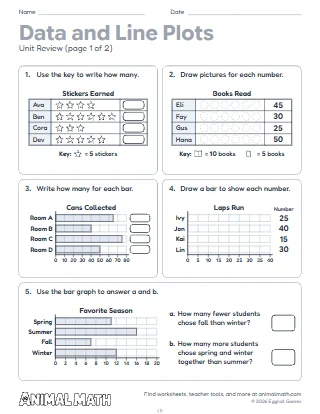
Day 141Unit ReviewThe review, to go over together.
Day 142Unit TestForm A; Form B (other numbers) is for a retest.
Unit 13

Shapes and Perimeter

Weeks 29–32 · 14 days

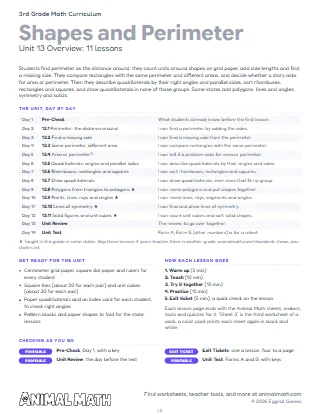
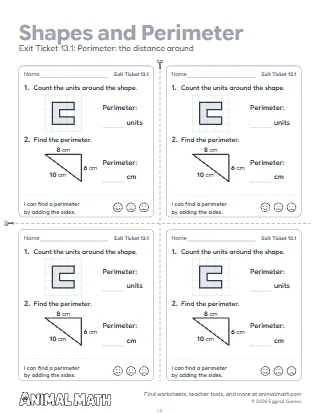
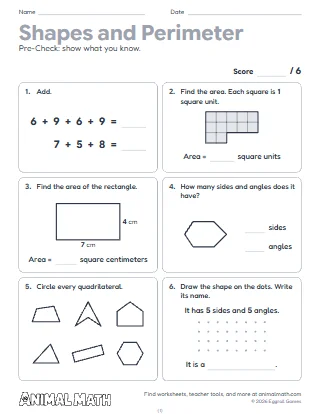
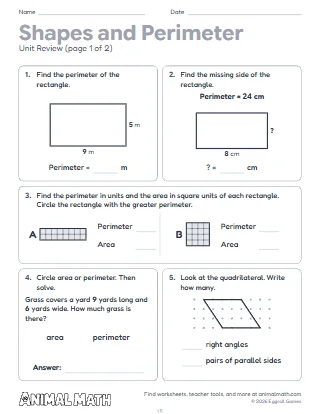
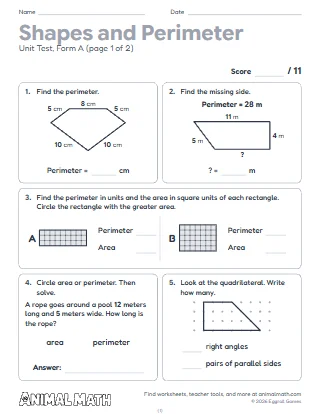
Students find perimeter as the distance around: they count units around shapes on grid paper, add side lengths and find a missing side. They compare rectangles with the same perimeter and different areas, and decide whether a story asks for area or perimeter. Then they describe quadrilaterals by their right angles and parallel sides, sort rhombuses, rectangles and squares, and draw quadrilaterals in none of those groups. Some states add polygons, lines and angles, symmetry and solids.

Week 29 (continued)
Day 143Pre-CheckWhat students already know, before the unit.
Day 14413.1 Perimeter: the distance aroundI can find a perimeter by adding the sides.
Day 14513.2 Find a missing sideI can find a missing side from the perimeter.
Week 30
Day 14613.3 Same perimeter, different areaI can compare rectangles with the same perimeter.
Day 14713.4 Area or perimeter?I can tell if a problem asks for area or perimeter.
Day 14813.5 Quadrilaterals: angles and parallel sidesI can describe quadrilaterals by their angles and sides.
Day 14913.6 Rhombuses, rectangles and squaresI can sort rhombuses, rectangles and squares.
Day 15013.7 Draw quadrilateralsI can draw quadrilaterals, even ones that fit no group.
Week 31
Day 15113.8 Polygons from triangles to octagons ★I can name polygons and put shapes together.
Day 15213.9 Points, lines, rays and angles ★I can name lines, rays, segments and angles.
Day 15313.10 Lines of symmetry ★I can find and draw lines of symmetry.
Day 15413.11 Solid figures and unit cubes ★I can count unit cubes and sort solid shapes.
Day 155Unit ReviewThe review, to go over together.
Week 32
Day 156Unit TestForm A; Form B (other numbers) is for a retest.
Unit 14 ★

Money and Financial Literacy

Weeks 32–34 · 11 days

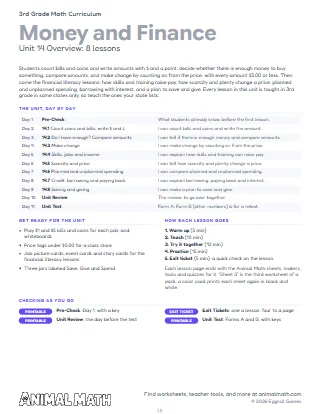
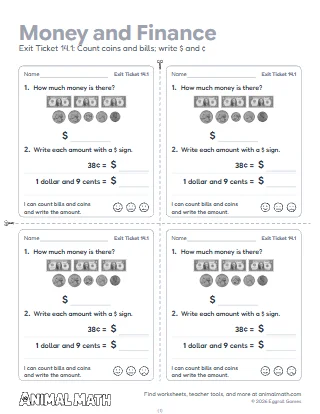
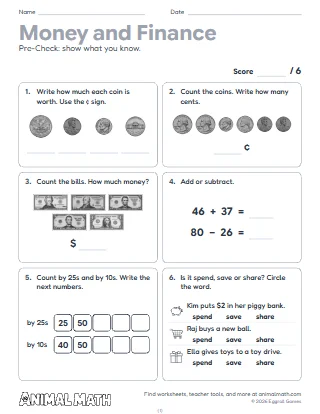
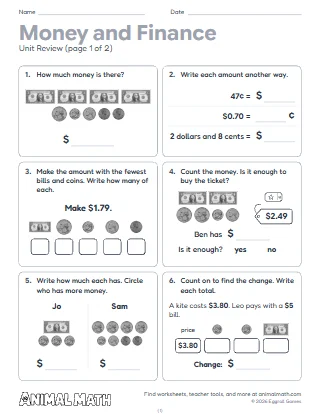
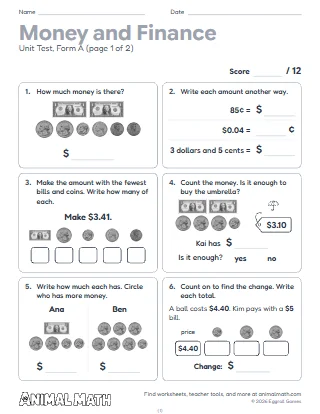
Students count bills and coins and write amounts with $ and a point, decide whether there is enough money to buy something, compare amounts, and make change by counting on from the price, with every amount $5.00 or less. Then come the financial literacy lessons: how skills and training raise pay, how scarcity and plenty change a price, planned and unplanned spending, borrowing with interest, and a plan to save and give. Every lesson in this unit is taught in 3rd grade in some states only, so teach the ones your state lists.

Week 32 (continued)
Day 157Pre-CheckWhat students already know, before the unit.
Day 15814.1 Count coins and bills; write $ and ¢I can count bills and coins and write the amount.
Day 15914.2 Do I have enough? Compare amountsI can tell if there is enough money and compare amounts.
Day 16014.3 Make changeI can make change by counting on from the price.
Week 33
Day 16114.4 Skills, jobs and incomeI can explain how skills and training can raise pay.
Day 16214.5 Scarcity and priceI can tell how scarcity and plenty change a price.
Day 16314.6 Planned and unplanned spendingI can compare planned and unplanned spending.
Day 16414.7 Credit: borrowing and paying backI can explain borrowing, paying back and interest.
Day 16514.8 Saving and givingI can make a plan to save and give.
Week 34
Day 166Unit ReviewThe review, to go over together.
Day 167Unit TestForm A; Form B (other numbers) is for a retest.

Lessons marked ★ are taught in 3rd grade in some states and in other grades elsewhere; skip them if your state does not teach them in 3rd grade (without them and Unit 14 the year is 89 lessons, which leaves time to spend two days on the fact lessons of Unit 3, the fractions units and the word problems of Unit 7). Unit 14 (money and financial literacy) is for the states that teach it in 3rd grade, and it can be spread through the year.

Teaching a grade we don’t cover yet?

Tell us which grade you want a curriculum for next.

Suggest a curriculum

A free curriculum

Every lesson plan, exit ticket and unit test here is free to download and print for your classroom or your home school. You do not need an account, and the PDFs have no watermarks.