Loading preview...

Features

  • Forms A and B ask the same questions with different numbers
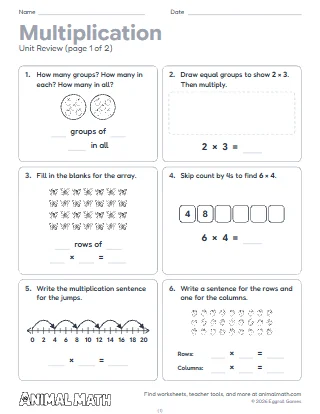
  • Count equal groups, draw groups for a multiplication sentence, and write sentences for arrays
  • Skip count by 3s and 4s, and write the sentence for equal jumps on a number line
  • Write the turn-around fact for an array by its rows and its columns
  • Answer facts for 2, 5 and 10, and facts with 0 and 1
  • Solve an equal groups story and an array story
  • The last question (one fact shown four ways) is for the states that teach it
  • Answer keys name the lesson and skill of every question

Skills Covered

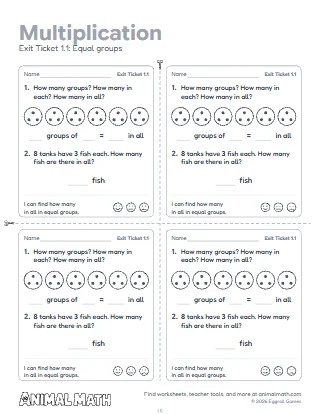
  • Equal groups: how many groups, how many in each, how many in all
  • 3 × 4 means 3 groups of 4
  • Arrays: rows and how many in each row
  • Skip count to find a product
  • Equal jumps on a number line
  • Turn-around facts (the order property)
  • Facts for 2, 5 and 10
  • Facts with 0 and 1
  • Equal groups and array stories
  • One fact shown as groups, an array, adding and jumps

How to Use This Pack

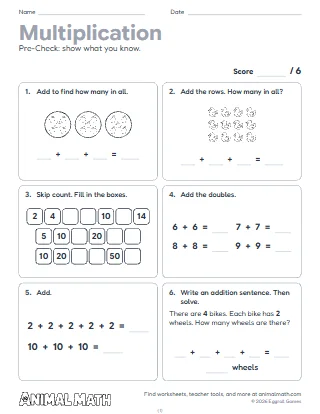
The unit test for the first unit of 3rd grade, what multiplying means. Pages 1 and 2 are Form A. Pages 3 and 4 are Form B: the same questions in the same order with different numbers, for a retake, a make-up or a second seating. Each form has 11 questions, one point each, and a Score line on its first page. Question 11 (show one fact four ways: equal groups, an array, adding and jumps) is for the states that teach it in this unit. The pre-check and the unit review are packs of their own.

In the Classroom

Give Form A the day after the unit review. Questions 7 and 8 are six facts each: give the point when all are right, or score them by the fact if you like. The keys write 3 × 4 as 3 groups of 4 (and 3 rows of 4); a turned-around sentence with the right product shows the same understanding. Question 11 is taught in this unit in some states: leave it out if your class does not learn it and score out of 10. The answer keys name each question's skill, so a missed question points to the lesson to reteach.

At Home

Use Form B as a check after the unit. Look for equal groups and arrays at home (eggs in a carton, socks in pairs, windows in rows) and ask how many groups, how many in each, and how many in all.

Tips for Success

  • Read 3 × 4 as "3 groups of 4"
  • Rows go across; count the rows, then how many in each row
  • Turning an array around gives the turn-around fact with the same product
  • Any number times 0 is 0, and any number times 1 is that number
  • Use Form B as a retake after reteaching what was missed

Common Core Standards Alignment

This pack supports the following Common Core State Standards for Mathematics:

  • 3.OA.A.1 Understand a product as the total in equal groups, such as 4 × 6 meaning 4 groups with 6 in each.
  • 3.OA.A.3 Solve story problems about equal groups, arrays and measurements by multiplying or dividing within 100, using drawings and equations.
  • 3.OA.B.5 Use the commutative, associative and distributive properties to multiply and divide, such as finding 7 × 8 from 7 × 5 and 7 × 3.
  • 3.OA.C.7 Multiply and divide to 100 fluently with strategies, and by year's end instantly recall every product of two single-digit numbers.
  • 3.OA.D.8 Solve two-step story problems with +, −, × and ÷, using a letter for the missing amount, and check answers by estimating or rounding.
  • 3.OA.D.9 Spot patterns in addition tables, times tables and other arithmetic, and explain them with properties, like why multiples of 5 end in 0 or 5.
  • 3.MD.C.7c Use tiles or area models to show that splitting a rectangle's side into two parts splits its area into two products (the distributive property).

© Copyright 2010. National Governors Association Center for Best Practices and Council of Chief State School Officers. All rights reserved.

3rd Grade Multiplication Test

The unit test on what multiplying means in two forms, with equal groups, arrays and the facts for 0, 1, 2, 5 and 10. Students write multiplication sentences for groups, arrays and jumps, skip count, use turn-around facts, answer facts and solve multiplication stories.

Download PDF
Pin

What’s Included

  • The unit test in two forms, A and B (11 questions each)
  • Answer keys that name each question's lesson and skill (8 pages in all)
Can’t find what you need?

Tell us what to make next, or build your own with a worksheet maker.

Suggest a worksheet

Free to print and share

This worksheet is free to download, print, copy, and hand out in your classroom or at home. You do not need to create an account, and there are no watermarks on the PDF.