Loading preview...

Features

  • Forms A and B ask the same questions with different shapes and numbers
  • Find a perimeter by adding the sides, and a missing side from the perimeter
  • Compare two rectangles with the same perimeter and different areas
  • Decide whether a story asks for area or perimeter, then solve it
  • Count the right angles and pairs of parallel sides of a quadrilateral, circle every rhombus (squares too), and draw a quadrilateral that is not a rhombus, a rectangle or a square
  • The last four questions (polygons, lines, rays and angles, lines of symmetry, and solids made of unit cubes) are for the states that teach them in 3rd grade
  • Answer keys name the lesson and skill of every question

Skills Covered

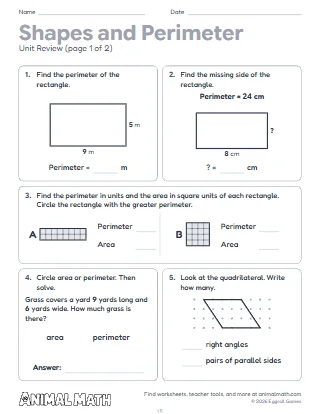
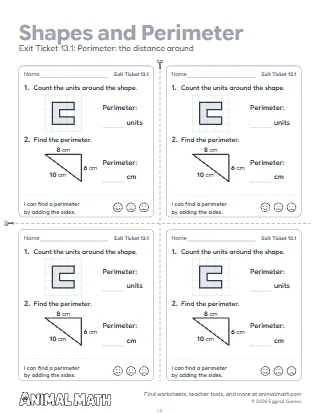
  • Find the perimeter of a polygon by adding its sides
  • Find a missing side from the perimeter
  • Rectangles with the same perimeter and different areas, and the reverse
  • Decide whether a story asks for area or perimeter
  • Right angles and parallel sides of quadrilaterals
  • Rhombuses, rectangles and squares (a square is both)
  • Draw quadrilaterals that are none of them
  • Polygons, lines and angles, symmetry and unit cubes

How to Use This Pack

The unit test on shapes and perimeter. Pages 1 and 2 are Form A. Pages 3 and 4 are Form B: the same questions in the same order with different shapes and numbers, for a retake, a make-up or a second seating. Each form has 11 questions, one point each, and a Score line on its first page. Questions 1 to 7 are the Common Core part of the unit; questions 8 to 11 (polygons, lines and angles, symmetry, and unit cubes) are state lessons. The pre-check and the unit review are packs of their own.

In the Classroom

Give Form A the day after the unit review. Questions 1 to 7 are the Common Core part of the unit and fill page 1 and the top row of page 2. Questions 8 to 11 are taught in 3rd grade in some states only: naming polygons (Virginia), lines, rays, parallel and perpendicular lines and angles (Florida, Georgia, Indiana, Oklahoma, South Carolina), lines of symmetry (Florida, Georgia) and solids made of unit cubes (Oklahoma, Texas). Give the ones your class learns and score out of what you give. Question 4 asks for the perimeter on Form A and the area on Form B, so a student who retakes the test has to decide again. The answer keys name each question's skill, so a missed question points to the lesson to reteach.

At Home

Use Form B as a check after the unit. Walk around a table or a rug and count the steps for its perimeter, then count the tiles or squares that cover it for its area.

Tips for Success

  • Have students mark each side as they add it, so none is counted twice
  • Ask "around or covering?" before every area or perimeter story
  • A square is a rectangle and a rhombus too: have students say why
  • Go over the unit review the day before the test
  • Use Form B as a retake after reteaching what was missed

Common Core Standards Alignment

This pack supports the following Common Core State Standards for Mathematics:

  • 2.G.A.1 Draw and spot shapes with given features, like a number of angles or faces, and name triangles, quadrilaterals, pentagons, hexagons and cubes.
  • 3.MD.C.7a Tile a rectangle with whole-number sides and show that the number of tiles matches multiplying its length by its width.
  • 3.MD.C.7b Multiply length by width to get the area of whole-number rectangles in story and math problems, and picture products as rectangles.
  • 3.MD.C.7c Use tiles or area models to show that splitting a rectangle's side into two parts splits its area into two products (the distributive property).
  • 3.MD.D.8 Solve perimeter problems for polygons: add side lengths, find a missing side, and compare rectangles with equal perimeters but different areas, or the reverse.
  • 3.G.A.1 See that shapes like rhombuses, rectangles and squares share features, such as four sides, that make them all quadrilaterals; draw quadrilaterals outside those groups.
  • 4.G.A.1 Draw and find points, lines, line segments, rays, right, acute and obtuse angles, and parallel and perpendicular lines, including in flat shapes.
  • 4.G.A.2 Sort flat shapes by whether they have parallel or perpendicular lines or angles of a certain size, and recognize right triangles as a group.
  • 4.G.A.3 Find a line of symmetry, a fold line that makes two matching parts; pick out shapes that have one and draw their lines of symmetry.

© Copyright 2010. National Governors Association Center for Best Practices and Council of Chief State School Officers. All rights reserved.

3rd Grade Shapes and Perimeter Test

A unit test on perimeter and quadrilaterals, in two forms, A and B. Students find perimeters and missing sides, compare rectangles with the same perimeter, decide whether a story asks for area or perimeter, and sort rhombuses, rectangles and squares.

Download PDF
Pin

What’s Included

  • The unit test in two forms, A and B (11 questions each)
  • Answer keys that name each question's lesson and skill (8 pages in all)
Can’t find what you need?

Tell us what to make next, or build your own with a worksheet maker.

Suggest a worksheet

Free to print and share

This worksheet is free to download, print, copy, and hand out in your classroom or at home. You do not need to create an account, and there are no watermarks on the PDF.