Loading preview...

Features

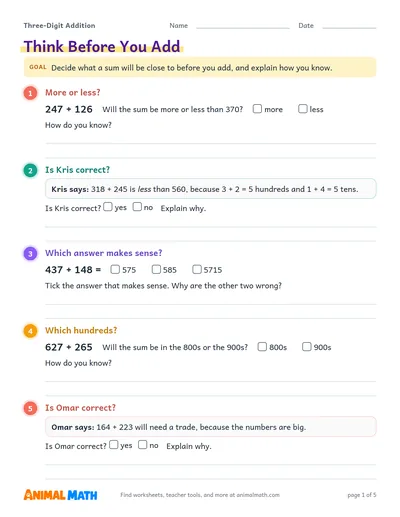
  • Think-first questions: which hundred will the sum be in?
  • A worked example where every place trades to make 1,000
  • Jump to the next hundred on a number line
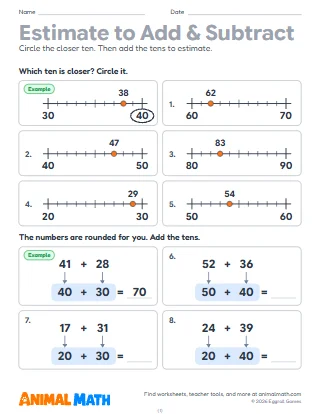
  • Round to estimate, then add with each new unit in its box
  • Why is there a zero? and check Zoe's answer
  • Line up the ones, and find two numbers that make 1,000
  • Every page in color and in black and white
  • Teacher notes for each lesson
  • Answer keys included

Skills Covered

  • Add three-digit numbers with sums to 1,000
  • Know that 10 hundreds make 1 thousand
  • Jump to the next hundred
  • Round to the nearest hundred to estimate
  • Explain a zero in a sum
  • Line up numbers with different digit counts

How to Use This Pack

Four pages on sums that move into a new hundred or reach 1,000. Page 1 asks which hundred a sum will be in before adding. Page 2 estimates a sum, shows 675 + 325 trading in every place to make 1,000, and shows a jump to the next hundred. Page 3 practises the jumps and then estimates and adds six sums. Page 4 explains a zero, checks a wrong answer with an estimate, lines up shorter numbers and asks for a pair that makes exactly 1,000.

In the Classroom

Walk the trade chart one row at a time and ask "How many did we get? Can this place hold that many?" Ten flats becoming one big cube makes 1,000 real. Ask for an estimate before every sum on page 3, and use it to check the answer afterwards.

At Home

Before your child adds, ask which hundred the answer will be in. Counting on from 596 to 600 and then 3 more is a good way to practise the jump.

Tips for Success

  • Estimate first: which hundred will it be in?
  • 10 tens make a hundred; 10 hundreds make 1,000
  • A zero in the sum can be right: check the trade
  • Line up ones under ones
  • Use the estimate to check your answer

Common Core Standards Alignment

This pack supports the following Common Core State Standards for Mathematics:

  • 2.NBT.B.5 Add and subtract to 100 fluently with place-value strategies, properties of addition, or the link between adding and subtracting.
  • 2.NBT.B.6 Find the sum of two, three or four two-digit numbers using place value and properties of addition.
  • 2.NBT.B.7 Add and subtract to 1,000 with models and place-value strategies, working hundreds, tens and ones separately and regrouping tens or hundreds as needed.
  • 2.NBT.B.9 Tell why an adding or subtracting method gives the right answer, reasoning from place value and number properties.
  • 3.NBT.A.1 Use place value to decide which ten or hundred a whole number is closest to, and round to it.
  • 3.NBT.A.2 Add and subtract to 1,000 fluently using place-value strategies and written methods, properties of addition, and fact-family relationships.

© Copyright 2010. National Governors Association Center for Best Practices and Council of Chief State School Officers. All rights reserved.

Adding to 1,000: Crossing a Hundred

2nd – 3rd Grade

Three-digit sums that cross into a new hundred or reach exactly 1,000, with zeros, chained trades and estimates. Students jump to the next hundred, estimate before adding, explain zeros in a sum and catch a dropped trade.

Download PDF
Pin

What’s Included

  • 4 worksheets, in color and in black and white
  • 4 answer key pages
  • 2 pages of teacher notes
Can’t find what you need?

Tell us what to make next, or build your own with a worksheet maker.

Suggest a worksheet

Free to print and share

This worksheet is free to download, print, copy, and hand out in your classroom or at home. You do not need to create an account, and there are no watermarks on the PDF.