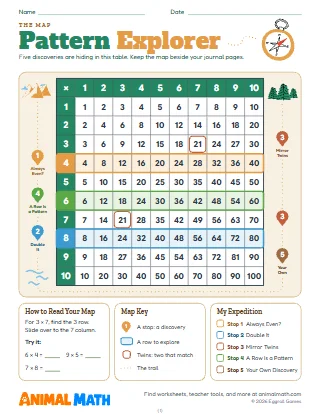
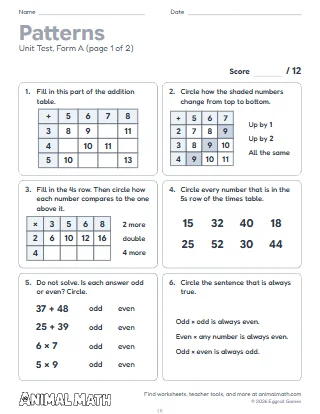
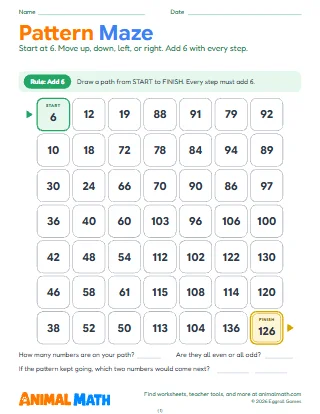
Five pages on patterns in addition and multiplication. Page 1 is the addition table to 9 + 9 with a piece left empty: students fill it in, shade every sum of 9 (they make a line from the bottom left to the top right), see that a row and a column go up by 1 and the doubles by 2, and explain why the sums on the line are equal and why the table matches on both sides of the doubles. Page 2 adds even + even, odd + odd and odd + even sums and sorts them, uses dots to show why the two left over in odd + odd make a pair, then predicts odd or even for eight sums (some within 1,000) before adding to check. Page 3 is a times table piece: fill in the empty squares, shade the odd products, and circle the rules (odd × odd is odd; any number times an even number is even); then predict and multiply, and split an even factor in half to see that 6 × 7 is 21 + 21, a double. Page 4 lists the multiples of 5, 10, 4 and 9 and asks what their digits do (0 or 5; 0; even; the digits of a 9s fact add up to 9), then students circle the multiples in a row of numbers. Page 5 has three "Who is right?" problems about a pattern (4 × 6 is double 2 × 6; odd + odd is even; the 3 row and the 3 column match), with room to show how you know, and six facts to find with a pattern. Each page starts with a worked example.
Project the addition table and shade the sums of 9 together before page 1, then ask what happens to each number as you move up a row and right a column. On page 3, ask students to explain the shaded checkerboard with the words odd and even before they circle the rules.
Play "odd or even?" in the car: say two numbers and ask whether their sum, or their product, will be odd or even before working it out. Ask your child why 7 + 9 has to be even.
This pack supports the following Common Core State Standards for Mathematics:
© Copyright 2010. National Governors Association Center for Best Practices and Council of Chief State School Officers. All rights reserved.
Patterns in the addition and times tables, in odd and even sums and products, and in the digits of multiples. Students fill in tables, shade the squares that fit a rule, predict odd or even before they add or multiply, and explain why each pattern works.
Tell us what to make next, or build your own with a worksheet maker.
This worksheet is free to download, print, copy, and hand out in your classroom or at home. You do not need to create an account, and there are no watermarks on the PDF.