Beadwork is a living art across many Native nations. Anishinaabe (Ojibwe) artists of the Great Lakes are known for floral beadwork with the flowers and plants of their woodland homes, stitched onto cloth or woven on a bead loom. The Plains nations are known for bold geometric beadwork, and Haudenosaunee artists make raised beadwork, with rows of beads that arch up from the cloth. Each nation's designs belong to its own artists and traditions, so the designs on these pages are our own simple patterns, made only for practicing math. Learn more from a Native artist, a tribal museum or a nation's cultural center near you.
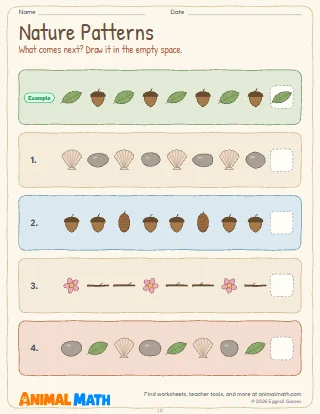
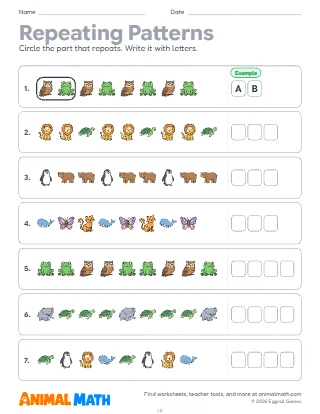
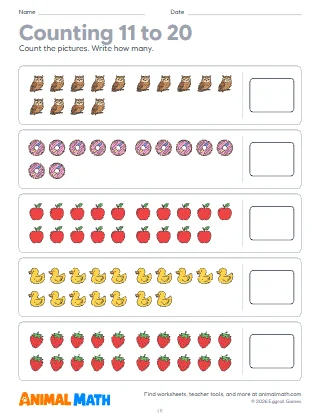
Five pages of Kindergarten and 1st grade patterns with beads. Page 1 shows six bead strips: children circle the bead that comes next. Page 2 asks them to circle the part of each strip that repeats and write how many beads are in it. Page 3 copies four patterns onto empty loom grids. Page 4 counts the beads of each kind on two loom designs. Page 5 finishes five rows so both sides of the dashed line match. The first problem on each page is a worked example. The beads are told apart by shape and shading (a dark round bead, a plain square bead and a dotted diamond bead), so the pages work in black and white.
Read the directions aloud and have children say each pattern as they point ("round, square, round, square"). Then string real beads, pasta or cereal on yarn to copy a pattern from the page. If you can, share work by a Native beadwork artist and talk about how artists plan a design before they bead it.
String beads, buttons or cereal on a piece of yarn to make a pattern, then ask your child to say the part that repeats and add the next three.
This pack supports the following Common Core State Standards for Mathematics:
© Copyright 2010. National Governors Association Center for Best Practices and Council of Chief State School Officers. All rights reserved.
Repeating patterns on bead strips and a loom bead grid, in simple designs of our own inspired by the beadwork many Native nations practice today. Students find the next bead, circle the part that repeats, copy a pattern onto a loom, count beads and finish rows that match like a mirror.
Tell us what to make next, or build your own with a worksheet maker.
This worksheet is free to download, print, copy, and hand out in your classroom or at home. You do not need to create an account, and there are no watermarks on the PDF.