Binary has only two digits, 0 and 1, and each place is worth two of the place on its right: 1, 2, 4, 8, 16 and so on. So adding works just like adding in base ten, except that you carry as soon as a column reaches two. 1 + 1 is two, written 10: write the 0 and carry the 1. Subtracting works the same way too: a 1 borrowed from the next place is worth two here. Computers add binary numbers like this billions of times a second, with tiny circuits that do one column at a time.
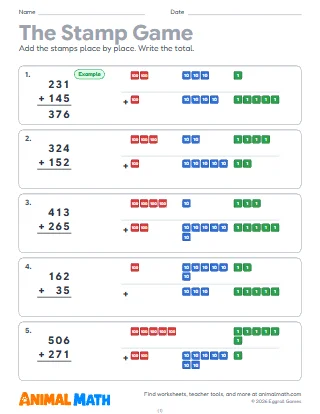
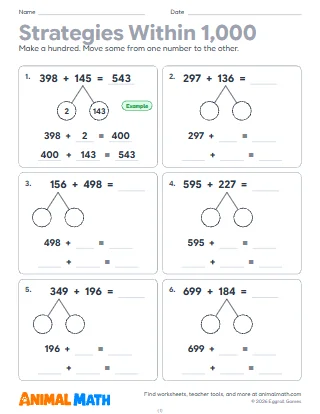
Seven pages of binary arithmetic, with the place values printed over every column. Page 1 starts with the binary addition facts and adds numbers whose 1s never meet, so there is nothing to carry; under each problem, students turn the numbers into base ten and check that the answer matches. Page 2 carries: 1 + 1 = 10, so write 0 and carry 1, using the small boxes over the columns. Page 3 adds columns with three 1s (1 + 1 + 1 = 11), and some answers grow to six digits. Page 4 subtracts with no borrowing, and page 5 borrows: when a column can't take 1 from 0, borrow from the next place, where a 1 is worth 10 (two) here. Page 6 gives six worked problems to mark right or wrong, and the wrong ones to fix. Page 7 is a magic trick: five cards of numbers that turn out to be the binary places. The first problem on each page is worked as an example.
Before page 2, do the same carry in base ten and in binary side by side: 5 + 5 = 10 means write 0, carry 1, and so does 1 + 1 in binary. On page 5, use the binary cards: borrowing a 2 card and trading it for two 1 cards is the same as writing 10 over the ones place. Page 7 is a good one to perform: let a student run the trick on the class, then ask why it works.
Do the magic trick on page 7 for the family, then explain it: each card is a binary place, and the first number on each card is that place's value. Try adding two small numbers both ways, in base ten and in binary, and see that they agree.
Column addition and subtraction in binary, the number system computers use, where 1 + 1 is written 10 and a borrowed 1 is worth two. Students add with and without carries, subtract with and without borrowing, check every answer in base ten, find the mistakes in worked problems and learn a magic number trick built on binary places.
Tell us what to make next, or build your own with a worksheet maker.
This worksheet is free to download, print, copy, and hand out in your classroom or at home. You do not need to create an account, and there are no watermarks on the PDF.