Five pages about putting solid shapes together. Page 1 starts with a worked example, then a block castle: students count its cubes, rectangular prisms, cylinders, cones, and pyramids and write each number in a table under a picture of the shape. Page 2 shows a tower and a bridge, each next to three sets of loose blocks, and students circle the set that built it. Page 3 asks whether six blocks can stack, roll, or both, then which block fits in the middle of a tower. On page 4 one block is gone from a build, and students circle the missing block. Page 5 counts the blocks in a rocket, a robot, and a bridge in a table and answers three questions about which build has the most or the fewest.
Put out real blocks before page 1 and build a small tower together, naming each block as it goes on. For page 2, build one of the sets and ask the class whether it matches the picture. Page 3 is best done with real blocks: try stacking and rolling each one, and try to put a block on top of a cone. On page 5, let partners build the rocket or the robot and count the blocks as they take it apart.
Build with whatever is in the kitchen: a box of crackers is a rectangular prism, a can is a cylinder, an orange is a sphere. Ask which ones you can stack into a tower and which ones roll away. Build something and count how many of each shape you used.
This pack supports the following Common Core State Standards for Mathematics:
© Copyright 2010. National Governors Association Center for Best Practices and Council of Chief State School Officers. All rights reserved.
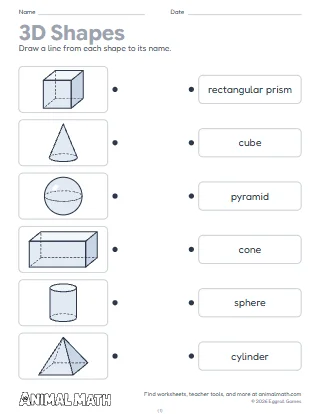
A 5-page 3D shapes pack for kindergarten and 1st grade about building with blocks. Count the cubes, rectangular prisms, cylinders, cones, and pyramids in a block castle, circle the set of loose blocks that made a build, and decide which blocks stack, which roll, and which one fits in the middle of a tower. Then find the block missing from a build, and count the blocks in a rocket, a robot, and a bridge to fill in a table and compare them. Every page comes in color and in black and white. Answer keys included.
Tell us what to make next, or build your own with a worksheet maker.
This worksheet is free to download, print, copy, and hand out in your classroom or at home. You do not need to create an account, and there are no watermarks on the PDF.