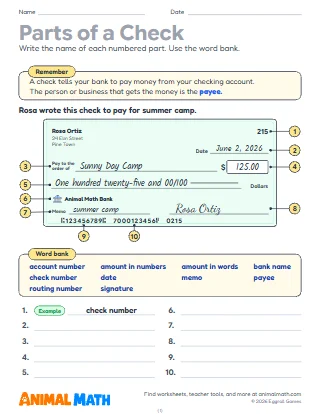
Five pages about the two accounts most families have. Page 1 explains that a checking account is for spending and paying (checks, a debit card, bills) and a savings account is for saving, where the bank pays interest. Students circle the account that fits eight uses, then match six bank words to what they mean. Page 2 is a month of a checking account statement: fill in the missing balances, then the account summary (starting balance + deposits − withdrawals = ending balance), and answer questions about the largest withdrawal, the debit card and the lowest balance. Page 3 follows a family's checking and savings accounts through a month of paychecks, buys and transfers: write both balances after every line, and notice that a transfer moves money without changing the total. Three short problems follow. Page 4 is simple interest: the bank pays a few dollars a year for every $100. Fill in balances year by year, compare a bank with a bonus to one with more interest (the better bank changes over time), and find how many years it takes to reach a goal. Page 5 is about fees: find what two accounts would cost four people in a month and circle the cheaper one, then solve three story problems about a monthly fee, ATM fees and an overdraft.
Before page 1, ask students where a family keeps money it will spend this week and money it will not need for a year. Show a real (blank) bank statement on the board before page 2 and find the summary box together. For page 3, act out a transfer with two jars of play money: the jars change, the total does not. Page 5 makes a good discussion about why it pays to read the fee rules before choosing an account.
If you have a bank statement or a banking app, look at a month together: find the deposits, the withdrawals and the balance. Talk about which of your accounts is for spending and which is for saving. If your child has savings, work out together what the interest would be in a year at your bank's rate.
This pack supports the following Common Core State Standards for Mathematics:
© Copyright 2010. National Governors Association Center for Best Practices and Council of Chief State School Officers. All rights reserved.
A 5-page banking pack for 4th and 5th grade. Learn what a checking account and a savings account are for, decide which account fits each use, and match six bank words to their meanings. Read a month of a checking account statement: fill in the missing balances, the account summary and the largest withdrawal. Follow a family's checking and savings through deposits, debit card buys and transfers, and see that a transfer does not change the total. Find simple interest year by year, compare two banks and count the years to a savings goal, then work out monthly fees, ATM fees and an overdraft, and choose the account that costs less. Every page comes in color and in black and white. Answer keys included.
Tell us what to make next, or build your own with a worksheet maker.
This worksheet is free to download, print, copy, and hand out in your classroom or at home. You do not need to create an account, and there are no watermarks on the PDF.