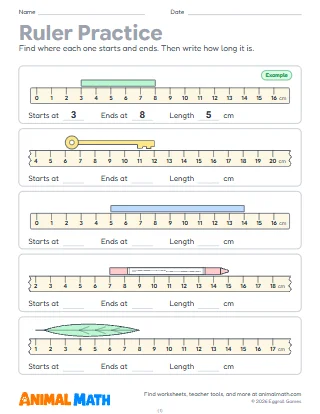
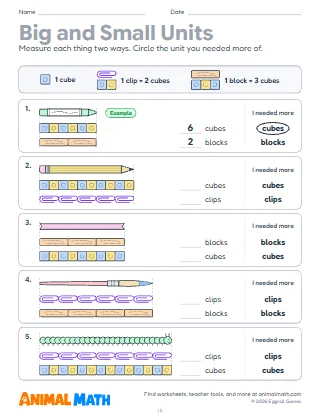
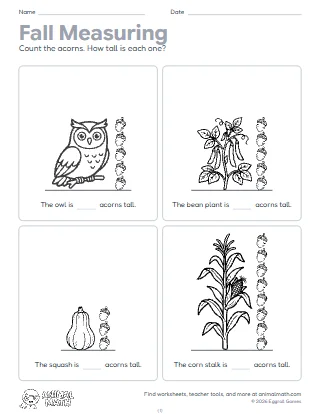
Five pages about comparing lengths, for 1st grade. Every cube in the pack is the same size, and every thing is a whole number of cubes long, so each count comes out exact. On page 1 two things lie side by side with their ends lined up at a dashed start line; students circle the longer one in the top half and the shorter one in the bottom half. On page 2 three things start at the same line, and students write 1, 2, 3 from shortest to longest, then from longest to shortest (the heading and a label say which). Page 3 compares two things that are never side by side: each one is held next to the same string, the sentences say which is longer, and students circle the answer. Page 4 has a cube train under each thing, starting at its end with no gaps; students count and write how many cubes long it is, then compare two lined-up things and count how many cubes longer one is. Page 5 puts it all together: measure three things, order them from shortest to longest, and find how many cubes longer the longest is than the shortest.
Before page 1, hold up two pencils with one end lower than the other and ask which is longer; then line the ends up on the table and ask again. For page 3, act it out: hold a piece of yarn next to a book and then next to the door, and ask how the yarn helps when the two cannot be put side by side. Linking cubes on every table make pages 4 and 5 concrete: build a train as long as a pencil and count it.
Line up three spoons, three shoes or three toys and put them in order from shortest to longest. Cut a piece of string as long as the couch and ask: is the table longer or shorter than the string? So is the table longer or shorter than the couch?
This pack supports the following Common Core State Standards for Mathematics:
© Copyright 2010. National Governors Association Center for Best Practices and Council of Chief State School Officers. All rights reserved.
A 5-page length pack for 1st grade. Circle the longer one, then the shorter one, of two things lined up at a start line. Write 1, 2, 3 to put three things in order, from shortest to longest and then from longest to shortest. Use a string to compare two things that are not side by side: if the snake is longer than the string and the string is longer than the worm, the snake is longer than the worm. Count the cubes under each thing to tell how long it is and how many cubes longer one is. Then measure three things, put them in order and find how much longer the longest one is. Every page comes in color and in black and white. Answer keys included.
Tell us what to make next, or build your own with a worksheet maker.
This worksheet is free to download, print, copy, and hand out in your classroom or at home. You do not need to create an account, and there are no watermarks on the PDF.