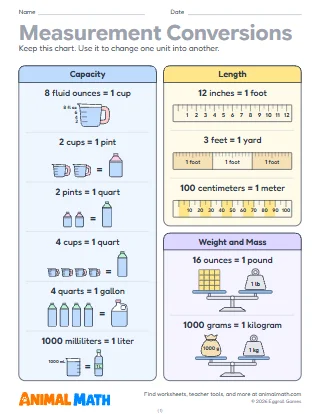
Five pages about measuring in the kitchen. Page 1 starts with a reminder of the tools (teaspoon and tablespoon, the 1/4, 1/3, 1/2 and 1 cup dry measures, and the liquid measuring cup): students number four amounts from least to most, then circle the best tool for an amount, such as a dry cup for flour and the liquid cup for milk. On page 2 students read four glass measuring cups, marked in quarter cups or third cups, and write the amount as a fraction or a mixed number (the first is done as an example), then color four cups up to an amount. Page 3 has a kitchen equivalents chart (3 teaspoons = 1 tablespoon, 16 tablespoons = 1 cup, 8 fluid ounces = 1 cup and more): students complete four conversion tables and compare eight pairs of amounts with >, < or =. Page 4 adds scoops (1/2 cup and 1/4 cup make 3/4 cup) and finds the fewest scoops that measure an amount. Page 5 has six kitchen word problems. Most sections start with a worked example.
Bring a set of measuring spoons, dry measuring cups and a liquid measuring cup. Before page 1, pass the tools around and ask which holds the most and the least. Before page 2, pour water into a glass measuring cup and read it together at eye level. For page 4, use rice or dried beans: fill a 1/2 cup and a 1/4 cup and pour both into a 1 cup measure to see that they make 3/4 cup.
Cook or bake something simple together and let your child do the measuring. Ask which spoon or cup to use for each ingredient, and why flour is leveled off but milk is poured to a line. Count how many teaspoons fill a tablespoon, or how many 1/4 cups fill a whole cup.
This pack supports the following Common Core State Standards for Mathematics:
© Copyright 2010. National Governors Association Center for Best Practices and Council of Chief State School Officers. All rights reserved.
A 5-page kitchen measuring pack for 3rd and 4th grade. Meet the measuring spoons, the dry measuring cups and the liquid measuring cup, put amounts in order from least to most, and circle the best tool for an amount. Read glass measuring cups marked in quarter and third cups, then color cups to an amount. Use a kitchen equivalents chart to complete conversion tables from teaspoons to quarts and compare amounts, add scoops like 1/2 cup and 1/4 cup, find the fewest scoops for an amount, and solve six kitchen word problems. Every page comes in color and in black and white. Answer keys included.
Tell us what to make next, or build your own with a worksheet maker.
This worksheet is free to download, print, copy, and hand out in your classroom or at home. You do not need to create an account, and there are no watermarks on the PDF.