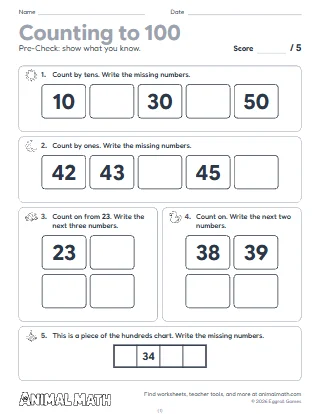
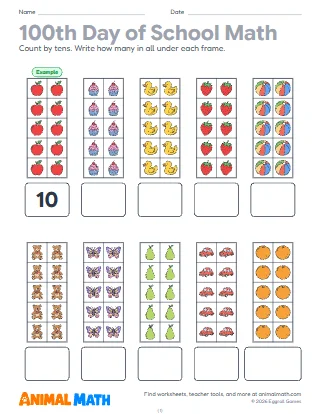
Five pages of counting on. Page 1 starts with a group a child does not need to count: a full ten frame is 10, two full frames are 20, a die shows its dots, and a bag has its number written on it. Children say that number and count on the pictures beside it, then write how many. Page 2 has number trains within 30: the first car shows where to start and children write the next three numbers. Page 3 counts over a ten, from 20 to 100, the place where many children get stuck (after 29 comes 30). Page 4 has pieces of the hundreds chart with the first number of each row given. Page 5 has number paths that snake back and forth, the last one ending at 100. Each page starts with a worked example.
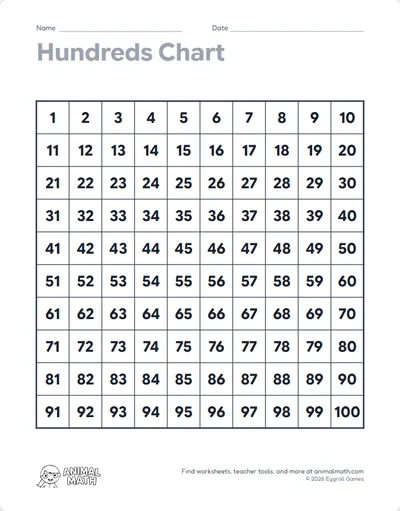
Put 10 counters in a cup, write 10 on it, and add a few more beside it. Ask the class to count on from 10 without tipping out the cup. Practice the hard spots out loud: 29, 30; 49, 50; 99, 100. Point along a hundreds chart as you count and show that each row ends with a ten. Read each page's directions aloud and do the example together.
Count on while you play: roll a die, say its number, then count on a few steps. Start counting at a number your child picks, like 37, and take turns saying the next number. Count to 100 together and listen for the jump to a new ten.
This pack supports the following Common Core State Standards for Mathematics:
© Copyright 2010. National Governors Association Center for Best Practices and Council of Chief State School Officers. All rights reserved.
Counting forward from a given number instead of starting at 1, and counting over each ten on the way to 100. Students count on from a full ten frame or a number on a bag, fill in number trains and pieces of the hundreds chart, and follow number paths past 30, 40 and on to 100.
Tell us what to make next, or build your own with a worksheet maker.
This worksheet is free to download, print, copy, and hand out in your classroom or at home. You do not need to create an account, and there are no watermarks on the PDF.