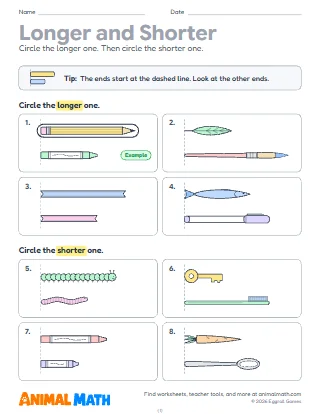
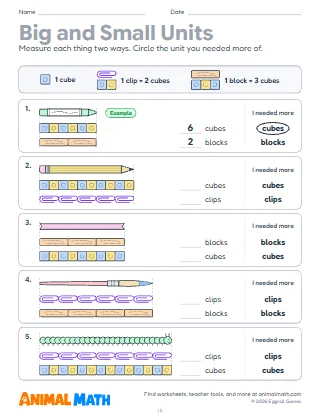
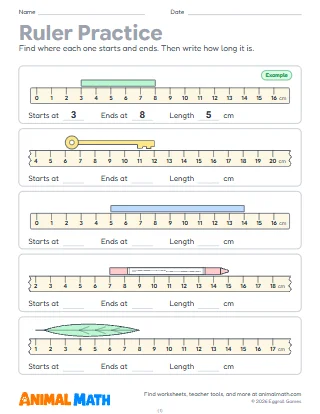
Five pages of measuring with real pieces instead of a printed ruler. Every page has a strip of one unit to cut apart, printed at true size: ladybugs on page 1, paper clips on page 2, cubes on page 3, blocks on page 4 and buttons on page 5. Each thing to measure starts at a green start flag and has a dashed lane under it. Students cut out the pieces, line them up in the lane from the start line, touching and not overlapping, and write how many long it is. Page 1 begins with three small pictures of the right way and two wrong ways (gaps, and pieces on top of each other), and a worked example. Page 4 measures height: students stack blocks from the ground up beside a giraffe, a sunflower and a nesting doll. Page 5 turns it around: line up 4 or 6 buttons and draw a worm that long, then measure two things and circle the longer one. Every picture is drawn a whole number of units long, so the pieces fit exactly.
Show the three pictures at the top of page 1 on the board and ask what went wrong in the second and third. Then model the example: start at the green line, put each ladybug right up against the one before it, and count. Keep each student's cut pieces in an envelope or a zip bag so they last for the whole page. Partners can check each other: are the pieces touching? Did you start at the line?
Cut out the strip together and talk about what to measure first. After the page, measure real things the same way: a spoon in paper clips, a shoe in crayons, a book in blocks. Ask your child to guess first, then measure.
This pack supports the following Common Core State Standards for Mathematics:
© Copyright 2010. National Governors Association Center for Best Practices and Council of Chief State School Officers. All rights reserved.
A 5-page cut-and-measure pack for kindergarten and 1st grade. Each page has its own unit to cut apart, printed at true size: ladybugs, paper clips, cubes, blocks and buttons. Students line the pieces up from a green start line, touching and not overlapping, and count how many long a caterpillar, a pencil or a toy train is, stack blocks to find how tall a giraffe is, make a worm 4 buttons long, and measure two things to find the longer one. Every picture is a whole number of units long. Every page comes in color and in black and white. Answer keys included.
Tell us what to make next, or build your own with a worksheet maker.
This worksheet is free to download, print, copy, and hand out in your classroom or at home. You do not need to create an account, and there are no watermarks on the PDF.