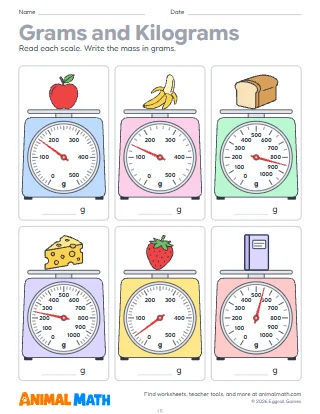
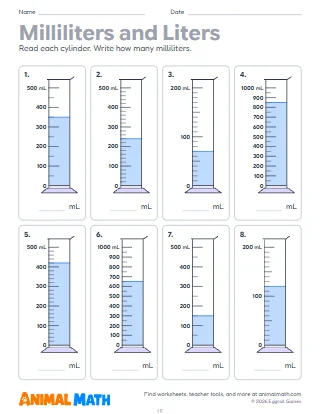
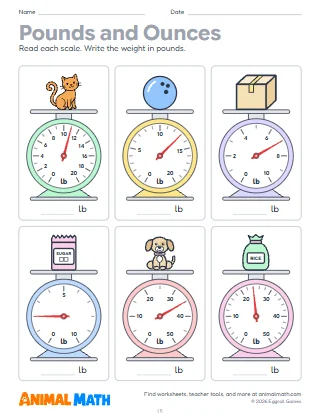
Five pages on estimating and measuring. Page 1 shows eight benchmarks (1 mm is about the thickness of a dime, 1 kg about the mass of a pineapple, 1 mL about 20 drops of water), circles the best unit for eight things from a ladybug to a train trip, and writes the missing unit in eight sentences such as "A juice box holds 200 ___." Page 2 estimates the length of five things in centimeters, then measures each on a real-size centimeter ruler to the nearest centimeter and to the nearest millimeter, and uses the lengths in two questions. Page 3 does the same in inches, to the nearest 1/8 inch and then to the nearest 1/16 inch, and finds a difference in sixteenths. Page 4 reads two dial scales (grams and kilograms) and two containers (milliliters and liters), estimating each to the nearest printed number first, then solves six story problems with the amounts. Page 5 estimates the perimeters of three polygons by rounding their sides, estimates the perimeters of a circle, an arch and a half circle on a centimeter grid (with a printed ruler for the string), and explains why an estimate of 20 cm for the circle is not reasonable.
Hand out paper clips, a liter bottle and a meter stick before page 1 and let students hold each benchmark. On pages 2 and 3, have students cover the rulers with an index card while they estimate, then compare estimates with a partner before measuring. For page 5, give each pair a piece of string to lay along the curves, then measure the string on the printed ruler.
Ask your child to guess the length of a spoon, the mass of a bag of rice or the amount in a water bottle, then check with a ruler, a kitchen scale or the label. Talk about which unit makes sense: would you measure a road trip in meters or kilometers?
This pack supports the following Common Core State Standards for Mathematics:
© Copyright 2010. National Governors Association Center for Best Practices and Council of Chief State School Officers. All rights reserved.
A 5-page measurement pack for 5th grade. Choose the best metric unit for lengths, masses and liquid volumes, from millimeters to kilometers, with benchmarks such as a paper clip for 1 gram, and write the right unit in story sentences. Estimate, then measure objects on real-size rulers to the nearest centimeter and millimeter and to the nearest 1/8 and 1/16 inch. Read dial scales in grams and kilograms and containers in milliliters and liters, then solve story problems with the amounts. Estimate the perimeter of polygons by rounding each side and of shapes with curves on a centimeter grid, and explain why an estimate is reasonable. Every page comes in color and in black and white. Answer keys included.
Tell us what to make next, or build your own with a worksheet maker.
This worksheet is free to download, print, copy, and hand out in your classroom or at home. You do not need to create an account, and there are no watermarks on the PDF.