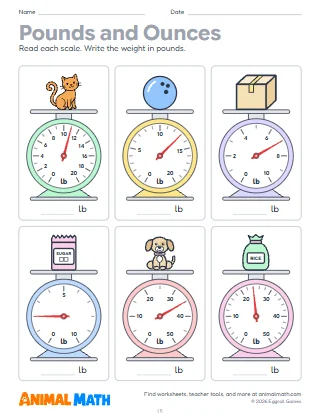
Five pages about measuring mass with a kitchen scale. On page 1 students read six dial scales in grams, where the numbers go up by 100 and the small ticks count by 10, 20 or 50. Page 2 reads heavier things in whole kilograms, on dials that count by 1s, 2s and 5s. On page 3 the scales have no pointer: students draw it to show the mass written underneath. Page 4 circles grams or kilograms for twelve pictured things, then the best estimate for four more. Page 5 has six one-step word problems that add, subtract, multiply and divide masses.
Pass around a paper clip (about 1 gram) and a 1-liter bottle of water (about 1 kilogram) before page 1, so the two units have a feel. Read one dial together first: find the numbers on each side of the pointer, then count the small ticks between them. On page 3, ask partners to check each other's pointers.
Look at the labels on food in the kitchen: a box of pasta, a bag of rice, a can of beans. Is the mass in grams or kilograms? If you have a kitchen scale, weigh a few pieces of fruit and read the dial together.
This pack supports the following Common Core State Standards for Mathematics:
© Copyright 2010. National Governors Association Center for Best Practices and Council of Chief State School Officers. All rights reserved.
A 5-page mass pack for 3rd grade. Read dial scales in grams and in kilograms, draw the pointer on a scale to show a mass, circle grams or kilograms for twelve everyday things and pick the best estimate, and solve one-step mass word problems with all four operations. Every page comes in color and in black and white. Answer keys included.
Tell us what to make next, or build your own with a worksheet maker.
This worksheet is free to download, print, copy, and hand out in your classroom or at home. You do not need to create an account, and there are no watermarks on the PDF.