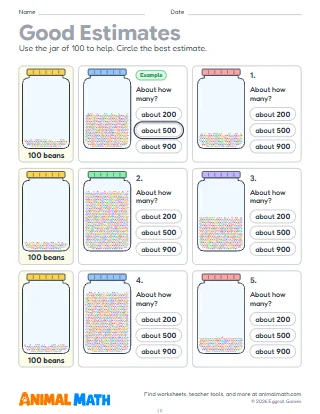
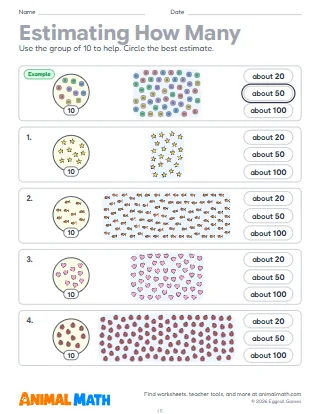
Five pages on estimating amounts under 1,000 with a referent: an amount you already know. On page 1 each row has a box of 50 dots beside a bigger set of the same dots; students think about how many boxes would fit and circle the best of three estimates. Page 2 has jars of jelly beans: the same jar holding a known number, or one jar filled to its 1/4 or 1/2 mark. Page 3 uses everyday referents: a stack of 100 sheets of paper, one shelf of about 30 books and one row of seats. On page 4 students write their own estimate with a box of 100 or 25 dots, then decide whether a friend’s estimate is too low, about right or too high. On page 5 one group of 25 or 50 dots is looped inside the set: students estimate how many groups there are, then how many dots in all. The first problem on each page is done as an example, and the keys show how each estimate was found.
Fill a small cup with 50 cubes or beans and count them together: this is your referent. Then show a bigger container and ask how many cups it would take to fill it. Write every estimate on the board and talk about which ones are reasonable and why. Count the big container afterwards in groups of 10 to check.
Count out 100 pieces of dry pasta or cereal into a cup with your child. Then estimate how many are in the whole box: about how many cups would it fill? Do the same with a stack of 100 sheets of paper and a full pack, or the books on one shelf and a whole bookcase.
This pack supports the following Common Core State Standards for Mathematics:
© Copyright 2010. National Governors Association Center for Best Practices and Council of Chief State School Officers. All rights reserved.
Estimating big amounts by comparing them with an amount you already know. Students use boxes of 25, 50 and 100 dots, jars of beans, stacks of paper, shelves of books and rows of seats to choose and write estimates, and judge whether other estimates are too low, about right or too high.
Tell us what to make next, or build your own with a worksheet maker.
This worksheet is free to download, print, copy, and hand out in your classroom or at home. You do not need to create an account, and there are no watermarks on the PDF.