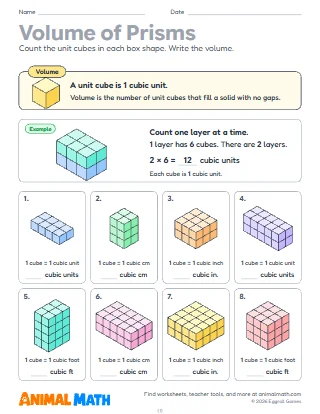
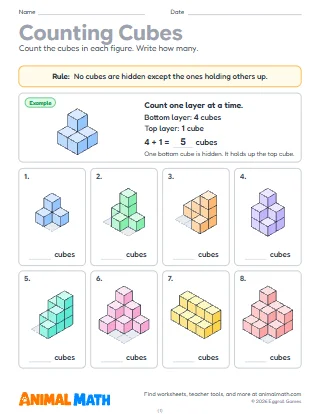
Five pages on solid figures. Page 1 names six solids from drawings and six from everyday objects (a number cube, a cereal box, a tent, a can, a party hat and a globe), using a word bank. Page 2 defines face, edge, vertex, base and apex on two labeled pictures, fills a table with the faces, edges and vertices of six solids and the shapes of their faces, and sorts nine solids into prisms, pyramids and solids with a curved surface. Page 3 compares a square with a cube, a rectangle with a rectangular prism and a triangle with a square pyramid (sides, angles, vertices, faces and edges), checks which of two solids each fact is true for, and says how a cube and a rectangular prism are alike and different. Page 4 matches four nets to their solids (one net is left over), circles the six-square patterns that fold into a cube, and draws a net of a box on a grid. Page 5 counts the unit cubes in box shapes layer by layer, finds how many cubes fill two clear boxes and how many more are needed, and builds two different boxes from 12 cubes.
Pass around real objects before page 1: a number cube, a cereal box, a can, a ball, a party hat. Have students touch a face, run a finger along an edge and point to a vertex. For page 4, print a few nets on card stock, cut them out and fold them: the patterns that do not fold into a cube are the best part of the lesson. Page 5 goes well with connecting cubes.
Go on a solid figure hunt in the kitchen: a box of crackers, a can of soup, an orange, a funnel. Ask your child to name each solid and count its faces, edges and vertices. Open a small box flat to see its net.
This pack supports the following Common Core State Standards for Mathematics:
© Copyright 2010. National Governors Association Center for Best Practices and Council of Chief State School Officers. All rights reserved.
A 5-page solid figures pack for 4th and 5th grade. Name cubes, rectangular prisms, triangular prisms, square pyramids, cylinders, cones and spheres from drawings and from everyday objects such as a cereal box, a tent and a globe. Count the faces, edges and vertices of each solid, name the shapes of its faces, and sort solids into prisms, pyramids and solids with a curved surface. Compare a square with a cube and a triangle with a pyramid, check what two solids have in common, match nets to solids, find the nets that fold into a cube, draw a net on a grid, and count the unit cubes that fill a box layer by layer. Every page comes in color and in black and white. Answer keys included.
Tell us what to make next, or build your own with a worksheet maker.
This worksheet is free to download, print, copy, and hand out in your classroom or at home. You do not need to create an account, and there are no watermarks on the PDF.