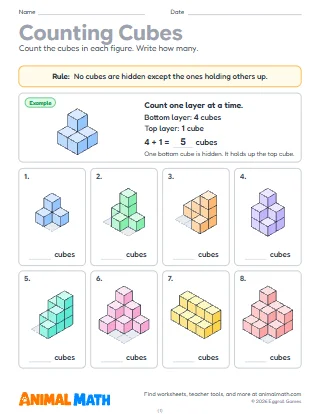
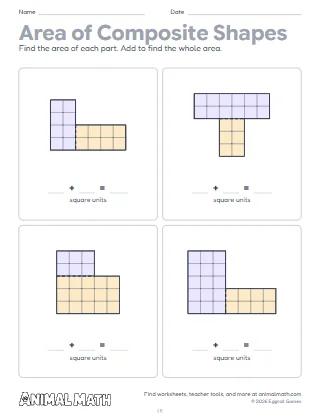
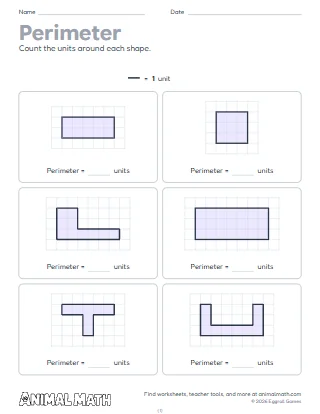
Five pages on the volume of rectangular prisms. Page 1 defines a unit cube and volume, works one box shape layer by layer, and asks for the volume of eight box shapes in cubic units, cubic centimeters, cubic inches, and cubic feet. Page 2 shows four clear boxes with some cubes inside: students find the cubes in the bottom layer, the number of layers, and the volume. Page 3 gives prisms with labeled edges for V = l × w × h, prisms with the area of the base for V = B × h, and two prisms with a missing edge. Page 4 joins two box shapes: first made of unit cubes to count in two parts, then solids with labeled edges, where students find the volume of each part and add. Page 5 has six story problems (a cereal box, a fish tank, a sandbox, a missing height), six situations to match with perimeter, area, or volume, and a row of boxes to circle when their volume is 24 cubic units.
Fill a small box with connecting cubes before page 1 and count them two ways: one at a time and as layers. On page 2, connect the bottom layer to the area of the base: l × w cubes in a layer, h layers. Before page 4, build an L shape from two box shapes and let students split it in different ways; the total volume stays the same.
Measure a cereal box or a shoe box with a ruler, rounding to whole inches, and multiply to find its volume. Ask which holds more, and check by filling both with rice or dried beans.
This pack supports the following Common Core State Standards for Mathematics:
© Copyright 2010. National Governors Association Center for Best Practices and Council of Chief State School Officers. All rights reserved.
A 5-page volume pack for 5th grade. Count unit cubes in cubic units, centimeters, inches, and feet, fill clear boxes layer by layer, and find volume with V = l × w × h and V = B × h. Find a missing edge, add the volumes of two prisms joined together, solve story problems about boxes, tanks, and sandboxes, choose perimeter, area, or volume, and find boxes with the same volume. Every page comes in color and in black and white. Answer keys included.
Tell us what to make next, or build your own with a worksheet maker.
This worksheet is free to download, print, copy, and hand out in your classroom or at home. You do not need to create an account, and there are no watermarks on the PDF.