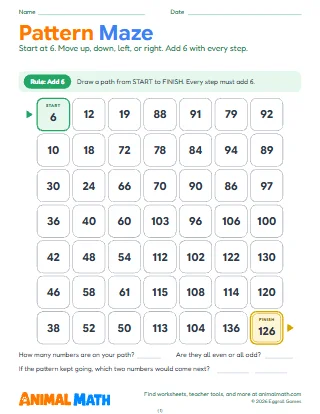
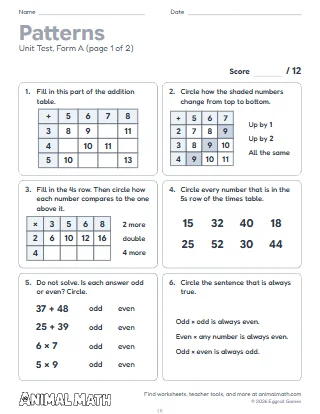
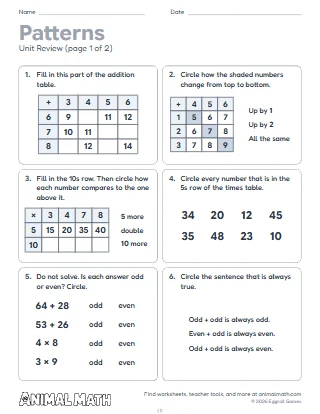
Fibonacci Day is November 23, because 11/23 shows the first four numbers of the Fibonacci sequence: 1, 1, 2, 3. The sequence is named for Leonardo of Pisa, known today as Fibonacci, whose book Liber Abaci (1202) helped bring the numerals we use to Europe and included a puzzle about rabbits whose answer is this sequence. Each number is the two before it added together, and the same numbers turn up in the square spiral, in counting the ways to climb stairs, and often in the petals and seed spirals of plants.
Six pages for Fibonacci Day. Page 1 shows how the sequence grows, then asks students to fill in missing numbers: rows 1 to 4 by adding the two numbers before, rows 5 to 7 by working backward and taking away. Page 2 uses the same rule with other starting numbers, including a row that is ten times the sequence and one the student makes up, then marks each Fibonacci number odd or even and uses the odd, odd, even pattern to tell whether the 30th and 31st numbers are odd or even. On page 3 students draw the 13 by 13 square of the Fibonacci spiral on grid paper and fill in a table of each square's area and each rectangle's sides, area and perimeter. Page 4 is a rabbit puzzle like the one in Fibonacci's book, worked month by month in a table. Page 5 lists every way to climb 2, 4 and 5 stairs taking 1 or 2 at a time, and finds the Fibonacci numbers in the counts. Page 6 counts the petals on six flowers, finds dates whose month and day are next to each other in the sequence, and circles Fibonacci numbers in a list. Every page starts with a worked example.
Write 1, 1 on the board on November 23 and let the class build the sequence together, saying each sum aloud. Pages 1, 2, 4 and 6 suit 3rd grade; pages 3 and 5 stretch 4th and 5th graders with area, perimeter and organized lists. Before page 5, have a few students act out the stairs at the front of the room, stepping 1 or 2 floor tiles at a time, and record each way on the board.
Look for Fibonacci numbers around the house and outside: count the petals on flowers, the sections of a fruit, or the spirals on a pinecone or a pineapple. Then take turns saying the next number of the sequence, adding the two before, and see how far you can go.
Number patterns for Fibonacci Day on November 23, built on the sequence 1, 1, 2, 3, 5, 8, where every number is the two before it added together. Students fill in the sequence forward and backward, try other starting numbers, draw the square spiral on grid paper, solve a rabbit puzzle like Fibonacci's, count the ways to climb stairs and look for Fibonacci numbers in flowers and dates.
Tell us what to make next, or build your own with a worksheet maker.
This worksheet is free to download, print, copy, and hand out in your classroom or at home. You do not need to create an account, and there are no watermarks on the PDF.