Loading preview...

Features

  • Add and subtract fractions with unlike denominators on tape diagrams
  • Estimate with 0, 1/2 and 1, or with whole numbers, before solving
  • Mixed number stories that join, take away and compare, trading a whole when needed
  • A fraction of a whole number, a fraction of a fraction and mixed numbers on tape diagrams and area models
  • Divide a unit fraction by a whole number and a whole number by a unit fraction
  • Sharing stories where a fraction is a division
  • Stories in two steps, and choosing the equation that fits a story
  • Every page in color and in black and white
  • Answer keys included

Skills Covered

  • Add and subtract fractions with unlike denominators in story problems
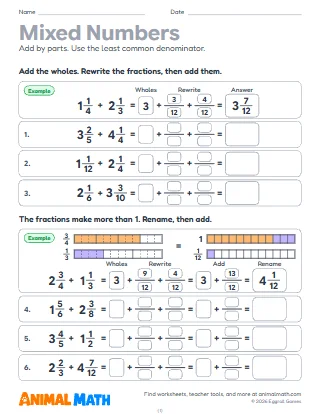
  • Add and subtract mixed numbers in stories, trading a whole when needed
  • Estimate with benchmark fractions and whole numbers to check an answer
  • Multiply fractions, whole numbers and mixed numbers in stories
  • Divide with unit fractions in stories, and read a fraction as a division
  • Solve fraction stories in two steps and choose the equation that fits

How to Use This Pack

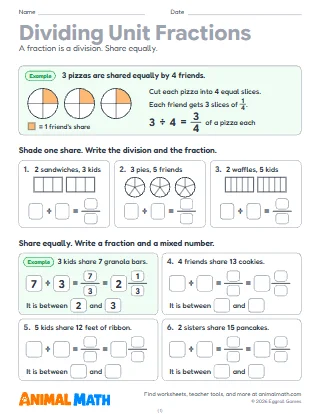
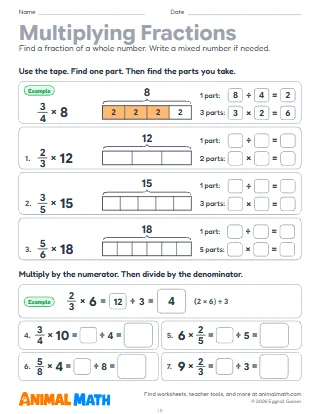
Five pages of fraction story problems, each page starting with a worked example. Page 1 adds and subtracts fractions with unlike denominators on tape diagrams: students estimate with 0, 1/2 and 1 (5/6 + 3/8 is about 1 + 1/2), write an equation and give the answer in simplest form or as a mixed number. Page 2 adds and subtracts mixed numbers in stories that join, take away and compare; students round to whole numbers first, then rename the fractions, trade a whole when they need to, and show their work. Page 3 multiplies: a fraction of a whole number on a tape diagram (2/5 of 30 books), a fraction of a fraction on an area model, and mixed numbers with partial products (a poster 3 1/2 feet by 2 2/3 feet). Page 4 divides a unit fraction by a whole number on an area model and a whole number by a unit fraction on a number line, then shares wholes equally: 5 sandwiches for 6 friends is 5 ÷ 6, or 5/6 of a sandwich each. Page 5 has stories in two steps that mix the operations, and stories with three equations to choose from. The keys write one equation for each story; others can be right too.

In the Classroom

Read a story aloud and ask what the whole is before anyone computes: is it 3/4 of the yard, or 3/4 of the grass? Have pairs sketch the model on a whiteboard and estimate before they solve, then compare the answer with the estimate. For page 5, ask students to explain why the other two equations do not fit the story.

At Home

Look for fractions in everyday plans: 3/4 hour of practice and 2/3 hour of reading, part of a bag of rice, a 1/4 cup scoop for 3 cups of flour. Ask your child to estimate first, then work it out and check that the answer makes sense.

Tips for Success

  • Find the whole first: the model and the equation both start from it
  • Estimate before solving, then check that the answer is close to the estimate
  • Add or subtract with a common denominator; the least one keeps the numbers small
  • A fraction of an amount means multiply: 2/5 of 30 is 2/5 × 30
  • Sharing is dividing: 5 things shared by 6 people is 5 ÷ 6, or 5/6 each

Common Core Standards Alignment

This pack supports the following Common Core State Standards for Mathematics:

  • 5.NF.A.1 Add and subtract fractions and mixed numbers with unlike denominators by rewriting them as equivalent fractions with a common denominator.
  • 5.NF.A.2 Solve story problems that add or subtract fractions of one whole, unlike denominators included, and check that answers make sense with benchmark fractions and estimating.
  • 5.NF.B.3 Understand a fraction as division, such as 2/5 = 2 ÷ 5, and solve sharing story problems with fraction or mixed-number answers.
  • 5.NF.B.4a Multiply a whole number or fraction by a fraction, seeing (3/4) × 2 as 3 of the 4 equal parts of 2, using models.
  • 5.NF.B.4b Tile a rectangle with fraction side lengths using squares whose sides are unit fractions, and see the area equals the two sides multiplied.
  • 5.NF.B.5a Without multiplying, tell how the size of a product compares to one factor by looking at the size of the other factor.
  • 5.NF.B.5b Explain why multiplying by a fraction above 1 makes a number bigger and below 1 makes it smaller; see equivalent fractions as multiplying by 1.
  • 5.NF.B.6 Solve real-life problems that multiply fractions and mixed numbers, using fraction models or equations.
  • 5.NF.B.7a Divide a unit fraction by a whole number, such as (1/2) ÷ 3 = 1/6, using models and stories, and check by multiplying.
  • 5.NF.B.7b Find how many unit fractions fit in a whole number, such as 3 ÷ (1/4) = 12, using models and stories, and check by multiplying.
  • 5.NF.B.7c Solve real-life problems that divide unit fractions by whole numbers or whole numbers by unit fractions, like how many 1/4-cup scoops fill 3 cups.
  • 5.MD.B.2 Make a line plot of measurements in halves, quarters and eighths, and solve problems from it with fraction operations, like sharing a total equally.

© Copyright 2010. National Governors Association Center for Best Practices and Council of Chief State School Officers. All rights reserved.

Fraction Word Problems for 5th Grade

5th Grade

Story problems that add and subtract fractions and mixed numbers with unlike denominators, multiply fractions and mixed numbers, and divide with unit fractions. Students show each story with a tape diagram, an area model or a number line, estimate first, write an equation and give the answer in simplest form.

Download PDF
Pin

What’s Included

  • 5 worksheets in color and in black and white, with answer keys (15 pages)
  • 27 story problems and 6 worked examples
  • Tape diagrams, area models and number lines for every operation
  • Estimates, equations, stories in two steps and choosing the equation
Can’t find what you need?

Tell us what to make next, or build your own with a worksheet maker.

Suggest a worksheet

Free to print and share

This worksheet is free to download, print, copy, and hand out in your classroom or at home. You do not need to create an account, and there are no watermarks on the PDF.