A meteor, or shooting star, is a tiny bit of rock that burns up as it races into the air high above us, leaving a quick streak of light. Every December the Earth passes through a trail of bits left by an asteroid called 3200 Phaethon, and we see the Geminid meteor shower. In 2026 it is best on the night of December 13 to 14, from about 9 p.m. until dawn, and the moon is only a thin crescent that sets early, so the sky stays dark. The meteors all seem to come from one place in the sky, near the stars of Gemini, the Twins. Under a perfectly dark sky you might see up to about 120 an hour; in a town with lights you will see far fewer.
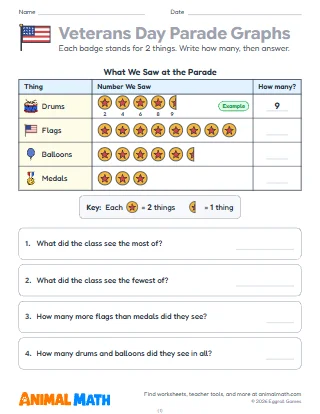
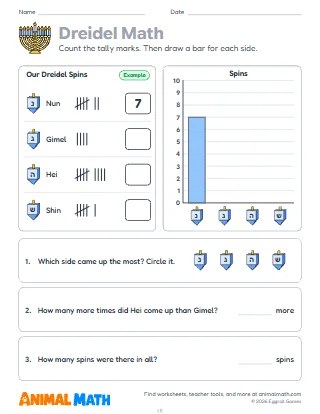
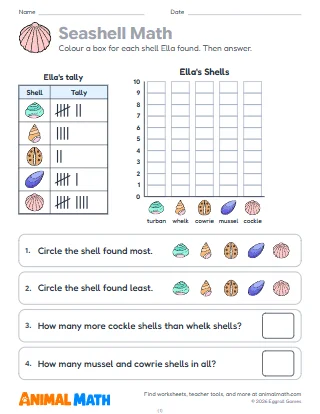
Six pages about a night of watching the Geminids. On page 1 students count the meteors in four pictures of the sky, one for each hour of the night, and write the number and the tally marks; the first picture is worked as an example, and two questions ask which hour had the most and how many more. Page 2 is a tally chart of the meteors Mia saw on five nights in December: students draw a bar for each night on a graph that counts by 1s (the first bar is done) and answer four questions. Page 3 is a picture graph where each meteor stands for 2, comparing what watchers saw in 15 minutes in the city, in a town, on a farm and in the mountains, with a question about why the city sees the fewest. Page 4 is a bar graph that counts by 5 of a star club's night, from 9 p.m. to 2 a.m. Page 5 has a time line from 8 p.m. to 3 a.m. and pairs of clocks: write the start and end times and how long each family watched, across midnight. Page 6 is six meteor stories.
Before page 1, show a photo or video of a meteor and talk about the tail: a star stays still, a meteor streaks. Count the first picture together, making a tally mark and crossing off each meteor. Page 3 is a good start for a talk about light pollution: why would the city see the fewest? On page 5, walk a finger along the time line past midnight, saying the hours aloud, before students count on their own.
On the night of December 13, go outside after dark with a warm drink and a blanket. Let your eyes get used to the dark for 15 minutes, then make a tally mark for every meteor you see. Look at the clock when you start and when you go in, and work out together how long you watched.
This pack supports the following Common Core State Standards for Mathematics:
© Copyright 2010. National Governors Association Center for Best Practices and Council of Chief State School Officers. All rights reserved.
Math for the Geminid meteor shower, one of the best meteor showers of the year, on a night of watching the sky. Students count meteors into tally charts, make and read bar graphs and a picture graph, find how long a family watched across midnight and solve meteor stories.
Tell us what to make next, or build your own with a worksheet maker.
This worksheet is free to download, print, copy, and hand out in your classroom or at home. You do not need to create an account, and there are no watermarks on the PDF.