A seashell was once the home of a sea animal. Snails such as whelks, cowries and augers grow one shell that twists round into a spiral as the animal grows, while cockles, mussels and scallops grow two flat halves joined by a hinge, so the half you find on the sand has no spiral. Many beaches ask visitors to leave shells where they are, and a shell with an animal still living in it, like a hermit crab, always goes back on the sand.
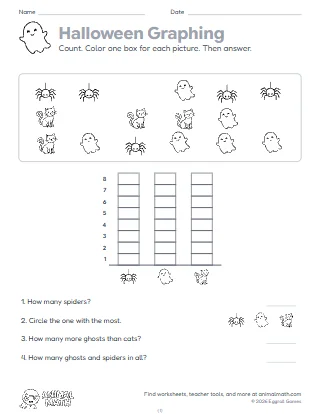
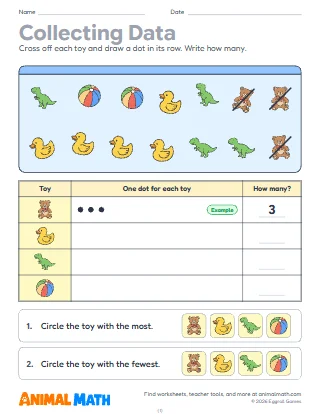
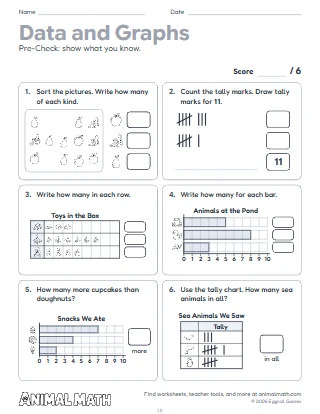
Six pages of shells from the beach. Page 1 gives Ella's tally chart: children colour one box in the bar graph for each shell, circle the shell found most and least, and answer two questions. On page 2 children count four kinds of shell in a beach scene, make a tally mark for each one and write the totals. Page 3 sorts the shells into those that twist into a spiral and those with no spiral, then asks how many in all and how many more. On page 4 children measure shells with centimetre rulers printed at real size. Page 5 shows shells in ten frames: each full frame is ten, so children write the tens, the ones and the number. Page 6 is six short shell stories. The first problem on pages 4 and 5 is worked as an example.
Bring in a basket of shells, or pictures of them, and let children sort them their own way before page 2: by size, by colour or by shape. Print page 4 at 100% (actual size) so the rulers measure true centimetres, and check one shell with a real ruler. Before page 6, talk about why we leave a shell on the beach when an animal still lives in it.
On a trip to the beach, count the shells you see together and make tally marks in the sand. Sort a handful into spiral and no spiral, line them up from shortest to longest, and then leave them where you found them.
Summer maths with the shells children find on the beach: whelks, cockles, cowries, sand dollars and more. Children turn a tally chart into a bar graph, count and tally shells, sort them into spiral and no spiral, measure shells in centimetres, count shells in tens and solve shell stories.
Tell us what to make next, or build your own with a worksheet maker.
This worksheet is free to download, print, copy, and hand out in your classroom or at home. You do not need to create an account, and there are no watermarks on the PDF.