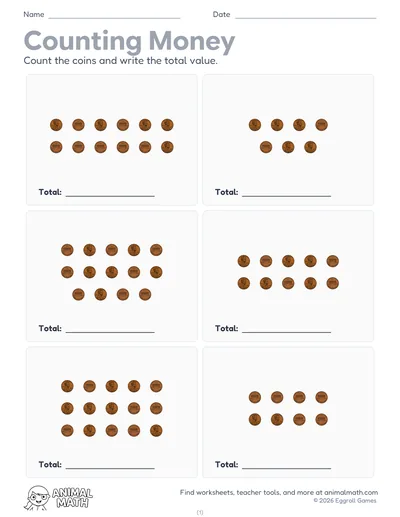
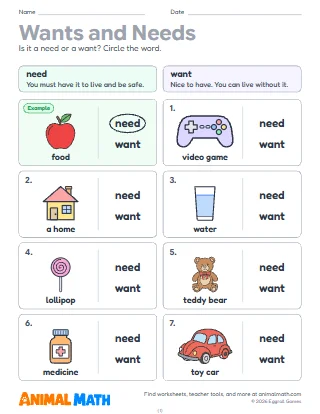
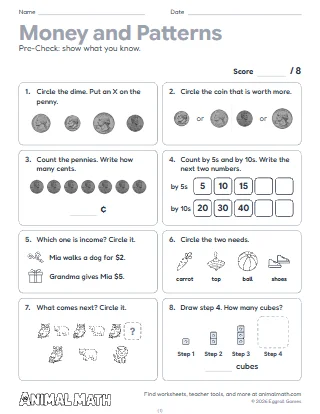
Five pages about how people earn money. On page 1 each job is shown by its hat or tool with its name (firefighter, mail carrier, farmer, dentist, builder, vet), and students draw a line to the work it does, like puts out fires or brings the mail. Page 2 has seven short sentences about a child who got money, from walking a dog or selling lemonade to a birthday present, and students circle earned or gift. Page 3 shows a job and two skills as pictures, and students circle the skill the job needs: a chef needs cooking, a bus driver needs driving. On page 4 each child did a chore, and students count the pennies, nickels, dimes or dollar bills they earned. Page 5 explains that income is money you earn by working: students circle the income of two ways a child got money, then add two incomes. The first problem on every page is done as an example.
Start with a picture walk: show a firefighter's helmet, a mail carrier's bag and a chef's hat and ask who uses each one and what work they do. Make a class list of jobs people in the students' families do. Read the sentences on pages 2 and 5 aloud, and ask for each one: did the child do work to get it? Keep a jar of play coins and dollar bills at the table for page 4.
Talk about the jobs people in your family and neighborhood do, and what each one needs to know. When your child helps with a chore, talk about how grown-ups earn money by working. If your child gets money as a present, talk about how that is a gift, not income, because no work was done for it.
This pack supports the following Common Core State Standards for Mathematics:
© Copyright 2010. National Governors Association Center for Best Practices and Council of Chief State School Officers. All rights reserved.
How people earn money with jobs, each shown by its hat or tool. Students match jobs to their work, tell earned money from a gift, circle the skill a job needs, and count the coins and bills earned for chores.
Tell us what to make next, or build your own with a worksheet maker.
This worksheet is free to download, print, copy, and hand out in your classroom or at home. You do not need to create an account, and there are no watermarks on the PDF.