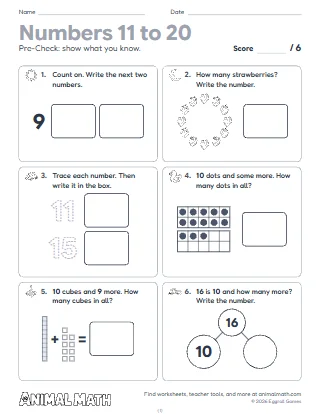
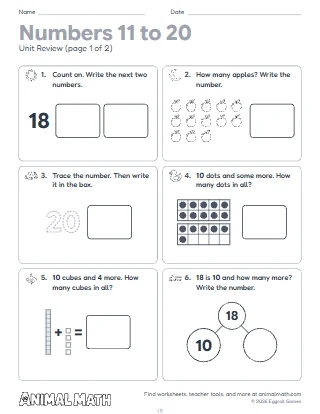
One page to give before the first lesson of the unit on numbers 11 to 20, to see what children already know. Read each of its six questions aloud: a small picture beside each question number (a sun, a moon, a car) lets you say "Find the sun. Count on. Write the next two numbers." Children count on from 9, count strawberries set in a circle, trace and write two teen numbers, count 10 dots and some more in ten frames, count a ten of cubes and some more, and find how many more than 10 a teen number is in a number bond. It has a Score line, and the key names the lesson each question leads into. Only the unit's Common Core lessons are asked. The unit review and the unit test are packs of their own.
Give the pre-check to a small group at a table before the first lesson, reading one question at a time and waiting until everyone is done. Then sort the children by what they missed: a child who loses count past 10 needs to count real things to 20 in the first lessons, and one who counts every dot of a full ten frame is ready to learn that it is 10. A low score at the start is no surprise; it shows where to begin.
Use it to see what your child knows before the unit on numbers 11 to 20 starts. Read each question aloud and let your child point and count out loud.
This pack supports the following Common Core State Standards for Mathematics:
© Copyright 2010. National Governors Association Center for Best Practices and Council of Chief State School Officers. All rights reserved.
A read-aloud check to give before the unit on numbers 11 to 20, to see what children already know. Children count on past 10, count a teen group, trace and write teen numbers and show a teen number as 10 and some more with ten frames, cubes and a number bond.
Tell us what to make next, or build your own with a worksheet maker.
This worksheet is free to download, print, copy, and hand out in your classroom or at home. You do not need to create an account, and there are no watermarks on the PDF.