Kindergarten Math Curriculum

A full year of Kindergarten math in 13 units and 123 lessons, free to print. Every lesson has a one-page lesson plan (how to teach it in about 35 minutes, the words to use, the mistakes to watch for) and an exit ticket, and every unit has a pre-check, a review and a test in two forms, all made to be read aloud. Each lesson plan points to the worksheets, worksheet makers, teaching tools and quizzes that practice it. The plan below counts one lesson a day, with a day for the pre-check, the review and the test of each unit: 162 days, which leaves room in a 180-day year for catching up, holidays and seasonal packs.
13 units123 lessons162 days33 weeks

Unit 1

Numbers to 5

Weeks 1–3 · 11 days

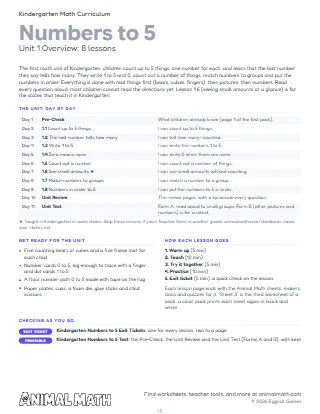
The first math unit of Kindergarten: children count up to 5 things, one number for each, and learn that the last number they say tells how many. They write 1 to 5 and 0, count out a number of things, match numbers to groups and put the numbers in order. Everything is done with real things first (bears, cubes, fingers), then pictures, then numbers. Read every question aloud; most children cannot read the directions yet. Lesson 1.6 (seeing small amounts at a glance) is for the states that teach it in Kindergarten.
Week 1
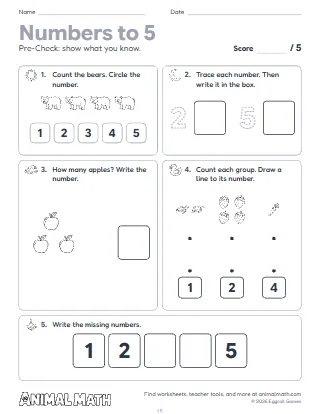
Day 1Pre-CheckWhat students already know, before the unit.
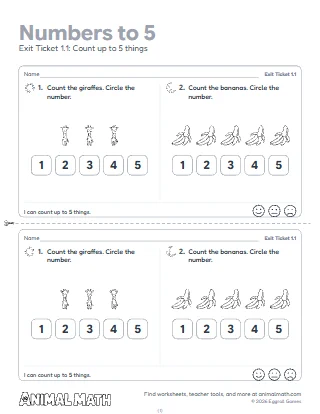
Day 21.1 Count up to 5 thingsI can count up to 5 things.
Day 31.2 The last number tells how manyI can tell how many I counted.
Day 41.3 Write 1 to 5I can write the numbers 1 to 5.
Day 51.4 Zero means noneI can write 0 when there are none.
Week 2
Day 61.5 Count out a numberI can count out a number of things.
Day 71.6 See small amounts ★I can see small amounts without counting.
Day 81.7 Match numbers to groupsI can match a number to a group.
Day 91.8 Numbers in order to 5I can put the numbers to 5 in order.
Day 10Unit ReviewThe review pages, with a tip beside every question.
Week 3
Day 11Unit TestForm A; Form B (other numbers) is for a retest.
Unit 2

Numbers to 10

Weeks 3–5 · 13 days

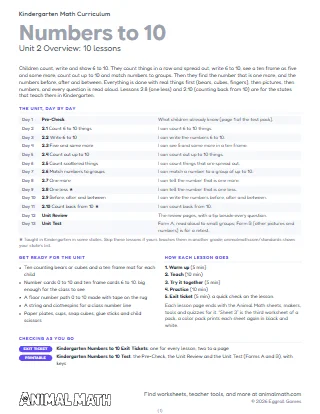
Children count, write and show 6 to 10. They count things in a row and spread out, write 6 to 10, see a ten frame as five and some more, count out up to 10 and match numbers to groups. Then they find the number that is one more, and the numbers before, after and between. Everything is done with real things first (bears, cubes, fingers), then pictures, then numbers, and every question is read aloud. Lessons 2.8 (one less) and 2.10 (counting back from 10) are for the states that teach them in Kindergarten.

Week 3 (continued)
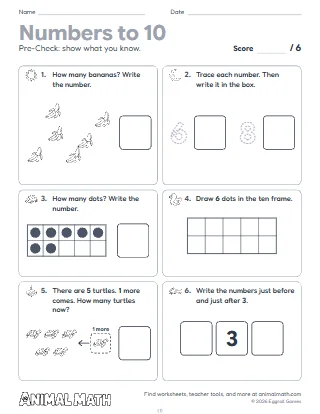
Day 12Pre-CheckWhat students already know, before the unit.
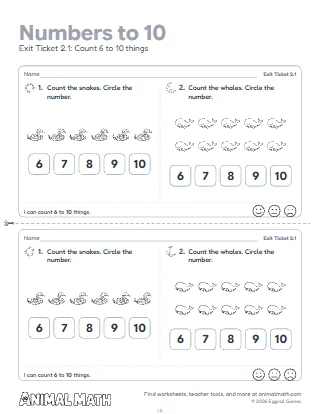
Day 132.1 Count 6 to 10 thingsI can count 6 to 10 things.
Day 142.2 Write 6 to 10I can write the numbers 6 to 10.
Day 152.3 Five and some moreI can see 5 and some more in a ten frame.
Week 4
Day 162.4 Count out up to 10I can count out up to 10 things.
Day 172.5 Count scattered thingsI can count things that are spread out.
Day 182.6 Match numbers to groupsI can match a number to a group of up to 10.
Day 192.7 One moreI can tell the number that is one more.
Day 202.8 One less ★I can tell the number that is one less.
Week 5
Day 212.9 Before, after and betweenI can write the numbers before, after and between.
Day 222.10 Count back from 10 ★I can count back from 10.
Day 23Unit ReviewThe review pages, with a tip beside every question.
Day 24Unit TestForm A; Form B (other numbers) is for a retest.
Unit 3

Sort, Count and Graph

Weeks 5–7 · 11 days

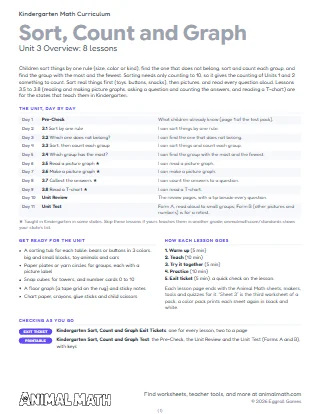
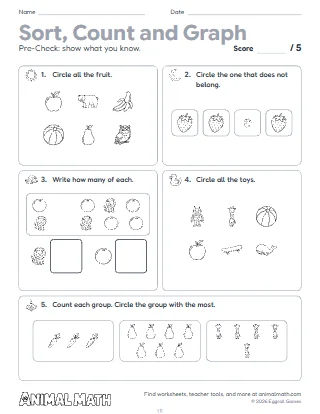
Children sort things by one rule (size, color or kind), find the one that does not belong, sort and count each group, and find the group with the most and the fewest. Sorting needs only counting to 10, so it gives the counting of Units 1 and 2 something to count. Sort real things first (toys, buttons, snacks), then pictures, and read every question aloud. Lessons 3.5 to 3.8 (reading and making picture graphs, asking a question and counting the answers, and reading a T-chart) are for the states that teach them in Kindergarten.

Week 5 (continued)
Day 25Pre-CheckWhat students already know, before the unit.
Week 6
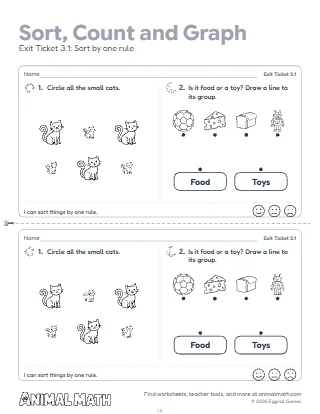
Day 263.1 Sort by one ruleI can sort things by one rule.
Day 273.2 Which one does not belong?I can find the one that does not belong.
Day 283.3 Sort, then count each groupI can sort things and count each group.
Day 293.4 Which group has the most?I can find the group with the most and the fewest.
Day 303.5 Read a picture graph ★I can read a picture graph.
Week 7
Day 313.6 Make a picture graph ★I can make a picture graph.
Day 323.7 Collect the answers ★I can count the answers to a question.
Day 333.8 Read a T-chart ★I can read a T-chart.
Day 34Unit ReviewThe review pages, with a tip beside every question.
Day 35Unit TestForm A; Form B (other numbers) is for a retest.
Unit 4

Compare to 10

Weeks 8–10 · 11 days

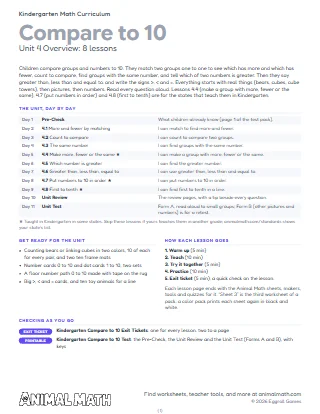
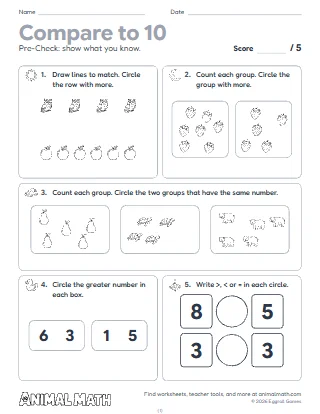
Children compare groups and numbers to 10. They match two groups one to one to see which has more and which has fewer, count to compare, find groups with the same number, and tell which of two numbers is greater. Then they say greater than, less than and equal to, and write the signs >, < and =. Everything starts with real things (bears, cubes, cube towers), then pictures, then numbers. Read every question aloud. Lessons 4.4 (make a group with more, fewer or the same), 4.7 (put numbers in order) and 4.8 (first to tenth) are for the states that teach them in Kindergarten.

Week 8
Day 36Pre-CheckWhat students already know, before the unit.
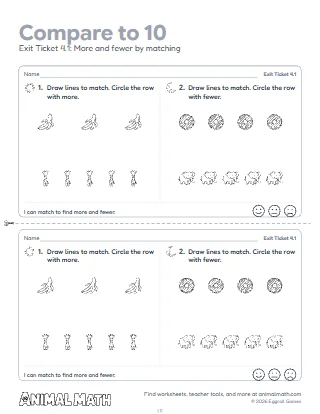
Day 374.1 More and fewer by matchingI can match to find more and fewer.
Day 384.2 Count to compareI can count to compare two groups.
Day 394.3 The same numberI can find groups with the same number.
Day 404.4 Make more, fewer or the same ★I can make a group with more, fewer or the same.
Week 9
Day 414.5 Which number is greaterI can find the greater number.
Day 424.6 Greater than, less than, equal toI can use greater than, less than and equal to.
Day 434.7 Put numbers to 10 in order ★I can put numbers to 10 in order.
Day 444.8 First to tenth ★I can find first to tenth in a line.
Day 45Unit ReviewThe review pages, with a tip beside every question.
Week 10
Day 46Unit TestForm A; Form B (other numbers) is for a retest.
Unit 5

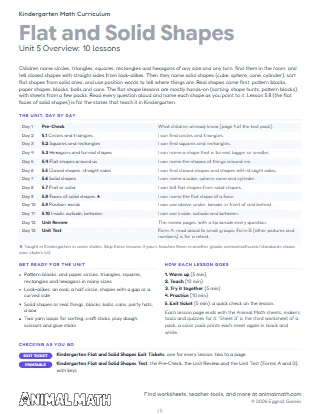
Flat and Solid Shapes

Weeks 10–12 · 13 days

Children name circles, triangles, squares, rectangles and hexagons of any size and any turn, find them in the room, and tell closed shapes with straight sides from look-alikes. Then they name solid shapes (cube, sphere, cone, cylinder), sort flat shapes from solid ones, and use position words to tell where things are. Real shapes come first: pattern blocks, paper shapes, blocks, balls and cans. The flat shape lessons are mostly hands-on (sorting, shape hunts, pattern blocks), with sheets from a few packs. Read every question aloud and name each shape as you point to it. Lesson 5.8 (the flat faces of solid shapes) is for the states that teach it in Kindergarten.

Week 10 (continued)
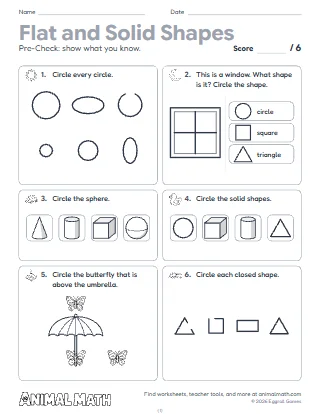
Day 47Pre-CheckWhat students already know, before the unit.
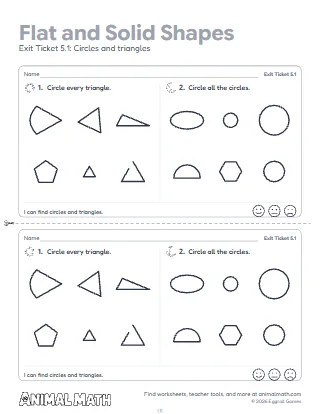
Day 485.1 Circles and trianglesI can find circles and triangles.
Day 495.2 Squares and rectanglesI can find squares and rectangles.
Day 505.3 Hexagons and turned shapesI can name a shape that is turned, bigger or smaller.
Week 11
Day 515.4 Flat shapes around usI can name the shapes of things around me.
Day 525.5 Closed shapes, straight sidesI can find closed shapes and shapes with straight sides.
Day 535.6 Solid shapesI can name a cube, sphere, cone and cylinder.
Day 545.7 Flat or solidI can tell flat shapes from solid shapes.
Day 555.8 Faces of solid shapes ★I can name the flat shape of a face.
Week 12
Day 565.9 Position wordsI can use above, under, beside, in front of and behind.
Day 575.10 Inside, outside, betweenI can use inside, outside and between.
Day 58Unit ReviewThe review pages, with a tip beside every question.
Day 59Unit TestForm A; Form B (other numbers) is for a retest.
Unit 6

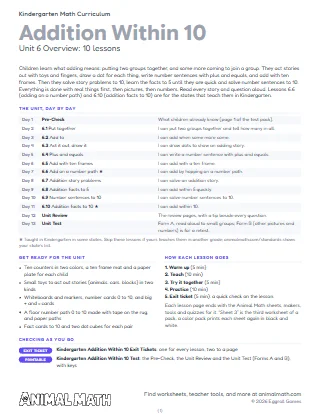
Addition Within 10

Weeks 12–15 · 13 days

Children learn what adding means: putting two groups together, and some more coming to join a group. They act stories out with toys and fingers, draw a dot for each thing, write number sentences with plus and equals, and add with ten frames. Then they solve story problems to 10, learn the facts to 5 until they are quick and solve number sentences to 10. Everything is done with real things first, then pictures, then numbers. Read every story and question aloud. Lessons 6.6 (adding on a number path) and 6.10 (addition facts to 10) are for the states that teach them in Kindergarten.

Week 12 (continued)
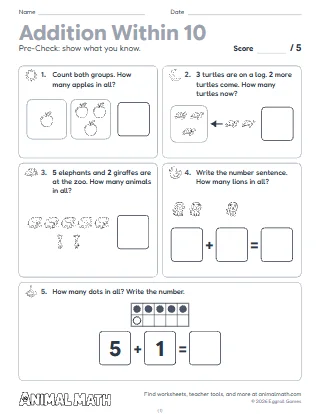
Day 60Pre-CheckWhat students already know, before the unit.
Week 13
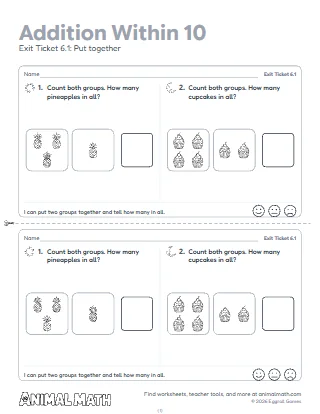
Day 616.1 Put togetherI can put two groups together and tell how many in all.
Day 626.2 Add toI can add when some more come.
Day 636.3 Act it out, draw itI can draw dots to show an adding story.
Day 646.4 Plus and equalsI can write a number sentence with plus and equals.
Day 656.5 Add with ten framesI can add with a ten frame.
Week 14
Day 666.6 Add on a number path ★I can add by hopping on a number path.
Day 676.7 Addition story problemsI can solve an addition story.
Day 686.8 Addition facts to 5I can add within 5 quickly.
Day 696.9 Number sentences to 10I can solve number sentences to 10.
Day 706.10 Addition facts to 10 ★I can add within 10.
Week 15
Day 71Unit ReviewThe review pages, with a tip beside every question.
Day 72Unit TestForm A; Form B (other numbers) is for a retest.
Unit 7

Subtraction Within 10

Weeks 15–17 · 13 days

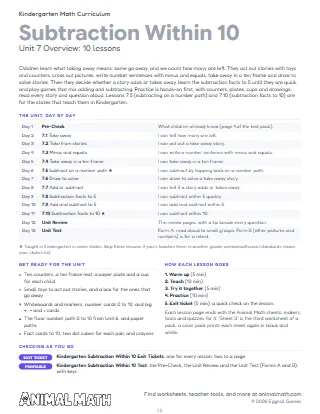
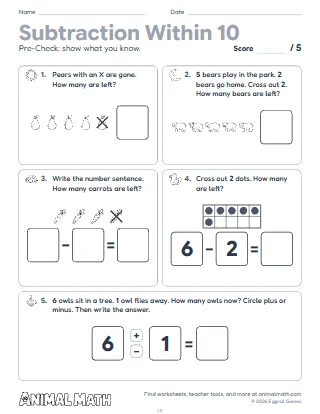
Children learn what taking away means: some go away, and we count how many are left. They act out stories with toys and counters, cross out pictures, write number sentences with minus and equals, take away in a ten frame and draw to solve stories. Then they decide whether a story adds or takes away, learn the subtraction facts to 5 until they are quick, and play games that mix adding and subtracting. Practice is hands-on first, with counters, plates, cups and drawings; read every story and question aloud. Lessons 7.5 (subtracting on a number path) and 7.10 (subtraction facts to 10) are for the states that teach them in Kindergarten.

Week 15 (continued)
Day 73Pre-CheckWhat students already know, before the unit.
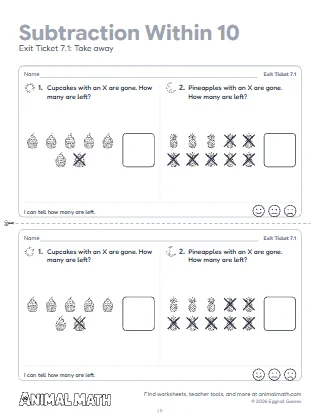
Day 747.1 Take awayI can tell how many are left.
Day 757.2 Take from storiesI can act out a take away story.
Week 16
Day 767.3 Minus and equalsI can write a number sentence with minus and equals.
Day 777.4 Take away in a ten frameI can take away in a ten frame.
Day 787.5 Subtract on a number path ★I can subtract by hopping back on a number path.
Day 797.6 Draw to solveI can draw to solve a take away story.
Day 807.7 Add or subtractI can tell if a story adds or takes away.
Week 17
Day 817.8 Subtraction facts to 5I can subtract within 5 quickly.
Day 827.9 Add and subtract to 5I can add and subtract within 5.
Day 837.10 Subtraction facts to 10 ★I can subtract within 10.
Day 84Unit ReviewThe review pages, with a tip beside every question.
Day 85Unit TestForm A; Form B (other numbers) is for a retest.
Unit 8

Number Pairs and Making 10

Weeks 18–20 · 13 days

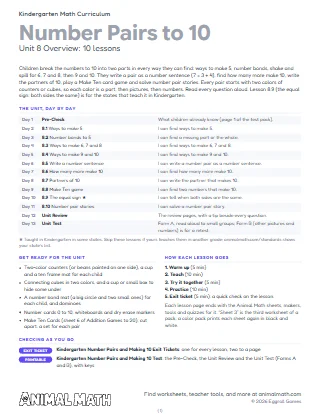
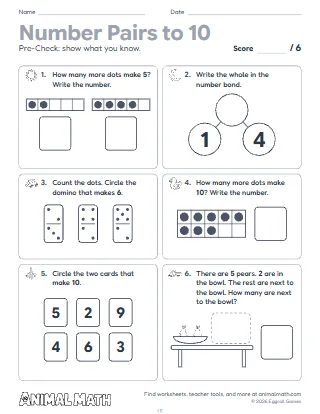
Children break the numbers to 10 into two parts in every way they can find: ways to make 5, number bonds, shake and spill for 6, 7 and 8, then 9 and 10. They write a pair as a number sentence (7 = 3 + 4), find how many more make 10, write the partners of 10, play a Make Ten card game and solve number pair stories. Every pair starts with two colors of counters or cubes, so each color is a part, then pictures, then numbers. Read every question aloud. Lesson 8.9 (the equal sign: both sides the same) is for the states that teach it in Kindergarten.

Week 18
Day 86Pre-CheckWhat students already know, before the unit.
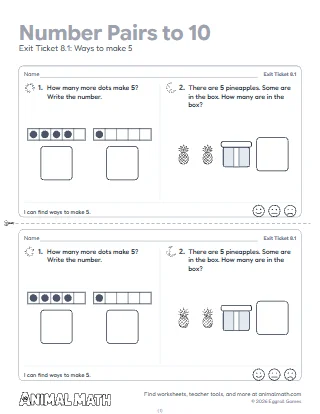
Day 878.1 Ways to make 5I can find ways to make 5.
Day 888.2 Number bonds to 5I can find a missing part or the whole.
Day 898.3 Ways to make 6, 7 and 8I can find ways to make 6, 7 and 8.
Day 908.4 Ways to make 9 and 10I can find ways to make 9 and 10.
Week 19
Day 918.5 Write a number sentenceI can write a number pair as a number sentence.
Day 928.6 How many more make 10I can find how many more make 10.
Day 938.7 Partners of 10I can write the partner that makes 10.
Day 948.8 Make Ten gameI can find two numbers that make 10.
Day 958.9 The equal sign ★I can tell when both sides are the same.
Week 20
Day 968.10 Number pair storiesI can solve a number pair story.
Day 97Unit ReviewThe review pages, with a tip beside every question.
Day 98Unit TestForm A; Form B (other numbers) is for a retest.
Unit 9

Numbers 11 to 20

Weeks 20–23 · 15 days

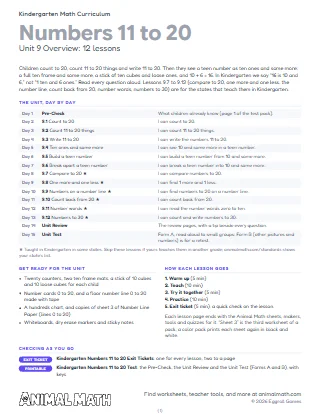
Children count to 20, count 11 to 20 things and write 11 to 20. Then they see a teen number as ten ones and some more: a full ten frame and some more, a stick of ten cubes and loose ones, and 10 + 6 = 16. In Kindergarten we say “16 is 10 and 6,” not “1 ten and 6 ones.” Read every question aloud. Lessons 9.7 to 9.12 (compare to 20, one more and one less, the number line, count back from 20, number words, numbers to 30) are for the states that teach them in Kindergarten.

Week 20 (continued)
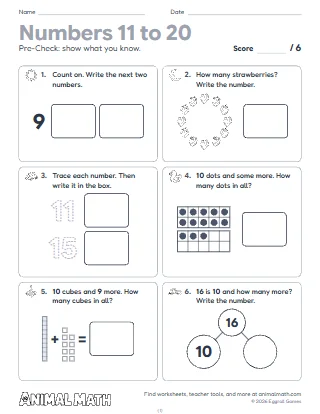
Day 99Pre-CheckWhat students already know, before the unit.
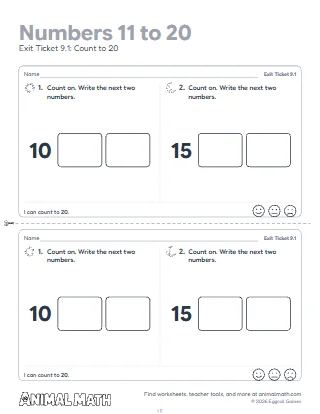
Day 1009.1 Count to 20I can count to 20.
Week 21
Day 1019.2 Count 11 to 20 thingsI can count 11 to 20 things.
Day 1029.3 Write 11 to 20I can write the numbers 11 to 20.
Day 1039.4 Ten ones and some moreI can see 10 and some more in a teen number.
Day 1049.5 Build a teen numberI can build a teen number from 10 and some more.
Day 1059.6 Break apart a teen numberI can break a teen number into 10 and some more.
Week 22
Day 1069.7 Compare to 20 ★I can compare numbers to 20.
Day 1079.8 One more and one less ★I can find 1 more and 1 less.
Day 1089.9 Numbers on a number line ★I can find numbers to 20 on a number line.
Day 1099.10 Count back from 20 ★I can count back from 20.
Day 1109.11 Number words ★I can read the number words zero to ten.
Week 23
Day 1119.12 Numbers to 30 ★I can count and write numbers to 30.
Day 112Unit ReviewThe review pages, with a tip beside every question.
Day 113Unit TestForm A; Form B (other numbers) is for a retest.
Unit 10

Counting to 100

Weeks 23–25 · 11 days

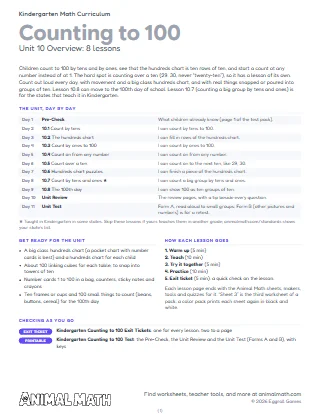
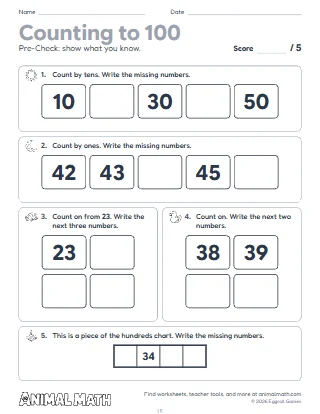
Children count to 100 by tens and by ones, see that the hundreds chart is ten rows of ten, and start a count at any number instead of at 1. The hard spot is counting over a ten (29, 30, never “twenty-ten”), so it has a lesson of its own. Count out loud every day, with movement and a big class hundreds chart, and with real things snapped or poured into groups of ten. Lesson 10.8 can move to the 100th day of school. Lesson 10.7 (counting a big group by tens and ones) is for the states that teach it in Kindergarten.

Week 23 (continued)
Day 114Pre-CheckWhat students already know, before the unit.
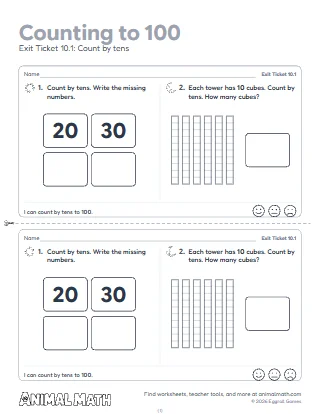
Day 11510.1 Count by tensI can count by tens to 100.
Week 24
Day 11610.2 The hundreds chartI can fill in rows of the hundreds chart.
Day 11710.3 Count by ones to 100I can count by ones to 100.
Day 11810.4 Count on from any numberI can count on from any number.
Day 11910.5 Count over a tenI can count on to the next ten, like 29, 30.
Day 12010.6 Hundreds chart puzzlesI can finish a piece of the hundreds chart.
Week 25
Day 12110.7 Count by tens and ones ★I can count a big group by tens and ones.
Day 12210.8 The 100th dayI can show 100 as ten groups of ten.
Day 123Unit ReviewThe review pages, with a tip beside every question.
Day 124Unit TestForm A; Form B (other numbers) is for a retest.
Unit 11

Measurement

Weeks 25–28 · 12 days

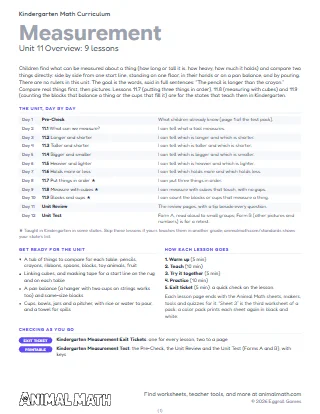
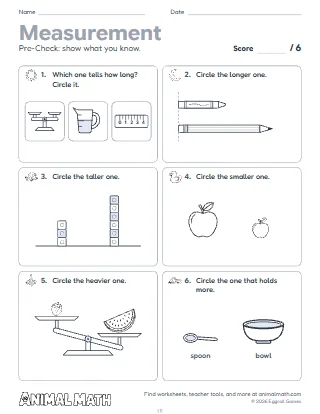
Children find what can be measured about a thing (how long or tall it is, how heavy, how much it holds) and compare two things directly: side by side from one start line, standing on one floor, in their hands or on a pan balance, and by pouring. There are no rulers in this unit. The goal is the words, said in full sentences: “The pencil is longer than the crayon.” Compare real things first, then pictures. Lessons 11.7 (putting three things in order), 11.8 (measuring with cubes) and 11.9 (counting the blocks that balance a thing or the cups that fill it) are for the states that teach them in Kindergarten.

Week 25 (continued)
Day 125Pre-CheckWhat students already know, before the unit.
Week 26
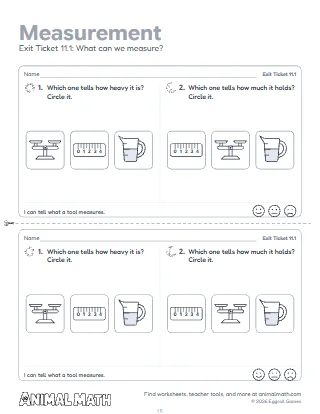
Day 12611.1 What can we measure?I can tell what a tool measures.
Day 12711.2 Longer and shorterI can tell which is longer and which is shorter.
Day 12811.3 Taller and shorterI can tell which is taller and which is shorter.
Day 12911.4 Bigger and smallerI can tell which is bigger and which is smaller.
Day 13011.5 Heavier and lighterI can tell which is heavier and which is lighter.
Week 27
Day 13111.6 Holds more or lessI can tell which holds more and which holds less.
Day 13211.7 Put things in order ★I can put three things in order.
Day 13311.8 Measure with cubes ★I can measure with cubes that touch, with no gaps.
Day 13411.9 Blocks and cups ★I can count the blocks or cups that measure a thing.
Day 135Unit ReviewThe review pages, with a tip beside every question.
Week 28
Day 136Unit TestForm A; Form B (other numbers) is for a retest.
Unit 12

Build and Compare Shapes

Weeks 28–30 · 11 days

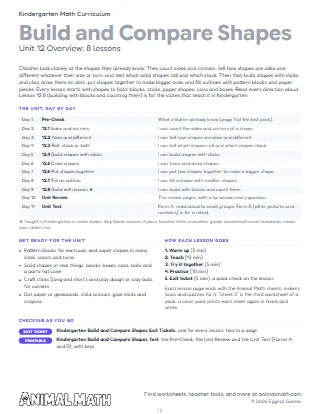
Children look closely at the shapes they already know. They count sides and corners, tell how shapes are alike and different whatever their size or turn, and test which solid shapes roll and which stack. Then they build shapes with sticks and clay, draw them on dots, put shapes together to make bigger ones and fill outlines with pattern blocks and paper pieces. Every lesson starts with shapes to hold: blocks, sticks, paper shapes, cans and boxes. Read every direction aloud. Lesson 12.8 (building with blocks and counting them) is for the states that teach it in Kindergarten.

Week 28 (continued)
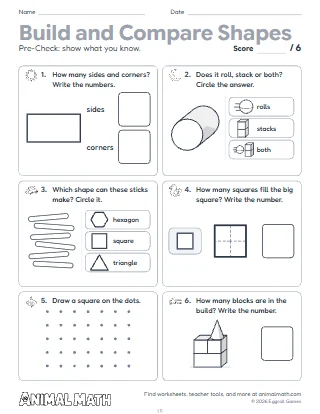
Day 137Pre-CheckWhat students already know, before the unit.
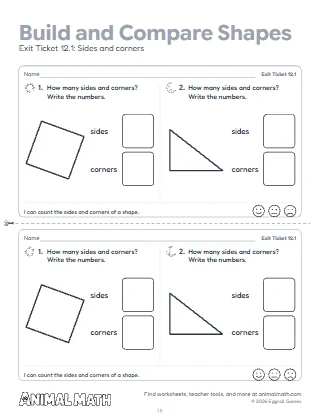
Day 13812.1 Sides and cornersI can count the sides and corners of a shape.
Day 13912.2 Alike and differentI can tell how shapes are alike and different.
Day 14012.3 Roll, stack or bothI can tell which shapes roll and which shapes stack.
Week 29
Day 14112.4 Build shapes with sticksI can build shapes with sticks.
Day 14212.5 Draw shapesI can trace and draw shapes.
Day 14312.6 Put shapes togetherI can put two shapes together to make a bigger shape.
Day 14412.7 Fill an outlineI can fill a shape with smaller shapes.
Day 14512.8 Build with blocks ★I can build with blocks and count them.
Week 30
Day 146Unit ReviewThe review pages, with a tip beside every question.
Day 147Unit TestForm A; Form B (other numbers) is for a retest.
Unit 13 ★

Money, Patterns and Calendar

Weeks 30–33 · 15 days

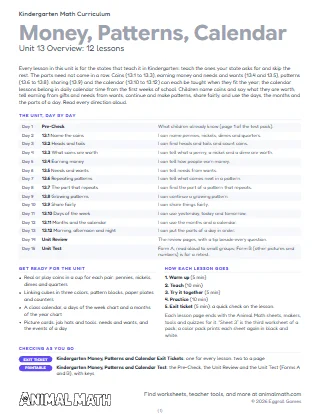
Every lesson in this unit is for the states that teach it in Kindergarten: teach the ones your state asks for and skip the rest. The parts need not come in a row. Coins (13.1 to 13.3), earning money and needs and wants (13.4 and 13.5), patterns (13.6 to 13.8), sharing (13.9) and the calendar (13.10 to 13.12) can each be taught when they fit the year; the calendar lessons belong in daily calendar time from the first weeks of school. Children name coins and say what they are worth, tell earning from gifts and needs from wants, continue and make patterns, share fairly, and use the days, the months and the parts of a day. Read every direction aloud.

Week 30 (continued)
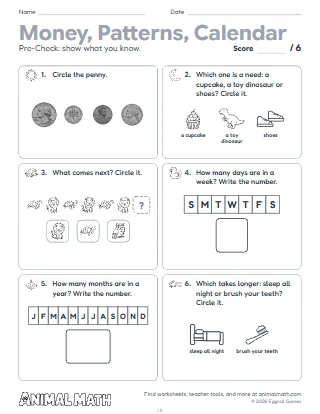
Day 148Pre-CheckWhat students already know, before the unit.
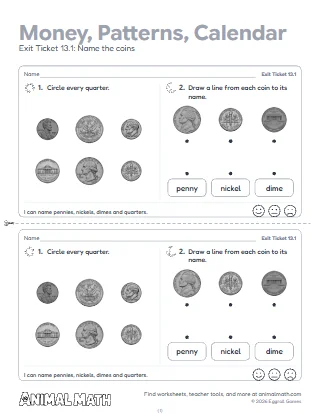
Day 14913.1 Name the coinsI can name pennies, nickels, dimes and quarters.
Day 15013.2 Heads and tailsI can find heads and tails and count coins.
Week 31
Day 15113.3 What coins are worthI can tell what a penny, a nickel and a dime are worth.
Day 15213.4 Earning moneyI can tell how people earn money.
Day 15313.5 Needs and wantsI can tell needs from wants.
Day 15413.6 Repeating patternsI can tell what comes next in a pattern.
Day 15513.7 The part that repeatsI can find the part of a pattern that repeats.
Week 32
Day 15613.8 Growing patternsI can continue a growing pattern.
Day 15713.9 Share fairlyI can share things fairly.
Day 15813.10 Days of the weekI can use yesterday, today and tomorrow.
Day 15913.11 Months and the calendarI can use the months and a calendar.
Day 16013.12 Morning, afternoon and nightI can put the parts of a day in order.
Week 33
Day 161Unit ReviewThe review pages, with a tip beside every question.
Day 162Unit TestForm A; Form B (other numbers) is for a retest.

Lessons marked ★ are taught in Kindergarten in some states and in other grades elsewhere; skip them if your state does not teach them in Kindergarten (without them and Unit 13, the year is 84 lessons). Unit 13 (money, patterns and the calendar) is for the states that teach them in Kindergarten, and it can be spread through the year: the calendar lessons fit daily calendar time. Lesson 10.8 can move to the 100th day of school.

Teaching a grade we don’t cover yet?

Tell us which grade you want a curriculum for next.

Suggest a curriculum

A free curriculum

Every lesson plan, exit ticket and unit test here is free to download and print for your classroom or your home school. You do not need an account, and the PDFs have no watermarks.