These are the lesson plans for Unit 11 of 13 in the Kindergarten Math Curriculum: 123 lessons in teaching order, week by week, each with a lesson plan and an exit ticket.
Also for this unit: this unit’s exit tickets and this unit’s test. See the whole year
Everything each lesson plan points to, with links. Sheet numbers count worksheets: a color pack prints each sheet again in black and white.
★ Taught in Kindergarten in some states.
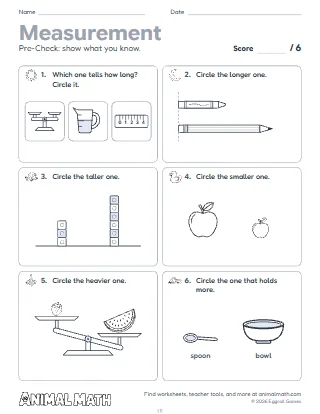
Nine lesson plans, one for each lesson of a Kindergarten unit on measurement, in teaching order, after an overview page that lays the unit out day by day: a pre-check, the nine lessons, a review and the unit test. Each plan fits on one page. It gives the goal, what to get ready, the words to use, the lesson in five steps with the words to say, questions to ask, common mistakes and what to do about them, and the Animal Math worksheets, tool and quiz for the lesson.
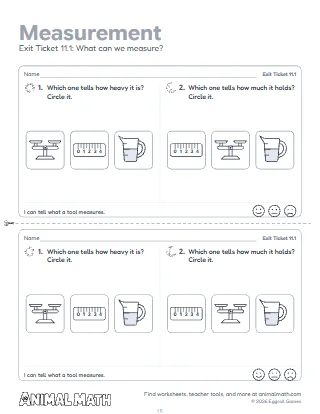
Print the unit, or just the day's page, and teach from it. Each lesson takes about 35 minutes: a 5 minute warm up, 10 minutes of teaching on the rug, 5 minutes together, 10 minutes of practice and an exit ticket you read aloud. Children compare real things side by side, in their hands, on a pan balance and by pouring; there are no rulers. The exit tickets and the unit test are separate packs, made for these lessons. Lessons 11.7 (putting three things in order), 11.8 (measuring with cubes) and 11.9 (counting the blocks that balance a thing or the cups that fill it) are for the states that teach them in Kindergarten.
Teaching at home? Compare real things: two spoons, two shoes, a cup and a bowl in the bath. Use the "Words to use" in full sentences ("The spoon is longer than the fork") and the warm ups as games. The mistakes to watch for are the ones most children make.
This pack supports the following Common Core State Standards for Mathematics:
© Copyright 2010. National Governors Association Center for Best Practices and Council of Chief State School Officers. All rights reserved.
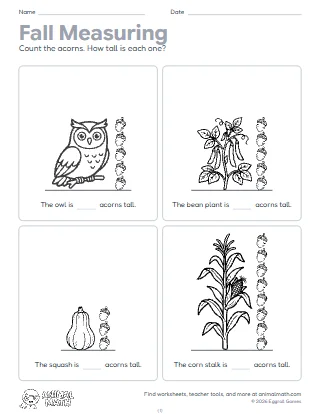
Lesson plans for every lesson of a Kindergarten unit on measurement, one page a lesson, with a unit overview that lays the unit out day by day. Each plan has the goal and its "I can" line, what to get ready, the words to use, a 35 minute lesson in five steps (warm up, teach with words to say, try it together, practice, an exit ticket read aloud), questions to ask, the mistakes children make and what to do about them, and ideas for children who need help or are ready for more. Each one ends with the Animal Math worksheets for that lesson, and the tool and quiz where one fits. Lessons: what we can measure, longer and shorter, taller and shorter, bigger and smaller, heavier and lighter, and holds more or less, with putting three things in order, measuring with cubes, and counting the blocks or cups that measure a thing for the states that teach them.
Tell us what to make next, or build your own with a worksheet maker.
This worksheet is free to download, print, copy, and hand out in your classroom or at home. You do not need to create an account, and there are no watermarks on the PDF.