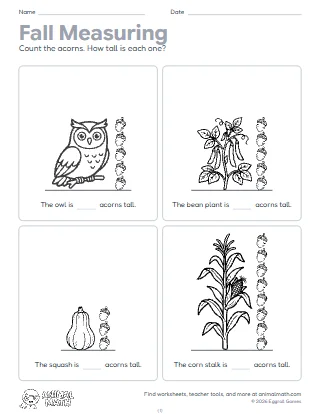
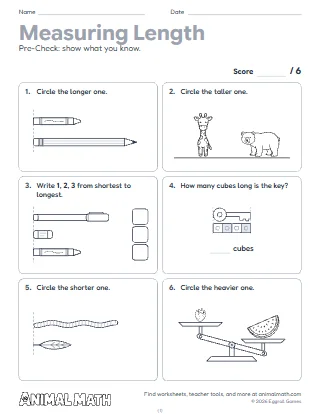
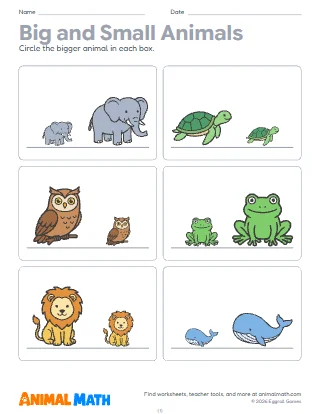
Seven pages for one Kindergarten unit on measurement. Page 1 is a pre-check to give before the unit, to see what children already know. Pages 2 and 3 are a review to do together before the test, with a tip on every question. Pages 4 and 5 are the unit test, Form A. Pages 6 and 7 are Form B: the same questions in the same order with different things and sizes, for a retake or a child who was away. Each form has 9 questions, one point each, and a Score line on its first page. Read every question aloud: a small picture beside each question number (a sun, a moon, a car) lets you say "Find the sun. Which one tells how heavy?"
Give the test to a small group at a table, reading one question at a time and waiting until everyone is done. Questions 7 to 9 (putting three things in order by length, measuring with cubes and counting the blocks that balance a thing) are taught in Kindergarten in some states only: leave out the ones your class does not learn and score out of what is left, out of 6 if you leave out all three. The answer keys name each question's skill, so a missed question points to the lesson to reteach.
Use the review as practice before a test at school, or Form B as a check after the unit. Read each question aloud, then compare real things at home: two spoons, two shoes, a cup and a bowl.
This pack supports the following Common Core State Standards for Mathematics:
© Copyright 2010. National Governors Association Center for Best Practices and Council of Chief State School Officers. All rights reserved.
A unit test for measurement in Kindergarten, made to be read aloud: a one-page pre-check, a two-page review with a tip on every question, and the unit test in two forms (A and B) that ask the same questions with different things and sizes. Children pick the tool that tells how long or how heavy, circle the shorter, the taller and the bigger thing, read a pan balance to find the heavier thing, and circle the container that holds more. The last three questions are for the states that teach them in Kindergarten: putting three things in order by length, measuring with cubes, and counting the blocks that balance a thing. A small picture beside each question number lets the teacher say "find the sun." Answer keys name the lesson and skill of every question.
Tell us what to make next, or build your own with a worksheet maker.
This worksheet is free to download, print, copy, and hand out in your classroom or at home. You do not need to create an account, and there are no watermarks on the PDF.