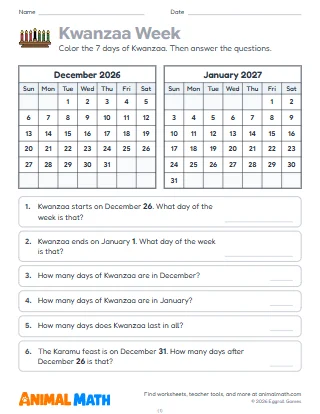
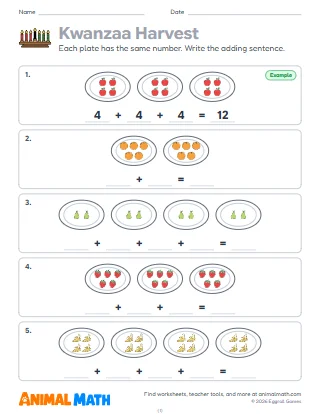
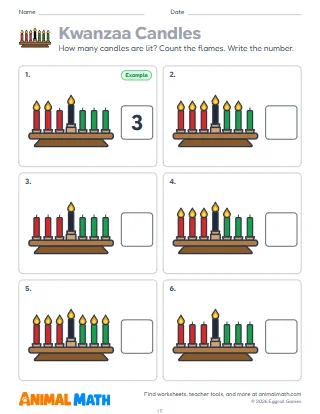
Kwanzaa is a celebration of African American family, community and culture, held each year from December 26 to January 1. Dr. Maulana Karenga created it in 1966, and its name comes from Swahili words meaning first fruits. Each of its seven days honors one of seven principles, the Nguzo Saba, and each evening one more candle is lit on the kinara. These pages tell the principles in short, simple sentences and ask every child how they can show each one, whatever holidays their family keeps.
Ten pages. Page 1 tells how Kwanzaa began, with questions. Pages 2 to 8 are the seven principles, one a page in the order of the days: the Swahili word and how to say it, what it means with an example, one question, and a box to draw and write how you can show it. Page 9 has the seven Kwanzaa symbols to name from a word bank, and page 10 the seven days of Kwanzaa, each with its kinara, to write the day’s principle.
Read page 1 together, then one principle a day in the week before winter break, or on the days of Kwanzaa themselves. Say each Swahili word aloud together. If a child in the class keeps Kwanzaa, invite them to share how their family does it, as families keep it in different ways. Pages 9 and 10 make a good review at the end.
Read a principle together each evening and talk about how your family already shows it. If your family keeps Kwanzaa, match each page to the candle you light that day.
How Kwanzaa began and its seven principles, one a day from Umoja to Imani, each told in short, simple sentences with an example. Children read and answer questions, draw and write how they can show each principle, name the seven symbols and match each day to its principle.
Tell us what to make next, or build your own with a worksheet maker.
This worksheet is free to download, print, copy, and hand out in your classroom or at home. You do not need to create an account, and there are no watermarks on the PDF.