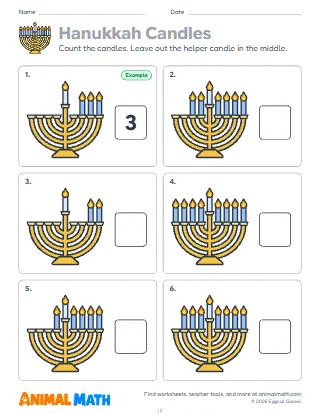
Kwanzaa is a celebration of African American family, community and culture held each year from December 26 to January 1. It was created in 1966 by Dr. Maulana Karenga. Each of its seven days is for one of seven principles, and each evening a candle is lit on the kinara, a holder for seven candles: a black candle in the middle, three red candles on its left and three green candles on its right. The black candle is lit first, on the first day, and one more candle is lit each day after, so all seven are lit on the last day.
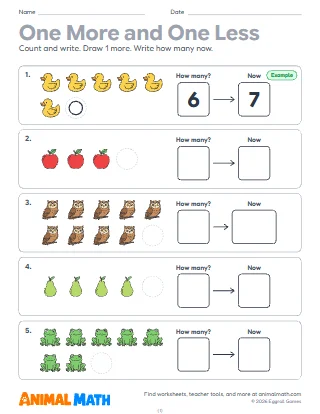
Six pages of kinara counting. Page 1 shows six kinaras: children count the candles that are lit, the ones with flames, and write how many. On page 2 each kinara has one more flame drawn with dashes: trace it, then write how many candles are lit now. Page 3 asks how many candles are lit and how many are not lit, two numbers that always make 7. Page 4 has candles in ten frames to count, up to 10. Page 5 shows two kinaras at a time: circle the one with more lit candles. On page 6 children draw that many flames on a kinara, starting with the middle candle. The first problem on every page is a worked example.
Read each direction aloud. Before page 1, look at a kinara together and count its seven candles: three on one side, one in the middle and three on the other side. Show that only the candles with flames are lit. For page 2, act it out with seven blocks in a row: light one block a day by turning it over, and count again each time. On page 3 ask children how the two numbers always add up to 7.
Count the candles together, touching each one. If your family keeps Kwanzaa, count the lit candles each evening and talk about how there is one more than the day before. Line up seven spoons or crayons and turn some over to show lit and not lit.
Kwanzaa counting practice with a kinara that has one more candle lit each day of the celebration. Children count lit candles, trace the next flame, find how many are lit and not lit, count candles in ten frames, find the kinara with more and draw the flames themselves.
Tell us what to make next, or build your own with a worksheet maker.
This worksheet is free to download, print, copy, and hand out in your classroom or at home. You do not need to create an account, and there are no watermarks on the PDF.