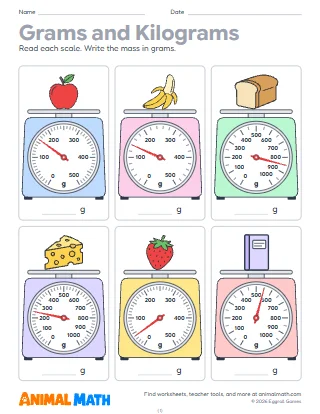
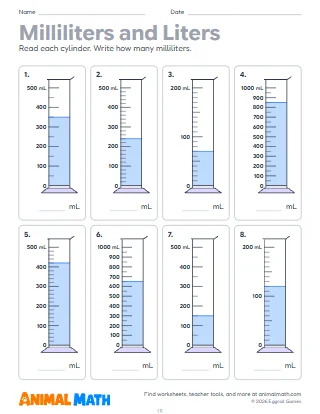
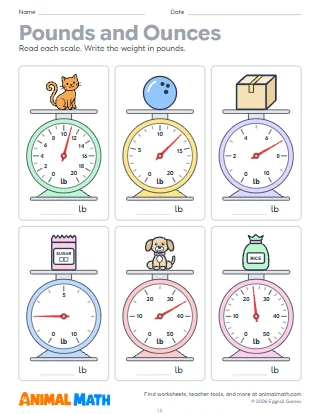
Five pages of one-step story problems about mass and liquid volume. On page 1 each problem shows two kitchen scales: students read the mass on each one, then add to find a total or subtract to find how much more. Page 2 does the same with measuring jugs in liters, and one pair of beakers in milliliters. Page 3 multiplies and divides: sacks of potatoes, pencils, bins of dog food, and water poured into bottles and buckets; students write the sign in the circle themselves. Page 4 compares two amounts with a bar model, such as a melon and an orange or a mug and a bowl. Page 5 mixes all four operations. Every story uses one unit, so nothing has to be converted. Pages 1 to 4 start with a worked example.
Bring a kitchen scale and a 1 liter measuring jug. Weigh two pieces of fruit, write each mass on the board and ask what question you could answer by adding them, and what question by subtracting. Before page 3, pour 6 liters of water into 3 equal bottles, or act it out with cups, and ask whether you multiplied or divided.
Read food labels together: a 500 gram box of pasta and a 2 kilogram bag of flour. How much do two boxes of pasta have? How many 2 liter bottles of juice would make 8 liters? Let your child choose whether to add, subtract, multiply or divide, then check with a scale or measuring cup.
This pack supports the following Common Core State Standards for Mathematics:
© Copyright 2010. National Governors Association Center for Best Practices and Council of Chief State School Officers. All rights reserved.
One-step story problems about mass in grams and kilograms and liquid volume in liters and milliliters. Students read scales and measuring jugs, then add, subtract, multiply or divide, and compare two amounts with a bar model.
Tell us what to make next, or build your own with a worksheet maker.
This worksheet is free to download, print, copy, and hand out in your classroom or at home. You do not need to create an account, and there are no watermarks on the PDF.