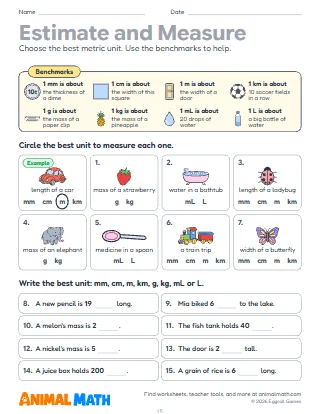
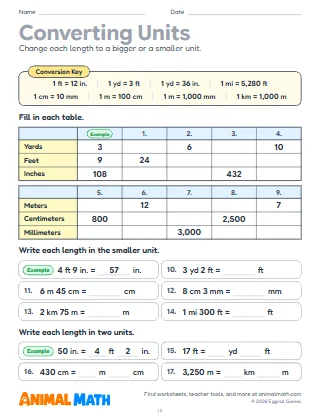
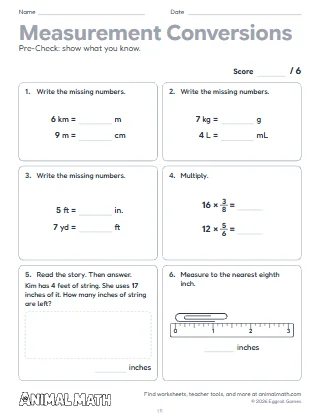
Six pages on the imperial units children still meet in the UK, each with a small box of rough equivalents to work from. Page 1 changes inches and feet to centimetres and back, with a ruler that has inches on one edge and centimetres on the other. Page 2 changes kilograms and pounds with a table to complete, then asks which of two amounts is heavier. Page 3 does the same for pints, gallons and litres. Pages 4 and 5 are the Year 6 work on miles and kilometres: a table to complete, road signs to read in kilometres, distances between UK places both ways and which of two distances is longer. Page 6 mixes all the units in short word problems.
Start with the ruler on page 1: lay a real 30 cm ruler beside a foot ruler, or look at both edges of a classroom ruler, and agree that an inch is about two and a half centimetres. Ask why we say "about": the equivalents are rounded, so the answers are rough too. For miles and kilometres, count up the table together in fives and eights before the road signs.
Look for imperial units around you: pints of milk, miles on road signs, a baby's weight in pounds or a height in feet and inches. Ask your child to change each one into metric units using the equivalents on the sheet, and to say whether the answer sounds sensible.
This pack supports the following Common Core State Standards for Mathematics:
© Copyright 2010. National Governors Association Center for Best Practices and Council of Chief State School Officers. All rights reserved.
Changing between metric units and the imperial units still used in the UK: inches, feet, pounds, pints, gallons and miles. Students use rough equivalents such as 1 inch is about 2.5 cm and 5 miles is about 8 km to convert both ways, compare amounts and solve everyday problems.
Tell us what to make next, or build your own with a worksheet maker.
This worksheet is free to download, print, copy, and hand out in your classroom or at home. You do not need to create an account, and there are no watermarks on the PDF.