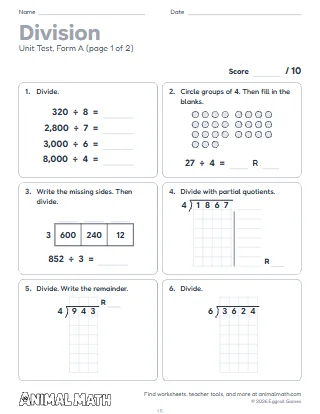
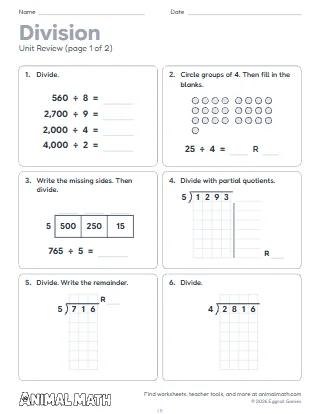
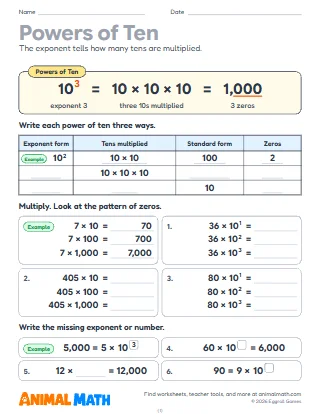
Five pages on multiplying and dividing with tens, hundreds and thousands. Page 1 puts a number in a place value chart and multiplies it by 10, 100 or 1,000: students write each digit in its new place and draw arrows to show that every digit moves one place to the left for each 10, then multiply without the chart and finish sentences such as "600 is 10 times as much as 60". Page 2 builds patterns from a fact (3 × 6, 3 × 60, 3 × 600, 3 × 6,000), including one whose fact already ends in 0, then writes products in place value units: 3 × 700 is 3 × 7 hundreds, or 21 hundreds, which is 2,100. Page 3 is 24 products of a one-digit number and a multiple of 10, 100 or 1,000, some written the other way round, then six comparisons with >, < or =. Page 4 divides with a fact: 42 ÷ 6, 420 ÷ 6 and 4,200 ÷ 6; 2,400 ÷ 6 as 24 hundreds ÷ 6; and dividing by 10, 100 and 1,000, where every digit moves to the right. Page 5 has missing factors, dividends and divisors, then four short stories to write an equation for and solve. Every page starts with a worked example.
Write 54 in a place value chart on the board and ask a student to multiply it by 10 by moving the digits, not by adding a zero. Ask why the 5 is now worth 500. Before page 2, say a pattern aloud as a class: 5 × 3, 5 × 30, 5 × 300, 5 × 3,000, then ask which product in 2 × 5,000 has one more zero than the others and why. On page 4, read 2,400 as 24 hundreds before anyone divides.
Count money in tens, hundreds and thousands: 6 bills of $100 is $600, so 6 bills of $1,000 is $6,000. Ask how many $10 bills make $350, and how many $100 bills make $2,400 shared among 6 people. Have your child say the fact first, then the zeros.
This pack supports the following Common Core State Standards for Mathematics:
© Copyright 2010. National Governors Association Center for Best Practices and Council of Chief State School Officers. All rights reserved.
Multiplying and dividing whole numbers by 10, 100 and 1,000 and by their multiples, using place value and the facts. Students move digits in a place value chart, follow patterns of zeros, multiply and divide tens, hundreds and thousands with a fact, find missing numbers and solve short stories.
Tell us what to make next, or build your own with a worksheet maker.
This worksheet is free to download, print, copy, and hand out in your classroom or at home. You do not need to create an account, and there are no watermarks on the PDF.