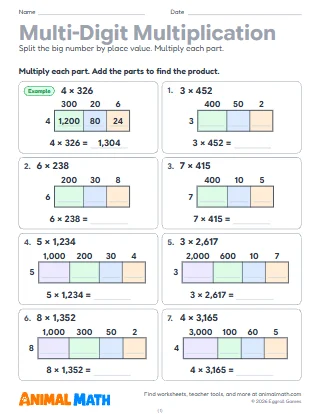
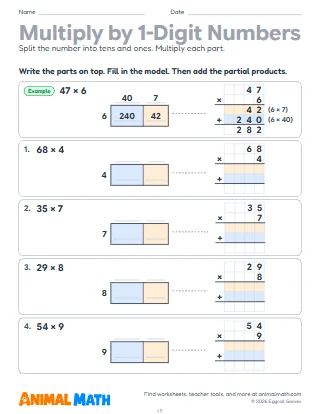
Five pages that move from pictures to the standard algorithm. Page 1 splits both factors by place value in an area model: 346 × 27 becomes 300, 40 and 6 across and 20 and 7 down, six parts to multiply; adding each row gives 346 × 20 and 346 × 7, which are the two rows of the standard algorithm. Page 2 writes the same parts as partial products in a column, each one labelled with what was multiplied, for 3-digit and 4-digit numbers. Page 3 is the standard algorithm for 3 digits by 2 digits, with small boxes for regrouped digits and the 0 that holds the ones place in the second row. Page 4 has larger factors: 4-digit numbers, numbers with zeros such as 6,040 × 38, and a 3-digit number times a 3-digit number. Page 5 rounds each factor to estimate before multiplying, then has one- and two-step stories. Every page starts with a worked example.
Put 346 × 27 on the board and solve it three ways side by side: an area model, partial products and the standard algorithm. Ask students to find the same numbers in all three (the area model's row for 20 adds up to 6,920, the second row of the standard algorithm). On page 3, ask why the second row starts with a 0, and what goes wrong without it: estimate 300 × 30 = 9,000 and compare.
Multiply with real numbers from around the house: 24 cans in a case and 15 cases, 365 days in a year and 12 years. Before multiplying, round each number and guess the answer. After, compare: is the answer close to the guess?
This pack supports the following Common Core State Standards for Mathematics:
© Copyright 2010. National Governors Association Center for Best Practices and Council of Chief State School Officers. All rights reserved.
Multiplying 3- and 4-digit numbers by 2-digit numbers, from area models and partial products to the standard algorithm. Students split both factors by place value, write every partial product, multiply by the ones and then the tens, work with zeros and 3-digit factors, estimate to check, and solve one- and two-step stories.
Tell us what to make next, or build your own with a worksheet maker.
This worksheet is free to download, print, copy, and hand out in your classroom or at home. You do not need to create an account, and there are no watermarks on the PDF.