Every new year starts on January 1, but on a different day of the week. A year of 365 days is 52 weeks and 1 day, so New Year's Day moves one day later in the week each year, and two days after a leap year. 2027 starts on a Friday and is not a leap year: February has 28 days. 2028 is a leap year, with a February 29.
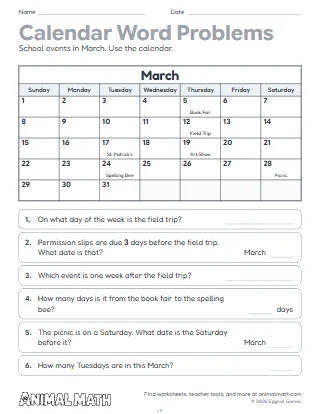
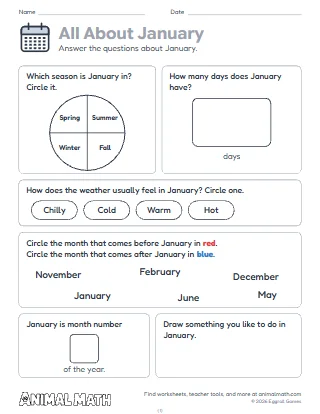
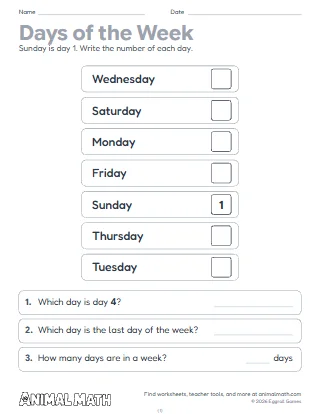
Six pages about the new year's calendar. Page 1 is the January calendar with six questions: New Year's Day, the days in January, a week later, the Saturdays, the second Monday and the last day. Page 2 puts the 12 months in order: children write the missing month names from a bank and how many days the months have. Page 3 shows the whole year on one page, with four questions. Page 4 counts weeks and days and works out why 365 days is 52 weeks and 1 day. Page 5 counts days across the January and February calendars. Page 6 counts by 4s on a number line of years to find the leap years. The first problem on page 4 is worked as an example.
Hang a new calendar on the first day back and find today's date together. Pages 1 and 2 suit 1st grade, pages 3 to 5 2nd grade, and pages 4 and 6 stretch 3rd grade. On page 5, count on from the start date with a finger, one square a day, and say when you cross into February.
Put up the new year's calendar together and mark birthdays and trips. Ask how many days or weeks are left until one of them, and what day of the week it falls on.
Calendar math for the start of 2027, from the January calendar to the whole year at a glance. Students find days of the week, put the months in order with their days, count weeks and days across months, see why 365 days moves next New Year's Day one day later, and count by 4s to the leap years.
Tell us what to make next, or build your own with a worksheet maker.
This worksheet is free to download, print, copy, and hand out in your classroom or at home. You do not need to create an account, and there are no watermarks on the PDF.