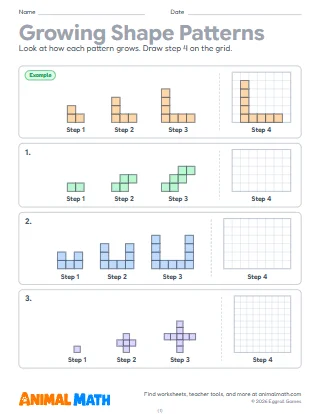
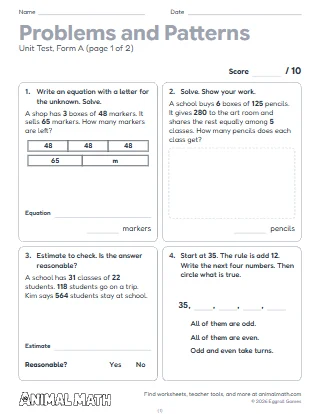
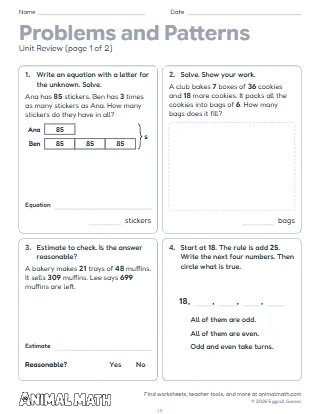
Five pages on patterns that follow a rule. Page 1 makes five patterns from a start number and a rule (start at 1,250 and subtract 150; start at 4 and multiply by 3), then asks for the rule and the next two numbers of four more. Page 2 has eight patterns with numbers missing anywhere, even at the start: find the rule, then fill in the gaps. Page 3 looks at what a rule does not say: students make a pattern, mark each number odd or even, and see that starting at 1 and adding 3 makes the numbers go odd, even, odd, even, while other rules keep them all even or all odd, or make the ones digits repeat; each box asks why. Page 4 has three growing tile patterns, each with its rule: students fill in a table to step 6, predict step 10, find the step with a given number of tiles, and use what every step has in common (odd and even, a multiple of 4) to say whether a number of tiles can ever come up. Page 5 has four pattern stories with tables: stickers saved each week, a candle burning down, rows of theater seats and a club that doubles, each with a question that needs the pattern's features to answer. The first problem on each page is worked as an example.
Start with the Common Core example on the board: start at 1 and add 3. Have students say the numbers aloud and clap on the odd ones; ask why the claps alternate. On page 4, ask how to find step 10 without drawing steps 4 to 9, and compare the ways students find.
Make patterns together on a walk or in the car: start at 7 and add 6, take turns saying the next number, and ask whether the numbers will ever end in 5. Look for patterns in prices, savings or the pages of a book read each night.
This pack supports the following Common Core State Standards for Mathematics:
© Copyright 2010. National Governors Association Center for Best Practices and Council of Chief State School Officers. All rights reserved.
Number and shape patterns that follow a rule, with rules past the times tables like add 25, subtract 150 and multiply by 3. Students make patterns from a rule, find the rule and the missing numbers, spot what the rule does not say (odd and even numbers, repeating ones digits) and explain why, then use tables to predict later steps of tile patterns and pattern stories.
Tell us what to make next, or build your own with a worksheet maker.
This worksheet is free to download, print, copy, and hand out in your classroom or at home. You do not need to create an account, and there are no watermarks on the PDF.