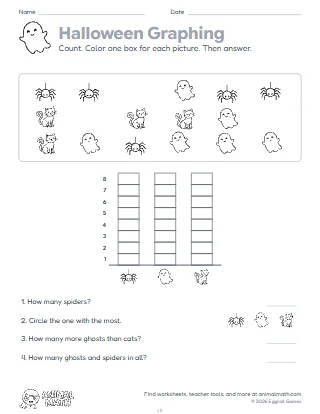
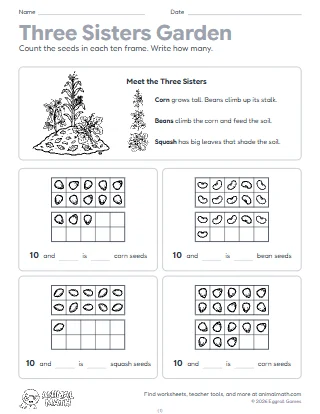
Five pages about the results that could happen when you flip a coin, roll a number cube, spin a spinner or pick from a bag or a set of cards. Page 1 starts with a reminder (an outcome is one result that could happen) and has six events: students write every outcome in a box and how many there are. The coin is done as an example. Page 2 has ten events, like rolling a 7 on a number cube or picking a blue marble, and students circle possible or impossible. Page 3 has spinners, a bag, cards and a cube where a color, number or letter shows up more than once: students list each different outcome only once and count them. Page 4 matches five events to their outcome lists, then asks which of three tools could give a set of outcomes. Page 5 is an experiment: roll a number cube 30 times, tally each roll, and answer questions about the outcomes, then design two spinners whose only outcomes are given.
Bring a coin, a number cube, a spinner and a paper bag with a few colored cubes. Before page 1, ask the class what could happen with each one and write the lists on the board. Put two red cubes and one blue cube in the bag and ask how many different outcomes there are: two, not three. Students can work in pairs on the experiment on page 5, one rolling and one tallying, then compare tables with another pair.
Play a board game with a number cube and ask what numbers could come up, and whether a 7 ever could. Put socks of two colors in a bag and ask what colors you might pull out. Flip a coin together 20 times, keep a tally, and talk about whether both outcomes happened.
This pack supports the following Common Core State Standards for Mathematics:
© Copyright 2010. National Governors Association Center for Best Practices and Council of Chief State School Officers. All rights reserved.
A 5-page possible outcomes pack for 3rd grade. List every outcome of flipping a coin, rolling a number cube, spinning a spinner, picking a marble from a bag or picking a card, and write how many there are. Circle possible or impossible for events like rolling a 7, list each different outcome once when a color or number shows up more than once, match events to their outcome lists and pick the tool that gives a set of outcomes. Then roll a number cube 30 times, tally the results, answer questions and design two spinners. Every page comes in color and in black and white. Answer keys included.
Tell us what to make next, or build your own with a worksheet maker.
This worksheet is free to download, print, copy, and hand out in your classroom or at home. You do not need to create an account, and there are no watermarks on the PDF.