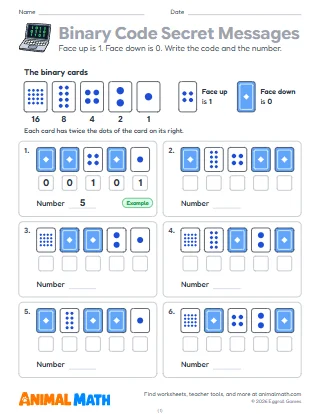
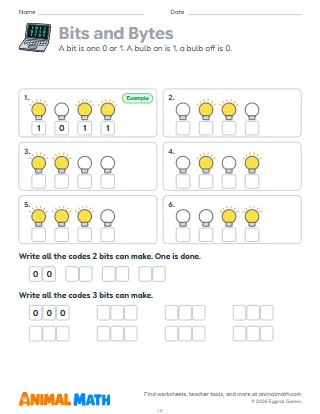
Start at 1 and keep doubling: 2, 4, 8, 16, 32 and on to 1,024 after ten doublings. These are the powers of 2. 2 × 2 × 2 can be written the short way as 2 with a small 3 (said "two to the third"), where the small number says how many 2s are multiplied. Powers of 2 are everywhere in computers: each place of a binary number is a power of 2, each extra bit doubles the number of codes, and memory comes in sizes such as 64, 128 and 256.
Seven pages of doubling and halving. Page 1 doubles from 1 all the way to 1,024, then from other numbers such as 3 and 25. Page 2 folds a paper again and again: students count the parts each fold makes, then fill in a table of folds and layers. Page 3 writes repeated multiplication the short way: 2 × 2 × 2 = 8 is 2 with a small 3, and students go both ways. Page 4 finds the powers of 2 up to 2 to the 12th, circles each ones digit and uses the repeating pattern 2, 4, 8, 6 to answer for powers too big to work out. Page 5 halves from 1,024 back down to 1. Page 6 shows that each binary place is a power of 2: write codes as sums and numbers as codes. Page 7 is six stories that double or halve. The first problem on each page is worked as an example.
Fold a sheet of paper in half with the class, again and again, counting the layers aloud: most papers stop folding at about 7 folds, and 128 layers. Before page 3, write 2 × 2 × 2 × 2 × 2 on the board and ask for a shorter way to write it. On page 4, ask students to predict the ones digit of 2 to the 20th before working it out.
Play a doubling game in the car or at dinner: start at 1 and take turns doubling until someone reaches 1,024. Then try halving back down. Look for powers of 2 on gadgets at home, such as a memory card that holds 64 or 128 gigabytes.
Doubling from 1 to 1,024, the numbers behind every binary place and every computer's memory. Students double and halve, count the parts a folded paper makes, write repeated multiplication the short way (2 × 2 × 2 is 2 to the 3rd), find the pattern in the ones digits, write binary codes as sums of powers of 2 and solve doubling stories.
Tell us what to make next, or build your own with a worksheet maker.
This worksheet is free to download, print, copy, and hand out in your classroom or at home. You do not need to create an account, and there are no watermarks on the PDF.